
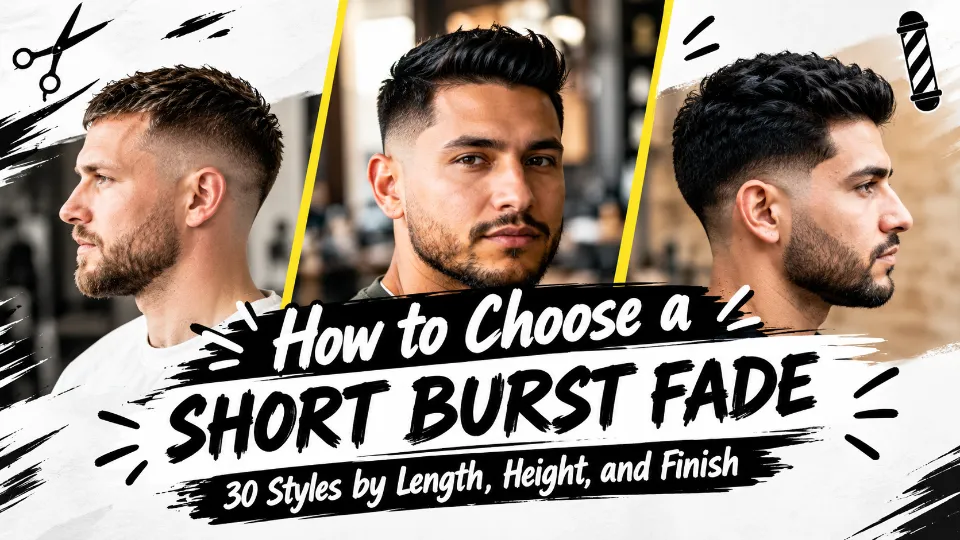
How to Choose a Short Burst Fade: 30 Styles by Length, Height, and Finish
The Quick Answer
• The shape: a burst fade curves around your ear in a rounded arc and stops. “Short” is a separate choice about the top.
• The definition: your barber keeps the top near an inch at most, using a #1–#4 guard, or scissors for a crop that runs a touch longer at the front.
• Three decisions: top length, fade height (low, mid, high), and finish (shadow, zero, skin).
• The upkeep: styling takes under a minute, but the arc needs a barber visit every two to four weeks.
What Is a Short Burst Fade?
This haircut pairs a rounded fade around the ear with a top of about an inch or less. The arc describes the sides; “short” describes the length above them. Your barber then picks the height and finish that fit your hair and skin.
The arc starts near the temple, loops around the ear, and tapers toward the nape instead of running straight across the back.
A short top is just one way to wear this rounded fade, and the right combination of length and height can create a very different look. Browse our burst fade haircut styles to compare more variations and find a cut that suits your hair type and personal style.
Three Decisions: Top Length, Fade Height, Finish
Treat the cut as three dials, and ordering gets much easier.
| Decision | What it controls | Your options |
| Top length | How much hair sits above the fade | Buzz (#2–#4), crew, crop, or textured top up to about 1 inch |
| Fade height | How far up the side the arc climbs | Low (near the ear), mid (temple level), high (well above the ear) |
| Finish | How close the shortest point cuts | Shadow (faint haze), zero (very tight, not bare), skin (bare scalp) |
• “Short” is not a fade height. It tells your barber about the top, while low, mid, and high place the arc.
• Finish is separate too. Two men can share a mid arc, one with a shadow finish and one with skin.
The height of the burst fade changes how much of the sides are exposed and how bold the curve looks. If you prefer a balanced look that sits between a low and high fade, explore these mid burst fade styles for ideas on choosing the right height for your next haircut.
How Short Is Short?
One definition runs through this guide: the top is about an inch or less. Guard sizes vary slightly by brand, so treat these figures as approximate.
Before you pick a guard number, check the clipper guard size chart.
| Option | Approx. length | What it looks like | Best for |
| #0 / no guard | About 1/16 inch or less | Near-bald, scalp clearly visible | Strong contrast on dark hair; very low effort |
| #1 | About 1/8 inch | Very close, soft shadow of hair | Sharp, clean tops with a tight arc |
| #2 | About 1/4 inch | Short and even, hides scalp better | The safest all-round buzz length |
| #3 | About 3/8 inch | Visible texture and curl | Wavy and curly tops; fuller look |
| #4 | About 1/2 inch | Longest guard in this guide | Crew cuts and textured tops |
| Scissor crop | Up to about 1 inch at the front | Fringe, crop, or faux hawk shape | Styles that need direction or movement |
Anything longer than about an inch belongs to the standard burst fade family. A common pairing is a #3 on top, with the arc stepping down through #2, #1, and #0.
How It Compares: Standard Burst, Taper, Buzz Cut, and Drop
People often mix this cut up with four neighbors.
| Cut | Top length | Fade shape | Typical barber visit | Daily effort |
| This cut | About 1 inch or less | Rounded arc that stops at the ear | Every 2–4 weeks | Under a minute |
| Standard burst fade | Several inches | Rounded arc around the ear | Every 3–4 weeks | A few minutes plus product |
| Taper fade | Any length | Short blend at sideburns and nape | Every 3–5 weeks | Depends on the top |
| Buzz cut | One guard all over | None | Every 2–4 weeks | None |
| Drop fade | Any length | Dips low behind the ear, then keeps fading | Every 2–4 weeks | Depends on the top |
• Short vs. low. “Low” names where the arc sits; “short” names the top. Say both, for example “short top, low arc.”
• Short vs. standard burst. The arc is identical; only the top changes.
• Burst vs. drop. A burst circles the ear and stops. A drop dips lower behind the ear and keeps fading.
• Short vs. buzz cut. A buzz uses one guard everywhere, so it has no contrast; the arc adds shape.
Low Maintenance — and Why It Isn’t
“Low maintenance” hides two kinds of effort.
• Daily styling: low. Buzz and crew tops need nothing; crops need a fingertip of paste.
• Barber upkeep: moderate to high. Regrowth shows around the ear first. Skin blurs within days; shadow blurs slowly.
• Why both are true. The top holds its shape for weeks, but the fade depends on contrast, and your finish decides how fast that fades.
The 30 Variations, Grouped by What They Change
Fade Height and Finish
1.Short Skin Burst Fade
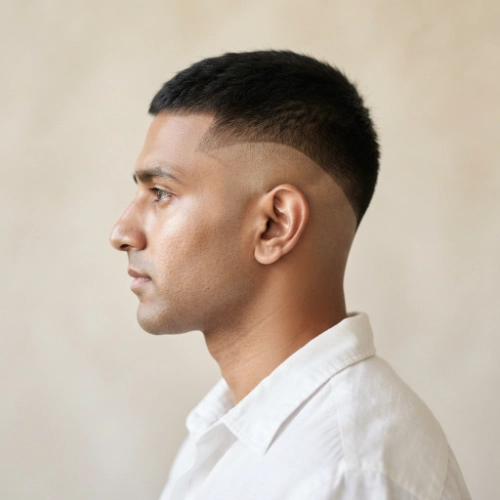
The shortest point goes to bare scalp, usually with a foil shaver. Contrast looks crisp, especially on dark hair, but stubble shows within days. Book your next visit early.
• Tip: Moisturize afterward, since a fresh scalp often feels tight for a day or two.
2.Short Low Burst Fade

The arc stays near the top of the ear, so most of the side keeps its length. It grows out gently and forgives small blending slips.
• Tip: It is the easiest height for first-timers and for strict office dress codes.
If you prefer a subtle haircut that keeps most of the sides fuller, a low burst fade is worth considering. Browse these low burst fade styles to see different ways to keep the curved fade close to the ear while maintaining a clean, understated look.
3.Short Mid Burst Fade

The arc peaks around temple level, fading roughly half the side. It shows the curve without looking shaved, and your barber can raise or lower it next visit. A sensible first choice.
• Tip: A side-view photo shows this height best, so bring one.
4.Short High Burst Fade

The arc rises well above the ear, so the arc itself becomes the design feature and uneven blending shows. Thinning hairlines should ask for a guard instead of skin.
• Tip: Expect a touch-up about every two weeks to keep the line from fuzzing.
A high burst fade creates a bolder look by taking the curved fade higher above the ear, making the shape more noticeable. If you want to compare more variations and find the right height for your next cut, explore these high burst fade styles.
5.Short Taper Burst Fade

Your barber fades only the sideburns, neckline, and a gentle curve around the ear, leaving most side length. It grows out softly, which suits long gaps between visits.
• Tip: It also keeps the neckline tidy through the long weeks between appointments.
If you prefer a softer finish around the sideburns and neckline, a taper variation may be a better fit than a standard burst fade. Check out these burst taper fade styles to compare different ways to keep the edges clean while maintaining a stylish look.
For a lower, softer version that keeps the fade close to the hairline, see the taper low burst fade.
6.Short Drop Burst Fade

A drop swings lower behind the ear and carries on toward the nape, where a burst would already have stopped. It adds movement through the back. Name the outline before the clippers start.
• Tip: From behind, the line looks longer and more angular than a plain burst.
7.Short Burst Fade With Temple Fade

Your barber fades the corner where hairline meets sideburn, sharpening the frame around your forehead. Ask for a gentle blend if your hairline is receding, because a harsh fade can make it look further back.
• Tip: Pair it with a light line-up and the whole front frame looks cleaner.
Top Styles
Same arc, different tops, all within the one-inch definition.
8.Short Buzz Cut Burst Fade

One even guard, usually #2 to #4, plus the rounded arc. It needs no product, but it exposes scars, so check your scalp.
• Tip: Choose a #2 for some scalp coverage, or a #1 for the tightest look.
A buzz cut keeps the top short and even, while the burst fade adds a curved blend around the ears for extra definition. For more haircut variations, clipper guard advice, and styling ideas, check out our burst fade buzz cut guide.
9.Short Crew Cut Burst Fade

The top stays slightly longer at the front and graduates shorter toward the crown, using a #3 or #4 or scissors. Your barber blends it into the arc so no weight line shows.
• Tip: Add a squared neckline for the classic sporty finish.
10.Short French Crop Burst Fade

A blunt, straight-across fringe about half an inch to an inch long sits over a point-cut top. A pinch of matte clay separates the strands. Straight and wavy hair work best.
• Tip: Trim the fringe line every three weeks so it stays straight.
11.Short Caesar Burst Fade

A short horizontal fringe at one even length, brushed forward. Unlike the layered French crop, it looks uniform. Ask your barber to hold it near half an inch so it stays crisp.
• Tip: It needs almost no product, just a brush forward after washing.
12.Short Fringe Burst Fade

Any front section styled forward counts here, so it is broader than a Caesar. Your barber leaves roughly an inch at the front. Trim every three or four weeks before it reaches your eyes.
• Tip: Sweep it to one side for a softer look, or forward for a sharper one.
13.Short Textured Burst Fade

Your barber point-cuts the whole top so strands sit at slightly different lengths while the height stays short. A trace of sea salt spray adds grip, and the texture hides a stubborn cowlick.
• Tip: Skip heavy wax, which flattens the movement your barber just cut in.
14.Short Burst Fade Mohawk

A true mohawk keeps a narrow strip, about an inch tall at most, with sides at a #1 or tighter. Confirm the strip width in the mirror before the first pass.
• Tip: Expect extra trimmer work along both sides of the strip every couple of weeks.
A short burst fade mohawk keeps the sides tight while leaving a narrow strip of hair running through the center. If you want to compare different variations and longer top shapes, explore these mohawk fade styles for more ideas on adapting the look to your preferred haircut.
15.Short Burst Fade Mullet

Keep the top within the one-inch definition and leave a small tail of one to two inches at the nape. The arc stops at the ear to preserve it.
• Tip: Ask your barber to blend the tail into the nape, so it does not look like a separate cut.
A short burst fade can also work with a mullet when you keep the top compact and leave extra length at the back. For more variations on this look, explore these burst fade mullet styles to find a balance between the curved fade around the ears and the longer shape at the nape.
Hair Texture and Type
Texture changes how a short top behaves.
16.Short Burst Fade With Curly Hair

Tight curls shrink as they dry, so an inch wet may sit near half an inch dry. Your barber cuts the top dry or lightly damp. Leave enough curl at the crown to form, and use a light cream.
• Tip: Skip brushing it dry, which frizzes curls and blurs the pattern.
17.Short Burst Fade With Straight Hair

Straight strands show every line, so your barber blends the arc smoothly into the top. The top lies flat with no styling, though cowlicks at the crown show, so point them out early.
• Tip: A light dusting of texture powder helps when the top lies too flat.
Straight hair can make every detail of a burst fade more noticeable, so getting the blend right is especially important. Explore our burst fade straight hair guide for more haircut ideas and tips on choosing a style that works with straight hair.
18.Short Burst Fade With Wavy Hair

Keep the top near an inch so the wave stays visible. Going below a #3 tends to erase the pattern. Mist sea salt spray onto damp hair and let it air-dry.
• Tip: Pat the hair dry instead of rubbing it, to keep the wave intact.
19.Short Burst Fade for Thick Hair

Thick hair stands up when short, so your barber removes bulk from the sides with the arc. Dense hair hides small blending flaws and holds a crisp edge longer. Mention your density when you sit down.
• Tip: A firmer paste helps, because dense hair pushes upward by afternoon.
20.Short Burst Fade for Thin Hair

A short, even top softens the gap between thicker and thinner patches. Skip the tightest skin finish and ask for a #2 or #3 at the lowest point, with a soft temple blend.
• Tip: Keep product light, since heavy wax clumps strands and shows more scalp.
21.Short Burst Fade for Blonde Hair

Light hair shows less contrast against skin, so the blend must be especially clean. Choose shadow for a soft outline or skin for a strong one, and wear sunscreen, because pale scalps burn fast.
• Tip: Ask your barber to check the blend under bright light before you leave.
22.Short Burst Fade for Black Men

Coily hair holds a crisp outline. A guard or shadow finish at the shortest point can reduce razor bumps for some men.
• Tip: Ask for clean edges at the temple and nape, and moisturize your scalp daily.
For cuts sorted by texture and comfort, see the burst fade for Black men.
23.Short Burst Fade for Round Face

Your barber keeps the top short and slightly taller at the front, while the arc narrows the sides. A mid or high arc tends to slim a round face, and a squared neckline adds structure. Avoid a very low arc, which leaves width at the ear.
Short tops leave nowhere to hide, so your face shape decides how short you can safely go. Most face shapes take a short burst well, but round faces gain length from a slightly higher curve. Check yours first with the free face shape detector online — it takes seconds and saves a grow-out.
Tip: Ask for about an inch at the front to add height
Details and Designs
Three small additions that change the cut’s character.
24.Short Burst Fade With Line Design

One straight or lightly curved line shaved into the faded area, near the temple or above the ear. It shows well on a short top. Refresh it every two weeks, since regrowth softens the edge.
• Tip: Choose a spot you can see in the mirror, so you can check it between visits.
If you want to try more than a single shaved line, explore our Burst Fade Design Guide for creative patterns, design placement ideas, and tips on choosing a style that suits your haircut.
25.Short Burst Fade With V Design

A V-shaped detail carved into the fade. Don’t confuse it with a V-cut neckline, which shapes the nape. Zero or skin finishes show it best, and your barber should mark the placement first.
• Tip: Show your barber a reference photo, since the angle of the V changes the whole look.
26.Short Burst Fade With Beard

Your barber carries the arc down the sideburn and into the beard, so no hard line separates them. A short, trimmed beard suits a short top.
• Tip: Keep the cheek line even on both sides so the blend looks balanced.
For more beard-blending options, see the burst fade with beard.
Audience and Setting
Two entries built around who wears the cut and where.
27.Short Professional Burst Fade

A low or mid arc, a shadow or zero finish, and a neat top of half an inch to an inch. Skip designs and extreme skin contrast, and book every three to four weeks for a low burst, two to three for a mid and one to two for a high to keep the edge crisp.
• Tip: Keep your sideburns even and your neckline squared for a polished look in meetings.
28.Short Burst Fade for Kids

A shadow finish feels gentler than skin and survives a school week. Your barber can keep the arc low, use a #2 or #3 above it, and stay away from razors near sensitive ears. School mornings stay simple.
• Tip: A calm first visit makes the next one easier, so bring a small treat for afterward.
29.Short Burst Fade With Hard Part

A hard part is a thin shaved line cut into the top, usually on one side. It separates the short top from the faded side and gives the arc a clean starting point. Unlike a line design, it marks the part rather than decorating the fade.
Tip: Brush the top away from the line each morning so the part stays visible
30.Short Burst Fade Edgar

An Edgar cut squares a short, blunt fringe straight across the forehead and pairs it with a sharp line-up. Your barber cuts the fringe closer and harder-edged than a Caesar, so the line reads as a deliberate shape. Straight and wavy hair hold it best.
- Tip: Book a line-up between cuts, because the squared edge softens first.
Which One Fits You?
| If this sounds like you | Start with | Why |
| You want it soft and easy to grow out | Shadow finish, low arc | Regrowth blurs slowly |
| You want the sharpest outline | Skin finish, mid arc | Maximum contrast, frequent refreshes |
| You work in an office | Professional: low or mid, zero or shadow | Groomed without announcing the arc |
| Your hair is thinning | #2 or #3 at the lowest point | A guard looks fuller than bare scalp |
| You rarely get to the barber | Taper burst, shadow finish | Softest grow-out of the group |
Ordering the Cut: What to Say in the Chair
Cover these six points, and say “burst, not drop” out loud. A side-view photo helps.
• Top length: a guard number or measurement, such as “a #3 on top.” Never only “short.”
• Fade height: low, mid, or high.
• Finish: shadow, zero, or skin.
• Top style: buzz, crew, crop, or textured.
• Back and nape: tapered, squared, or a small tail.
• Line-up: yes or no.
Copy this into your notes and swap the brackets before your appointment:
“I’d like a burst fade with a short top — burst, not drop. Top: [#1–#4 guard, or up to 1 inch with scissors]. Height: [low / mid / high]. Finish: [shadow / zero / skin]. Top style: [buzz / crew / crop / textured]. Nape: [tapered / squared / small tail]. Line-up: [yes / no].”
What Your Barber May Ask You
• How do you wear it day to day? This decides between a crop and a buzz.
• Do you have a cowlick, scar, or bumpy skin? Short hair exposes all three.
• How often can you return? This points toward shadow or skin.
What Your Barber Is Actually Doing
A short top hides nothing, so the order of work matters.
1. Your barber studies your crown, cowlicks, hairline, and ear position before a clipper switches on.
2. Your barber sets the top first, because its length decides how the fade blends.
3. Your barber draws the guideline, curving from the temple around the ear toward the nape.
4. Your barber builds the fade from the shortest finish upward, stepping through guards in small passes.
5. Your barber softens every transition with a clipper-over-comb pass until no line shows.
6. Your barber completes the shortest point: close clipper for shadow, bare blade for zero, foil shaver for skin.
7. Your barber tidies the hairline and nape with a trimmer, compares both ears, and you approve the result.
How to Style It in Under a Minute
Each routine takes under a minute and leaves the sides product-free.
Buzz or crew top
1. Towel-dry, then smooth your head with your palm.
2. Add light moisturizer if the scalp feels tight.
Crop, fringe, or textured top
1. Dry the top almost fully.
2. Warm a fingertip of matte paste between your palms.
3. Push the top forward, then separate the front with two fingers.
Curly or coily top
1. Work a little curl cream through damp hair.
2. Scrunch upward once, then air-dry or diffuse on low.
Keeping a short burst fade looking sharp also depends on how you care for the hair on top.
Best Products and Tools
• Buzz and crew: a scalp moisturizer with SPF.
• Crops and textured tops: matte paste, clay, or texture powder.
• Waves: sea salt spray on damp hair.
• Curls and coils: leave-in conditioner or curl cream.
• Tools: a trimmer for the nape and a handheld mirror.
Maintenance and Realistic Upkeep
These figures are typical, not guaranteed.
| Finish | Fast growth | Average growth | Slow growth |
| Skin | Every 10–14 days | Every 2 weeks | Every 2–3 weeks |
| Zero | Every 2 weeks | Every 2–3 weeks | Every 3–4 weeks |
| Shadow | Every 2–3 weeks | Every 3 weeks | Every 3–4 weeks |
Schedule: Pick your finish first and book the next visit before you leave. Fast growers can add an edge-only visit.
Home versus barber: Tidy the nape and sideburns yourself. Leave the arc to your barber, since one wrong pass cuts a step into the blend.
Washing: Wash two or three times a week and rinse behind the ears, where sweat and product collect.
Skin and Scalp Comfort
A short cut exposes more scalp and often cuts closer to the skin.
• Close finishes can irritate. If redness or ingrown hairs appear, ask for shadow or a #1.
• Persistent bumps need attention. The American Academy of Dermatology advises seeing a dermatologist for recurring bumps.
• Protect your scalp. The same organization recommends broad-spectrum, water-resistant sunscreen of SPF 30 or higher, including the tops of your ears.
• Moisturize. A near-bare scalp can feel tight and flake.
Growing It Out
Short tops make this phase easier than most.
• Weeks 1–4: the arc softens first. Hair often grows about half an inch a month.
• Weeks 4–8: the top passes an inch and starts covering the faded area.
• Bridge cuts: a textured crop or longer French crop keeps you looking intentional.
Once the top is long enough to comb back, the short slick back version is one grow-out option that still looks deliberate. For the full long-hair versions, see the burst fade long hair guide.
What Does It Cost?
Your barber prices the fade, not the top; the arc, finish, and edges take the time.
• Ask for a quote, and ask whether it covers the line-up and razor finish.
Who Should Skip It — and the Trade-Offs
• You rarely visit a barber. The arc blurs in weeks.
• You prefer a long top. This cut leaves very little to style or sweep.
• You react badly to close shaving. Choose shadow instead of skin.
• Trade-off: low daily effort comes with regular barber visits.
Common Mistakes
• Asking for “short” without a number. Name a guard or length.
• Ignoring the finish. Many men choose a height and never mention shadow, zero, or skin.
• Expecting zero barber visits. The top is low effort; the arc is not.
• Picking skin on sensitive skin. Shadow works just as well.
• Forgetting cowlicks. Short hair exposes every swirl at the crown.
• Mixing up burst and drop. The wrong outline changes the whole profile.
Short on top does not have to mean cropped all over. A flat top keeps the top short but squared and level, and it is one of the looks in our flat top guide if you want more shape than a plain short cut.
On thick hair, a short burst fade is mostly a weight decision: the top has to be thinned and textured or it sits like a cap. The burst fade for thick hair guide covers the guard work and the short cuts that keep dense hair light.
FAQs
How short should the top be?
Keep the top at about an inch or less. Most barbers use a #1 to #4 guard, which leaves roughly 1/8 to 1/2 inch, or they cut a scissor crop that reaches about an inch at the front. Anything longer moves toward a standard burst fade.
Is “short” the same as a low burst fade?
No. “Short” describes the hair on top, while “low” describes how high the fade climbs on the sides. You can combine them: a short low burst fade has a top of about an inch or less and an arc that stays near the ear.
What is the difference between shadow, zero, and skin finishes?
They are finishes at the shortest point of the arc. Shadow leaves a faint haze of hair, zero uses a very tight clipper pass without going bare, and skin removes hair down to the scalp. Shadow grows out softest, while skin shows regrowth fastest.
Is this cut really low maintenance?
Daily styling is low: many men use nothing or a dab of paste. Barber upkeep is not, because the arc blurs within a couple of weeks, especially with a skin finish. Expect a visit every two to four weeks, depending on your finish and growth speed.
What is the difference between a burst fade and a drop fade?
A burst fade stops once it has circled the ear, while a drop fade swoops lower behind the ear and carries on toward the nape. Say “burst, not drop” and show a side-view photo, since the names sound alike but the outlines differ.
Does it work with thinning hair or a receding hairline?
It can work well. A short, even top reduces the contrast between thick and thin areas. Choose shadow or a #2 guard at the lowest point instead of skin, and ask for a soft temple blend. A very tight finish beside a receding hairline can make it look further back.
Is this cut suitable for kids?
Yes, with a few adjustments. Choose a low or mid arc, a shadow finish, and a #2 or #3 on top, and skip razors near the ears. The cut needs no morning styling, which suits school routines. Book a quiet time and let your child say if the clippers feel uncomfortable.
How do I grow this cut out?
Expect the arc to soften within a few weeks and the top to reach crop length in about two months, since hair often grows roughly half an inch a month. Ask your barber for a textured crop as a bridge, and keep tidying the nape while you wait.
Final Thought
This cut works best as three small decisions: a numbered top length, a photographed height, and a finish chosen for your skin. Reserve your next appointment on the way out
If you want a longer top styled upward instead of a short top, see the burst fade faux hawk.

