
Burst Fade Hard Part: A Shaved Line Above a Curved Fade and What to Say at the Chair
Three Things to Settle Before You Sit Down
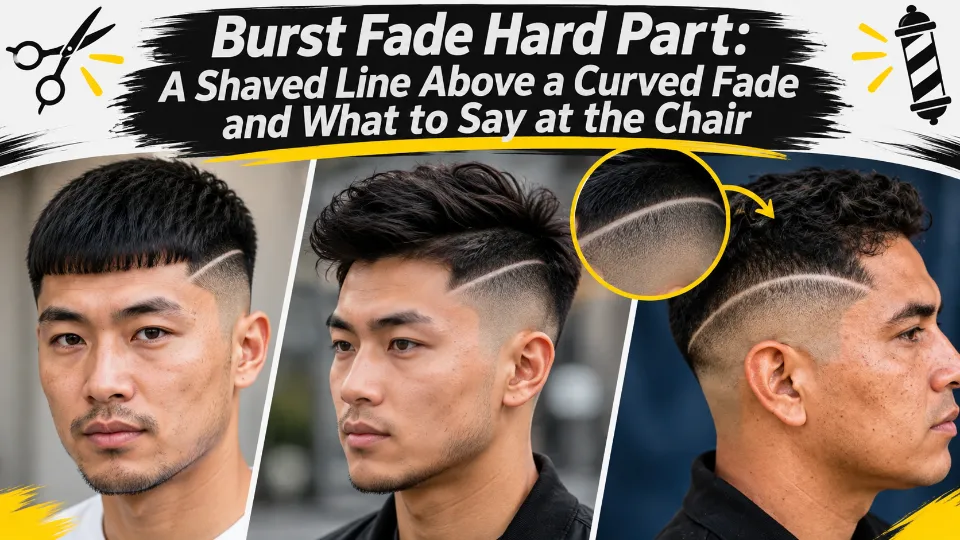
• Expect a rounded burst fade at the sides and one thin shaved line that marks the part.
• Before the appointment, choose a side, a line width and a burst height, then name them early in the chair.
• Refresh the line before the sides, since the shaved line grows in first.
Burst Fade Hard Part: How the Shaved Line Meets the Curve
A burst fade hard part is a burst fade on the sides with a thin line shaved into the hair to mark the part. Hair on top is styled across that line, while the sides fade in a curve that wraps each ear, with skin left as an option.
The shaved line is the feature people notice first. A barber uses a trimmer or razor to cut a thin line into the hair, so the part stays in place until new hair grows back across it.
The burst handles the sides. Instead of dropping flat across the temple, the fade bows around the ear and usually leaves a bit more length at the nape.
Joined up, the two parts read as one deliberate shape. The line cuts a crisp edge across the crown area, the arc rounds off the sides, and a burst fade hard part suits men who like a tidy head.
Most lines begin close to where the burst ends and run toward the front hairline. That meeting point is the detail barbers and clients most often misread, so agree on it first.
Hard Part, Comb Part, Line Up and Razor Design: How They Differ
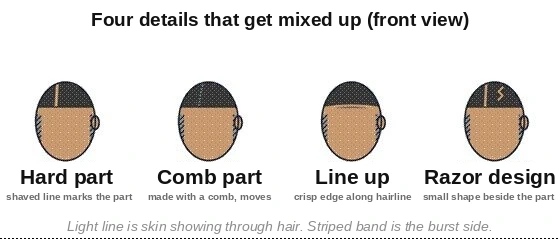
Clients and shops use these four terms loosely, so the table separates them.
| Detail | What it is | How it behaves |
| Hard part | A thin line shaved into the hair to mark the part | Stays put until hair grows back over it |
| Comb part | A part made with a comb and a little product | Moves with the hair and the weather |
| Line up | A crisp edge along the hairline | Frames the face and does not mark a part |
| Razor design | A shape or pattern cut into the sides | Adds detail, and a part line is only one option |
• A hard part is cut into the hair, so it stays crisp for days and then softens as hair returns.
• A comb part needs a comb each morning and shifts whenever the hair moves.
• A burst fade line up edges the hairline at the front, while the hard part sits further back on the top.
• A razor design can sit beside the part, and one small detail is plenty.
Shops use these words loosely, so ask for exactly the detail you want and bring a photo.
Line Width, Line Length, Side Placement and Burst Height
Width, length and side all belong to the line, and the burst height sits beside them.
A thin line is typical, and one source puts it at about one eighth to one quarter inch. Another says only thin, and a third calls a thick line edgier and a slim one more classic. Treat width as a choice, and ask the barber to check it in the mirror before the first pass.
The run can end halfway along the top for a softer result or carry on toward the brow for a longer one, so state where it should stop.
Put the line on the side where the hair already parts. Every source agrees, though a cowlick or strong crown can push hair against it, so have the barber look at both before the first cut.
Side finish matters as well. Bare skin shows the most contrast and needs trims often. A very short finish reads calmer, while a shadow finish leaves a faint haze of hair and looks softest.
| Height | Where it starts | What it does beside the line |
| Low | Just above the ear | Keeps more weight at the sides and gives the line a soft start |
| Mid | Halfway up the side | Leaves a clean step under the line |
| High | Near the temple | Gives the sharpest contrast and the boldest line |
A low burst fade hard part reads quiet, a mid burst fade adds a tidy step beneath the line and a high burst fade shows the sharpest contrast. Unsure? Begin in the middle and move up or down later.
Shops mean slightly different things by each label, so point to a photo when you choose one.


Hair Type, Black Hair and a Quick Face Shape Check
• Straight hair: exposes any wobble, so request an even, steady line.
• Wavy hair: moves around the line, so keep the top short enough to part cleanly.
• Coily hair: springs up and hides the line, so keep the line a little bolder.
• Thick hair: needs bulk cut back beside the line so the top sits flat.
• Fine hair: gains body when the line is short and the burst sits low.
Black hair suits a burst fade hard part well, because the line stays sharp against dense hair, and the burst fade for Black men page covers the wider cut.
If you keep asking what is my face shape, one clear photo run through a face shape detector online will give you a starting answer. Show the result to your barber, who can judge the head in person before the line side and burst height are settled.
What to Say at the Chair, Line by Line
The request comes down to five details. Short, plain wording for each one cuts the chance of a surprise.
| Part | What to say | Example |
| Line side | The side where the hair already parts | Left side, slightly off center |
| Width | Thin or a little wider | Thin, about one eighth inch |
| Length | Where the line starts and stops | Start above the burst, stop halfway |
| Burst | Height and finish | Mid burst, shadow finish |
| Photos | Front, side and back, all dry | Line and arc both visible |
Three photos help: the front for the line, the side for the arc, the back for the nape. Near the end, ask the barber to compare the two ears.
A short script works: the line on the natural side, thin, starting above a mid burst and stopping halfway, with a shadow finish, then the photos. It fills in what the names alone leave open.
Thirty-Three Burst Fade Hard Part Looks, Grouped by Line, Top and Burst
In the looks below, the line, the top and the burst are each described in plain terms. Choose the closest one, read the Request line to your barber and keep the Tip for the finish.
Line Position, Side and End Point
Only the line changes in these six, in position and in length.
Thin Shaved Line Set Slightly Off Center on the Natural Side

The shaved line sits slightly off center on the side where the hair already parts, so the top falls away from it easily and the burst curves around the ear below.
• Request: Place the part line off center, natural side, burst below.
• Tip: Check the natural part when the hair is dry.
Straight Part Line Starting Just Above the Burst Edge

A straight shaved line begins just above the edge of the burst and runs toward the front hairline, so the part and the curve around the ear read as one design.
• Request: Straight part line starting just above the burst edge.
• Tip: Ask for the start point to be checked in a mirror.
Line Set Level With the Corner of the Forehead

Here the line is placed level with the corner of the forehead, which gives the part a high, open start while the burst keeps the sides tidy beneath it.
• Request: Begin the part line at the forehead corner, burst below.
• Tip: Hold a comb at the hairline to preview the start.
Line Widening Slightly as It Runs Toward the Back

The shaved line begins thin near the front and opens a little as it runs back, which adds subtle shape above the burst without turning into a wide stripe.
• Request: Part line thin in front, wider toward the back, burst below.
• Tip: Ask the barber to widen it gradually, never in one step.
Line Stopping at the Back of the Ear Where the Burst Ends

The line finishes level with the back of the ear, in the same area where the burst arc ends, so the two features close the design together neatly.
• Request: Stop the part line behind the ear, burst ending there.
• Tip: Point to the ending spot in the mirror first.
Short Line Stopping Halfway Along the Side

A shorter line stops halfway along the side of the head, which gives a softer, less showy part and lets the burst arc stay the main feature of the cut.
• Request: Short part line, halfway along the side, with a soft burst.
• Tip: Choose this one if a long line feels too sharp.
How Wide and How Shaped the Line Is
Width and shape move here, and the rest of the cut stays the same.
Hair-Thin Line Kept Narrow for Longer Wear

A very thin line keeps the part looking precise, and sources say a narrow line looks cleaner and lasts a little longer before the hair grows back across it.
• Request: Cut a very thin part line over a clean burst arc.
• Tip: Ask for a fine trimmer rather than a wide blade.
Wider Line Left Bolder Against Thick Dark Hair

A wider line, nearer one quarter inch than one eighth, shows up clearly against thick dark hair, giving the part a bold edge above a clean, tidy burst.
• Request: Wider part line, near one quarter inch, burst below.
• Tip: Wide lines blur sooner, so book the line refresh early.
Gentle Curve Line Following the Arch of the Brow

The line bends in a soft curve that follows the arch of the brow rather than running dead straight, so the part feels gentler and the burst arc echoes the shape.
• Request: Curve the part line gently along the brow, burst below.
• Tip: Bring a front photo so the curve starts and ends cleanly.
Line Carried Forward to the Edge of the Brow

The line runs all the way to the front hairline and stops at the edge of the brow, which gives a long, dramatic part above a neat burst at the sides.
• Request: Take the part line out to the brow edge, burst below.
• Tip: Long lines need more upkeep, so confirm you want one.
Two Parallel Lines Cut Close Together

Two thin lines sit side by side with a small gap of hair between them, giving the top a layered look while the burst keeps the sides simple and calm.
• Request: Two thin part lines close together, plain burst beneath.
• Tip: Keep the gap even, or the pair will look crooked.
Small Razor Design Added Beside the Part Line

A small razor design sits beside the line for extra detail, and the burst fade design guide covers patterns in depth, beyond this short look.
• Request: Tiny design beside the part line, with a clean burst.
• Tip: Pick one detail only, so the part stays the focus.
What the Top Does Over the Line
Here the line holds still and only the finish on top changes.
Brushed-Over Top Resting Along the Part Line

The top is combed over and rests along the line, a pairing the burst fade comb over page explains, while the burst keeps the sides neat.
• Request: Comb the top over, lying along the part line, burst low.
• Tip: Blow-dry the top toward the line, then add product.
Centered Shaved Line Splitting a Mid-Length Top

A centered line splits a mid-length top into two even halves, a shape the middle-parted burst fade page explores while the burst frames each ear.
• Request: Center the part line, mid-length top, burst around each ear.
• Tip: Check both halves fall evenly before leaving the chair.
Textured Top Pushed Up and Back From the Line

The top has choppy texture and is pushed up and back from the line, which adds movement above the burst while the part keeps a crisp edge at the front.
• Request: Textured top lifted from the part line, burst kept clean.
• Tip: Scrunch-dry the top until it feels loose, then dab paste.
Slicked Top Combed Smooth Away From the Line

The top is combed smooth away from the line, with the burst fade slick back page covering that finish while the burst curves under it.
• Request: Smooth top combed back, part line visible, burst beneath.
• Tip: Use a fine comb to keep the lines tidy.
Loose Fringe Falling Forward Beside the Line

A loose fringe falls forward beside the line instead of being swept away, which softens the front a little while the part stays sharp and the burst stays tidy.
• Request: Loose fringe beside the part line, burst arcing behind it.
• Tip: Trim the fringe a touch shorter than you expect.
Long Top Flopping Over One Side of the Line

A longer top flops over to one side of the line, which gives a relaxed, easy, grown-out feel above a burst that keeps the sides short and clean.
• Request: Leave the top long, falling over the part line, burst short.
• Tip: A longer top needs regular trims so the line stays visible.
Looks Shaped by Hair Type
In these five, the hair itself drives the small changes.
Pin-Straight Hair Parted Sharp Along a Clean Line

Straight hair shows every edge, so the line reads crisp and the top lies flat on each side, with the burst adding a smooth curve around the ear.
• Request: Crisp part line on straight hair, clean burst beneath.
• Tip: Straight hair shows wobbles, so ask for a steady line.
Wavy Top Falling Naturally on Both Sides of the Line

Waves fall naturally on both sides of the line, which softens the contrast between the sharp part and the burst without losing the neat edge or the clean shape of the cut.
• Request: Wavy top parted by a thin line, soft burst below.
• Tip: Let waves dry naturally to see how they sit.
Tight Curls Parted by a Close Shaved Line

Tight curls split cleanly along a close line, and the burst fade for curly hair page covers curl care while the burst keeps the sides short.
• Request: Curls parted by a close shaved line, tight burst beneath.
• Tip: Cut the line on dry curls so it sits true.
Dense Hair Cut Back Evenly Next to the Line

Dense hair is cut back evenly beside the line so the top does not bulge over it, and the burst removes extra bulk and weight from the sides underneath.
• Request: Dense hair taken back beside the part line, burst cut low.
• Tip: Ask for thinning only where the hair sits heavy.
Short Top With a Long Back Section Beside a Shaved Part

A short top pairs with a longer back beside a shaved part, a blend the burst fade mullet page explores while the burst frames the ears.
• Request: Short top, longer back, with a part line and burst.
• Tip: State how long the back stays, then let the cutting begin.
Burst Height and Finish at the Sides
These five slide the arc higher or lower and adjust the side finish to match.
Low Burst Meeting a Soft Line Above the Ear

A low burst fade keeps more weight at the sides, with the arc just above the ear, so the part line looks soft and the whole cut stays calm and easy.
• Request: Go low with the burst at the ear, soft part line.
• Tip: Choose low if you prefer to rebook less often.
Mid Burst Leaving a Neat Shelf Under the Line

A mid burst fade rises halfway up the side and leaves a neat shelf under the line, giving clear contrast while the part still looks balanced and controlled.
• Request: Take the burst to mid height, crisp part line above.
• Tip: Mid suits most first visits and is easy to adjust.
High Burst Framing a Strong Line Near the Temple

A high burst fade reaches near the temple and frames a strong line, which gives the sharpest contrast and the boldest look, though the arc blurs quickly and needs frequent trims.
• Request: Raise the burst to the temple, strong part line above.
• Tip: Expect earlier rebooking, because a high arc blurs fast.
Soft Shadow Burst Beneath a Crisp Line

A shadow finish leaves a faint trace of hair on the sides, so the burst reads soft and the crisp part line becomes the one sharp detail on the head.
• Request: Shadow finish burst under a crisp, thin part line.
• Tip: Ask to see the shadow level before the last pass.
Bare Skin Burst Making the Line Stand Out Sharply

Bare skin at the sides gives the strongest contrast, so the line and the burst arc both stand out sharply, though skin grows in fast and asks for early visits.
• Request: Skin finish burst, thin part line standing out sharply.
• Tip: Skin blurs fast, so book the sides a little early.
Beard and Small Details
Each of these five adds one small detail to the base cut.
Neat Beard Blended Into a Burst Side Below the Line

A neat beard blends into the burst at the sideburn, and the burst fade with beard page shows how, while the part line finishes the top.
• Request: Beard blended into the burst side, thin part line above.
• Tip: Book the beard trim for the same visit as the burst.
Short Stubble Following the Burst Under the Line

Short stubble follows the gentle curve of the burst along the cheek, so the face looks evenly and softly framed beneath a thin line and a tidy top.
• Request: Short stubble following the burst, part line kept thin.
• Tip: Ask for even stubble so the arc stays easy to see.
Clean Hairline Edge Sitting Beside the Part

A crisp edge along the hairline sits beside the part, which adds polish, though a line up and a hard part are separate details, and the burst keeps the sides soft.
• Request: Clean hairline edge, thin part line, soft burst at the sides.
• Tip: Ask for the edge and the part to be cut separately.
Wispy Hair Given Body by a Short Line and Low Burst

Wispy hair gains body when the line is kept short and the burst stays low, since leaving more weight at the sides lets the top look much fuller.
• Request: Cut a short part line, low burst, side weight kept.
• Tip: Keep the top blunt, because layers can thin wispy ends.
Grown-Out Burst Carrying a Freshly Cut Line

After a few weeks the burst softens and grows out, and a fresh line cut over it brings the whole cut back to neat without a full new haircut.
• Request: Refresh only the part line, leave the grown-out burst.
• Tip: Ask whether your barber offers quick line-only visits between full cuts.
Rebooking the Line, the Sides and Growing Out
Advice on visits ranges from a few days to three weeks, and sources do not agree. A workable plan is to refresh the line every one to two weeks and the sides every two to three, and the barber can fine-tune it.
| What | Typical window |
| Line refresh | Every one to two weeks |
| Sides with the burst | Low burst three to four weeks, mid two to three, high one to two |
| Skin finish | Rebook a little sooner |
| Growing out | Let the line fill in and keep the sides trimmed |
The line grows in first, so it comes due before the sides. Dark, thick hair shows regrowth sooner, and a quick line-only visit can stretch a full cut.
Styling the Top Over the Line in Five Steps
Follow these five steps for any of the looks above.
1. Start from clean hair that is only slightly damp.
2. Dry the top away from the line, guiding it with your fingers.
3. Rub a small dab of light product between your palms.
4. Work it through the top, then set the hair on each side of the line.
5. Look at the part in the mirror and smooth any loose strands.
Keep the product light, because too much sits on the line and hides it.
When hair keeps drifting over the line, mention it next visit, as a small trim of the top length often solves it.
Fixing a Line That Went Wrong, and Other Fixes
| Problem | Likely cause | Fix |
| Line too wide | A wide cut at the last visit | Let it grow in and ask for a thinner line next time |
| Line too long | It runs past the spot you wanted | Let hair grow in and ask for a shorter run |
| Crooked line | The part followed the wrong direction | Ask the barber to correct it and bring a photo |
| Line too sharp | The edge is bare and freshly cut | Wait a day or two, or ask for a softer edge |
A razor can sting, so ask for a trimmer if your skin irritates easily. If something still looks off after a few days, a short return trip is fine.
Common Mistakes With the Line and Who Should Skip It
• Choosing a very wide line: it loses the crisp look, so start narrow.
• Skipping the burst height: the arc carries its own height and finish, so state both.
• Ignoring the natural part: a line against the hair keeps losing, so follow the growth.
• Waiting too long: a shaved line is first to go soft, so rebook early.
• Heavy product: weight hides the line and flattens the top.
Think twice if a strong cowlick sits right at the part or if you dislike frequent visits. A comb part or a softer top is the better match for those wishes, since this cut asks for regular refreshes.
Frequently Asked Questions
What is a burst fade hard part?
Picture a rounded fade at the sides and a thin shaved line above it that marks where the hair parts. The top falls over the line and the fade curves around each ear, and you choose how close the sides go.
How wide should the hard part line be?
Most sources call thin the usual choice, and one gives about one eighth to one quarter inch. Others only say thin or call a wider line bolder. A narrow line looks cleaner and holds a little longer, so start narrow with your burst fade hard part.
Which side should the hard part go on?
Start with the side where your hair already parts, because the top then falls away from the line without a fight. A cowlick or a strong crown can pull hair across, so ask the barber to check both before cutting.
How often should you refresh the hard part?
The line usually comes due every one to two weeks, while the sides last about two to three. Timing advice varies from a few days up to three weeks. Dark thick hair shows regrowth sooner, so book earlier if the line starts to blur.
What is the difference between a hard part and a line up?
The first marks the part with a shaved line on top. The second is a crisp edge along the hairline and never marks a part. Many men get both, though each is cut on its own and needs its own details.
Does a burst fade hard part work on straight hair?
Yes, and straight hair shows the line most clearly because nothing curls across it. Any wobble shows too, so ask for a steady, even line. The burst around the ear then adds a smooth curve to the sides of a burst fade hard part.
Can you get a burst fade hard part with a beard?
Yes. The burst blends into the beard at the sideburn, and the line sits above on the top. Trim the beard on the same day as the sides so the curve stays even from ear to jaw, and mention the beard when you book.
What should you tell your barber to get a burst fade hard part?
Give the side for the line, the width, where it starts and stops, the burst height and the finish. Bring dry photos from three angles. Name each part one at a time instead of describing the whole cut in a single go, and request a final symmetry check.
Final Thought
Choose the side, width and burst height, say them out loud and carry your photos. With that, your burst fade hard part has a good chance of matching the picture.
Editorial Note
General grooming advice from common barber practice appears on this page, and it is no professional opinion about your own hair or head. Have your barber confirm the line width, side and burst height before cutting

