
Burst Fade with Beard: 24 Style Matches + How to Blend Them
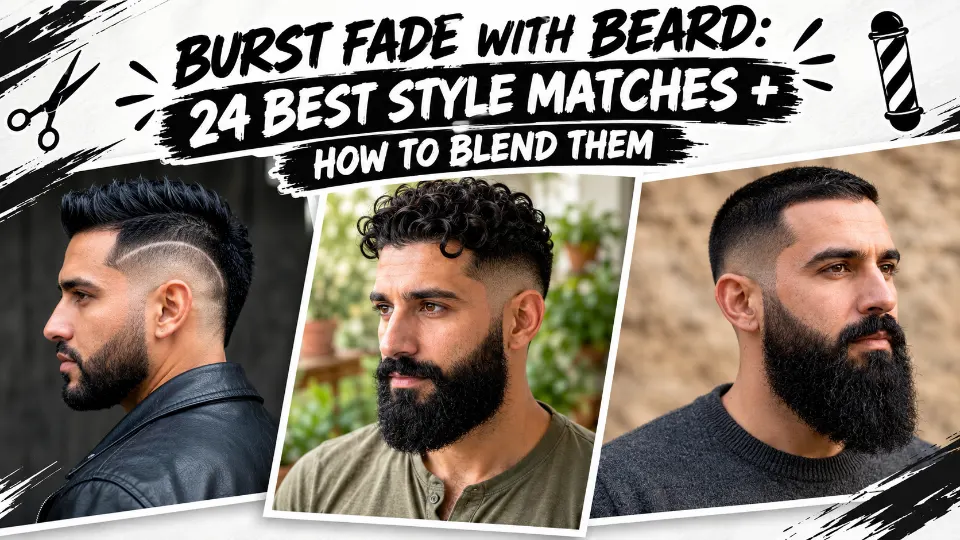
A burst fade on its own is a sharp cut. A burst fade with beard, blended properly at the sideburn, is a complete look. The fade handles the top half of your profile, the beard handles the jaw, and the two meet so smoothly that neither looks separate.
Done badly, though, you get a shelf: skin-tight fade, sudden full beard, and a hard step at the sideburn where the two collide. Every style below is matched so the beard weight, the fade height and the top work together instead of fighting.
The Quick Answer
A burst fade pairs with almost any beard as long as the sideburn is blended into one gradient, where the fade comes down, the beard fades up, and they meet at the sideburn with no hard line. Short beards and stubble suit mid and high bursts; full beards suit low and mid bursts that leave enough side hair to connect. Book the haircut and the beard trim in the same appointment, because the two are shaped against each other.
How the Blend Works
The connection point is the sideburn. The burst fade’s arc curves around the ear, and the shortest part of that arc ends right where the sideburn begins. The beard, meanwhile, grows up the cheek toward the same spot. The barber’s job is to make hair fade down and beard fade up into one continuous gradient.
If the fade is taken to skin and the beard starts at full length, there is nowhere for the eye to travel. That is the step you want to avoid. The fix is a transition zone at the sideburn: the barber works clipper-over-comb or a short guard through the sideburn area, shortening the beard gradually as it rises to meet the fade’s shortest point.
This is also why both should be cut in one appointment. The beard’s cheek line, neckline and length are all shaped relative to where the arc sits. If the beard is trimmed two weeks after the fade, the barber is guessing at lengths that have already changed, and the blend slowly drifts apart. Ask for a combined haircut-and-beard service, because the two are shaped against each other at the sideburn.
The blend changes with the burst height you choose. A low burst fade keeps the blend soft around the ear, which suits a longer beard that does most of the talking, while a mid burst fade balances beard and hair more evenly and a high burst fade makes the whole look sharper and more deliberate. If you are still deciding between heights, those three guides show each one with photos, so you can compare the blend before you sit in the chair.
Full Beard
1.Mid Burst Fade with Full Beard and Textured Top
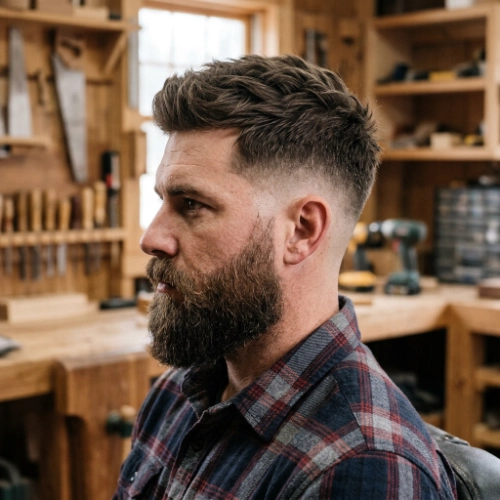
The benchmark pairing. A mid burst leaves enough hair low on the sides to run into a full beard (roughly 15–30mm through the chin), and a textured, scissor-cut top keeps the proportions balanced, with volume above, volume below, and a clean arc in the middle.
Suits oval, square and diamond faces. Ask for the sideburns blended, not disconnected, and style the top with matte clay pushed forward and slightly up.
2.Low Burst Fade with Long Full Beard

For beards past the chin (30mm+), keep the burst low. A high arc next to a long beard makes the head look top-heavy; a low arc keeps the fade quiet and lets the beard be the statement, with the sideburn gradient doing the joining work.
Best on long and oval faces, since the beard lengthens the jaw further. The top can stay medium length and natural, and this look needs almost no product beyond beard oil.
3.High Burst Fade with Full Beard and Quiff

Maximum contrast: a high burst taken to skin, a tall quiff on top, and a full beard shaped tight at the cheeks so it does not compete with the quiff’s height. The beard should be trimmed shorter at the sides and longer at the chin to mirror the top’s shape.
Suits round and square faces that need length. This is the highest-maintenance style in this guide (barber every 2 weeks), and the quiff needs a blow-dryer and strong-hold paste daily. Normally full beards suit low and mid bursts best, but this high burst works because the beard is shaped tight and short at the sides, so the sideburn still connects.
4.Burst Fade Mullet with Full Beard

The mullet’s back length plus a full beard is a lot of hair, and that is the point. The burst arc keeps the middle of the profile clean so the length at the back and the beard at the front read as deliberate, not grown-out-by-accident.
Works on straight, wavy and curly hair. See the full burst fade mullet guide for back-length options, and keep the beard’s neckline carved clean so the front stays as sharp as the back.
5.Curly Top Burst Fade with Full Beard

A mid burst under a full, natural curly top, with a full beard underneath, with texture on both ends and order in the middle. The arc should be cut on dry hair so the curl pattern sits where it will actually live.
Suits curly and coily hair (types 3A–4C) and most face shapes. Moisture is the whole routine here: curl cream on top, beard oil below, and never let either dry out, or the silhouette frazzles at both ends.
A beard changes how your face shape reads — length at the chin can stretch a round face, and a boxed line can sharpen a soft jaw. Before you pick a beard length from the styles below, match it to your shape with the free face shape detector: the same burst and beard look balanced on one face shape and heavy on another.
Short and Boxed Beard
6.Mid Burst Fade with Boxed Beard and Crop

The neat, deliberate option. A boxed beard — defined cheek lines, clean neckline, kept around 5–10mm — pairs with a mid burst fade and a short textured crop for a look that is sharp without being loud.
Suits almost every face and workplace. The boxed lines need home upkeep with a trimmer every few days, touching only the cheek and neck lines, never the sideburn blend.
7.Low Burst Fade with Short Beard and Fringe

A low burst, a short uniform beard (around 5mm), and a textured fringe pushed forward. Everything is soft-edged, which makes this the easiest full look to grow out gracefully between cuts.
Good for younger men and first-time beard growers whose coverage is still filling in. Style the fringe forward with a fingertip of matte paste; keep the beard one length all over.
8.High Burst Fade with Short Beard and Buzz Cut

Short everywhere: a high skin burst, a buzz cut on top (#2–#4 guard), and a short boxed beard. The beard is what stops this from looking like a plain military cut, because it restores the jaw definition the buzz removes.
Our burst fade buzz cut guide covers guard choices in detail. This pairing suits square and oval faces, and it is the fastest morning routine in the guide: no styling, just beard line upkeep.
9.Burst Taper Fade with Short Beard

Instead of fading to skin, the burst tapers down gradually and the neckline stays soft. Matched with a short natural beard (no hard carved lines), this is the most conservative burst-and-beard combination, and it is the one that works in formal offices.
Ask your barber to taper the sideburn into the beard rather than fading it, so the whole side of the head is one soft gradient from top to jaw.
10.Textured Burst Fade with Short Corporate Beard

A mid burst with a messy, point-cut top, balanced by a beard kept short, even and unlined, groomed but not sculpted. The contrast between the relaxed top and the tidy beard keeps it modern rather than severe.
Suits straight and wavy hair, round and oval faces. Use sea salt spray for the top’s texture and keep the beard at a uniform #2–#3 trimmer guard so it never needs line carving at home.
Stubble
11.Low Burst Fade with Heavy Stubble

Heavy stubble (3–5mm) with a low burst is the lowest-effort pairing that still looks intentional. The stubble shadows the jaw, the low arc cleans the ears, and neither element asks much of you between barber visits.
Ideal for patchy beard growers. At 3–5mm, thin areas read as texture rather than gaps. Trim the stubble to one length every 3–4 days and moisturise the skin underneath.
12.Mid Burst Fade with Light Stubble and Messy Top

Light stubble (1–3mm) barely counts as a beard, but with a mid burst and a deliberately messy top it frames the face just enough. The balance is casual: nothing in this look is lined or precise.
Best on strong jawlines, which carry the stubble; weaker jaws should go heavier (style 11) for more coverage. Keep the neckline of the stubble cleaned so “light” does not become “forgot to shave.”
13.High Skin Burst Fade with Designer Stubble

The sharpest stubble look: a high burst taken to skin, a longer top, and designer stubble (around 5mm) with carved cheek lines. The contrast between bald arc, dark stubble and full top is graphic and deliberate.
Suits oval and diamond faces. Be honest about upkeep before choosing it, because the carved lines need a trimmer every second day, and the high skin fade needs a barber every 2 weeks.
14.Burst Fade with Stubble and Slick Back

A mid burst, a slicked-back top, and uniform stubble: the classic-grooming version. The slick back adds formality, the stubble stops it looking too clean-cut, and the burst arc modernises both.
Works with straight and wavy hair long enough on top (3+ inches) to comb back. Use a water-based pomade for shine you can wash out, and keep the stubble at one length so the polish stays even.
15.Short Burst Fade with Five O’Clock Shadow

The minimum viable version: a short top, a low-to-mid burst, and permanent five o’clock shadow (0.5–1mm). It suits men whose beards grow fast but patchy, or who simply prefer the shadow to any real length.
Maintenance is nearly zero. A foil shaver or trimmer with no guard every other day keeps the shadow level. This is also the easiest style here to grow into a heavier beard later.
Faded Beard (Beard Fade Blend)
16.Mid Burst Fade with Beard Fade and Textured Crop

The true beard fade: the beard itself is faded, shortest at the sideburn (where it meets the haircut), building to full length at the chin. With a mid burst above it, the side of the head becomes one unbroken gradient from skin to crop to full beard.
This is the most technical blend in the guide, so ask your barber specifically for a beard fade, not just a beard trim. Suits thick beards best, since the gradient needs density to show.
17.Low Burst Fade with Seamless Beard Blend

A low burst flowing into a beard that is only lightly faded at the top, and it is the softest version of the blend. Nothing is taken to skin, so the transition is almost invisible and the whole profile looks natural.
The safest choice if your barber is new to beard fades, and the most forgiving as it grows out. Works on medium-density beards and all top styles.
18.High Burst Fade with Tapered Beard Fade

High contrast at the top of the sideburn, full beard at the bottom: the beard fade here is tapered steeply, going from skin at the arc to 10mm+ at the jaw within a few centimetres. It makes the jaw look carved and the fade look higher.
Suits round faces especially well, because the steep gradient adds angles. This blend needs a skilled hand; bring a photo, because “tapered beard fade” is described differently in different shops.
19.Burst Fade Mohawk with Beard Fade

A mohawk’s centre strip, a burst around the ears, and a beard faded up to meet it. Three bold elements, one gradient. The beard fade is what stops the look tipping into costume, by keeping the jaw end as considered as the top.
Keep the mohawk strip textured rather than spiked for a modern read, and expect 2-week barber visits: mohawk shape, arc and beard gradient all blur on the same schedule.
20.Burst Fade with Beard Fade and Curly Fringe

A curly fringe falling forward, burst arcs at the sides, and a beard faded at the sideburns so the curls and the beard never visually collide. The fade work at both ends of the sideburn is what makes a busy look feel clean.
Suits type 2C–3C curls. Define the fringe with curl cream on damp hair, and let the beard keep its natural cheek line, because carving it would fight the fringe’s softness.
Goatee and Partial Beards
21.Mid Burst Fade with Goatee

A classic goatee (chin beard connected to the moustache, cheeks clean) with a mid burst. Without cheek hair, the sideburn blend matters less. Instead, the goatee’s edges must be razor-clean, because there is no surrounding beard to hide a wobbly line.
Suits men with patchy cheeks but a strong chin and moustache area, and the goatee plays to the coverage you have. Keep the top simple: a crop or short texture works best.
22.Low Burst Fade with Chin Strap Beard

A thin strap of beard running along the jawline, paired with a low burst so the sideburn flows straight into the strap’s top end. The line of the strap should follow the jaw, not the cheek, or it rides too high and shrinks the face.
This is a precise, youthful style that shows every millimetre of regrowth, so budget for line upkeep every 2–3 days. Best on defined jawlines and younger faces.
23.High Burst Fade with Van Dyke

A Van Dyke (pointed chin beard and a separate, often styled moustache) under a high burst fade. The high arc’s drama matches the Van Dyke’s deliberate, vintage character; a low fade would underplay it.
Suits oval and long faces. The moustache usually needs wax to hold its shape, and the gap between moustache and chin beard must be kept shaved clean, or the style reads as an unfinished goatee.
24.Burst Fade with Moustache and Light Goatee

The lightest partial option: a prominent moustache, a small patch of chin beard, clean cheeks, and a low or mid burst. It has a retro, barbershop feel and puts all the emphasis on the moustache.
Good for men whose moustache grows far better than the rest of the beard. Keep the moustache trimmed off the lip line, and the chin patch shaped symmetrically, because asymmetry is very visible in a style this minimal.
How to Ask Your Barber
- Bring reference photos, ideally one that shows the sideburn area clearly, because the blend at the sideburn is the part most likely to be misunderstood. Screenshots of this guide’s styles are a good start, because the same names can mean different cuts in different areas.
- Book a haircut and beard trim together, and say you want them blended, not done as two separate services.
- Name your burst height (low, mid or high) and the shortest guard you are comfortable with, skin, #0.5 or #1. Your barber will then build the arc around that floor instead of guessing, which matters because the arc’s lowest point is set in the first minute and cannot be lowered later.
- Name your beard style and length in millimetres or trimmer guards, and say whether you want a beard fade at the sideburn or a simple connection.
- Agree on the cheek and neckline finish: natural, soft-shaped or sharply carved. Ask the barber to set these lines while both the fade and beard are fresh.
Two tools make the appointment easier: a clipper guard size chart if you want to name guards instead of guessing lengths, and the burst fade designs guide if you are thinking about adding a line or pattern near the blend. A faux hawk with a burst fade is another way to keep the top interesting without taking attention away from the beard, and the mohawk fade guide shows the bolder end of the same idea.
Compare clipper guard sizes on the chart before you name your shortest guard.
Maintenance: Keeping the Fade and Beard in Sync
The fade and the beard grow at the same speed but blur at different rates, so they are maintained on slightly different cycles at home, and the same cycle at the barber’s.
- Every 2–3 weeks: barber visit for both together. The arc is reshaped, the beard is re-faded at the sideburn, and lengths are re-matched. High bursts and beard fades sit at the 2-week end; low bursts and full beards can stretch to 3.
- Every 2–4 days at home: tidy the beard’s cheek and neck lines with a trimmer, and trim stray hairs below the neckline. Never touch the sideburn blend zone — that gradient is the barber’s work, and one slip at home undoes it.
- Daily: beard oil on the beard (a few drops, worked to the skin) to stop the itch and flaking that faded sides expose. Most barbers suggest washing the beard with shampoo only 2–3 times a week; plain water is enough on the other days. Brush or comb it daily to train the growth direction and even out the oils.
- Weekly: check the balance in the mirror. If the beard has outgrown the fade, the look slumps; a beard trimmer pass at one guard longer than your barber’s setting keeps proportions until the next visit.
A beard does not live alone — the top and the back of the cut change how it reads. Short hair with a beard keeps everything low-maintenance, as the short burst fade guide shows, while a burst fade mullet pairs a longer back with a full beard and a burst taper fade gives a softer edge if a full burst feels too strong. For the lowest, softest taper version, the taper low burst fade guide shows how a low taper keeps the beard blend gentle.
On straight hair the blend line shows clearly, so the burst fade for straight hair guide is worth a look before you commit, and for coily hair and waves the burst fade for black men guide covers beard pairings with growth patterns in mind. If you want the beard to be the main feature, a burst fade buzz cut is the simplest route.
Frequently Asked Questions
Should a burst fade connect to the beard?
For almost every style, the fade and beard should be blended at the sideburn into one gradient. A disconnected beard, where the beard starts abruptly below a skin fade, looks like two separate styles worn at once. The only exception is a deliberate disconnection with a hard line, which is a specific barbershop style, not a default.
What beard length works best with a burst fade?
Any length works if it is matched to the fade height. Stubble and short beards (up to 10mm) suit mid and high bursts, while full beards (15mm and longer) look best with low and mid bursts, which leave enough side hair for a smooth sideburn transition.
Can my barber blend them if my beard is patchy at the sideburns?
Usually, yes. A beard fade actually helps patchy sideburns, because the shortest part of the gradient sits exactly where growth is thinnest, so the patch reads as an intentional fade. If the cheeks are very sparse, a goatee or chin-focused style from this guide will suit you better.
How often do the fade and beard need trimming together?
Every 2 to 3 weeks for most men, at the same visit. The beard’s lines can be tidied at home between visits, but the blend itself should be re-cut professionally, because home trimming at the sideburn is the fastest way to destroy the gradient.
Does a burst fade with a beard suit a round face?
It can genuinely help. Keep the burst at mid height with some texture on top, and shape the beard slightly shorter at the cheeks, because that adds definition exactly where round faces need it. A high burst plus a long, wide beard adds width and length in the wrong places, so avoid that pairing here.
What if I want the beard without any fade in it?
Ask for a simple connection instead of a beard fade: the barber shortens only the very top of the sideburn so it meets the haircut, and the beard keeps one uniform length below that. It is less dramatic than a beard fade and grows out more forgivingly.
Once your beard pairing is decided, it helps to see the full picture. Browse our burst fade style collection to compare low, mid and high bursts, tapers, mullets and mohawks side by side — then take your favourite reference photo to your barber

