
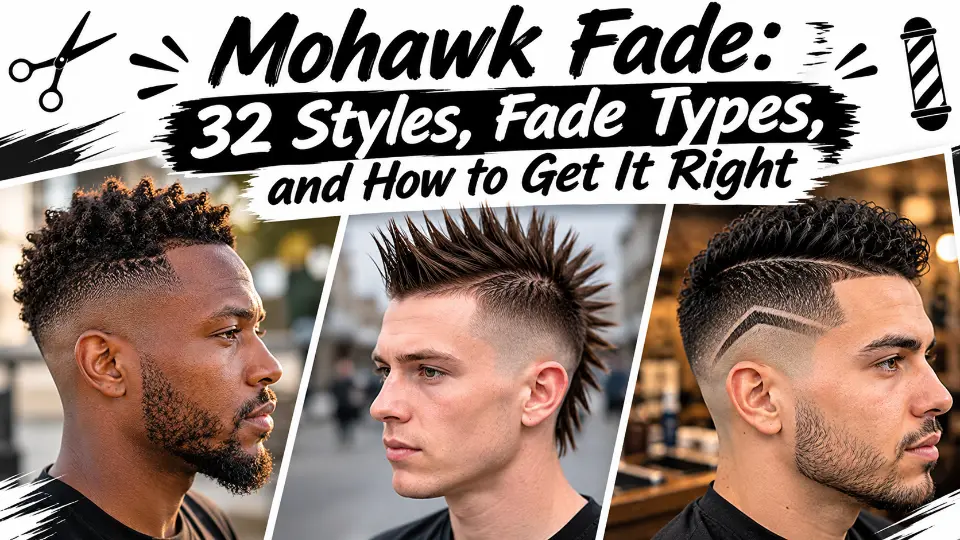
Mohawk Fade: 32 Styles, Fade Types, and How to Get It Right
What Is a Mohawk Fade?
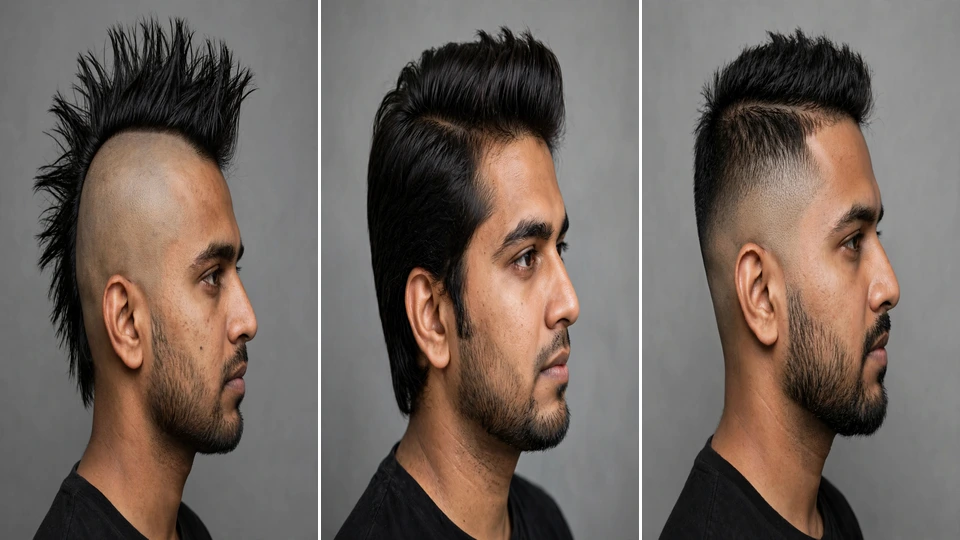
A mohawk fade keeps a strip of longer hair running down the center of the head while the sides shorten gradually through a clipper fade instead of a hard shaved line. The contrast between the strip and the sides stays sharp, but the graduated blend is what makes it read as modern and wearable rather than purely rebellious.
Mohawk Fade vs. Faux Hawk vs. Classic Mohawk
People lump these three cuts together constantly — here’s the real difference about them.
| Sides | Strip Source | |
| Classic Mohawk | Bare skin (razor or very short clipper) | Absolute contrast, hard line, no gradient |
| Mohawk Fade | Blended gradually, not shaved bald | Built into the cut — still visible even un-styled |
| Faux Hawk | Left longer | Mostly created by product, not the cut itself |
| Frohawk | Faded at the sides like a mohawk fade, shaped for coily hair | Natural coils form the strip — the texture is the style, not product |
The quick test: stop styling it. A faux hawk mostly disappears without product. A real mohawk fade still shows its shape air-dried. If you like that softer faux hawk shape but want it paired with a burst fade, start with our burst fade faux hawk guide.
One more distinction worth being precise about: “frohawk” is sometimes used informally for this shape cut into natural afro-textured hair specifically — not a separate haircut so much as a particular pairing of shape and texture, covered under Afro Mohawk Fade and Mohawk Fade for Black Men below .
Why the Mohawk Fade Stays Popular
A few real reasons this cut keeps showing up rather than fading out as a passing trend. Athletes and musicians have popularized it in recent years, which keeps it visible without tying it to one specific subculture the way the original mohawk was. It also flexes at every level — fade type, strip width, top length — so a client can commit to something bold or something office-appropriate without changing the underlying shape.
Who It Suits
Who it suits: nearly every hair texture, from fine straight hair to coily and afro-textured hair. Most face shapes can wear some version, though a wider strip generally balances a narrower face while a narrower strip suits a broader head shape better. It reads as professional at a low or taper fade with a moderate strip, and as a genuine style statement at a high or skin fade with real height on top.
The 32 Mohawk Fade Variations
Every variation below shares the same core shape — what changes is fade type, hair texture, strip length, or what it’s paired with.
Fade Types in Detail
1.Low Fade Mohawk

The blend starts just above the ear and stays subtle, which keeps most of the side length intact. This is the safest starting point for a first mohawk fade, since the strip reads more like a stylish brush-up than a bold statement, and it stretches three to four weeks between visits.
2.Mid Fade Mohawk

Splits the difference at the temple, delivering real contrast without the full exposure of a high fade. It’s the most versatile pairing on this list and works on nearly every face shape and hair type, which is why most barbers default to it for first-time clients.
If you’re interested in exploring more variations of this fade height, check out our Mid Burst Fade Styles guide for additional haircut ideas, styling options, and examples of how the mid-level burst shape can be adapted to different hair types
3.Mohawk Skin Fade

Takes the sides all the way to bare skin using a foil shaver or razor, at whatever height (low, mid, or high) you choose. It’s the sharpest possible transition into the strip and needs the most frequent upkeep on this list, typically every one to two weeks.
4.Taper Fade Mohawk

Uses a softer, shorter taper concentrated at the hairline rather than a full fade running up the side. Most of the side length stays intact, making it the most corporate-friendly pairing here, and it holds its shape three to four weeks before softening.
For a lower, softer version that keeps the fade close to the hairline, see the taper low burst fade.
For more taper-based variations and styling ideas, check out our guide to burst taper fade styles
5.High Fade Mohawk

The blend climbs up near the parietal ridge, giving the sharpest possible contrast against the strip. It’s the boldest fade-height pairing on this list and suits guys who want the cut to make a clear statement, though it needs a touch-up roughly every two weeks since the contrast shows regrowth fastest.
If you prefer a more dramatic fade around the sides, a High Burst Fade creates a stronger contrast while keeping the top length of a mohawk intact. It’s a good option for anyone who wants a bolder variation of the traditional mohawk fade.
6.Burst Fade Mohawk

Curves in a rounded arc around the ear instead of running in a straight line. The contrast feels sharp without reading as aggressive, and it’s become one of the most-requested pairings in modern barbershops — especially on textured or curly hair.
For a softer take on the style, explore these low burst fade styles that keep the curved fade closer to the ear.
Want to add a shaved pattern to the sides? A burst fade mohawk pairs especially well with simple lines, lightning bolts, geometric shapes, and other clean patterns. See our Burst Fade Design Guide for ideas on design placement, pattern options, and how different designs work with low, mid, and high burst fades
7.Drop Fade Mohawk

Arcs downward behind the ear, sitting lower at the back of the head than at the front. The curved transition gives the cut a sense of movement from behind, and it pairs particularly well with longer strip lengths since the curve echoes the flow on top.
8.Temple Fade Mohawk

Contains the gradient to the temple and front hairline only, leaving the rest of the side longer. It’s the lightest-touch fade type here, a lower-commitment way to add contrast without a full side fade, and holds up well on afro-textured hair. Barbers also call this a temp fade, so either name gets you the same cut.
Length and Shape Variations
9.Short Mohawk Fade

Keeps the strip cropped close, often within a guard length or two of the fade itself, so daily styling takes under a minute. It’s the lowest-effort variation here and the one most suited to workplaces where a longer strip would draw too much attention.
If you prefer keeping your hair short while maintaining a clean, curved fade around the ears, a short burst fade is another style worth considering. Check out our Short Burst Fade Guide for more ideas on shorter cuts, fade variations, and easy-to-maintain styles.
10.Long Mohawk Fade

Leaves significant length on the strip, sometimes four inches or more, opening the door to dramatic styling like a tall pompadour, slick-back, or full quiff over the faded sides. It needs real daily styling effort and a strong-hold product, especially in humid conditions.
11.Mullet Mohawk Fade

Pairs the faded sides and center strip with noticeably longer hair left at the back, creating a hybrid with real attitude. It’s surged in popularity alongside the broader mullet revival and works particularly well on wavy or curly hair, where the back develops natural movement.
If you like the longer-back look, explore these burst fade mullet styles for more variations and styling ideas
12.Messy Mohawk Fade

Leans into a deliberately tousled, unstyled-looking top rather than a crisp, defined strip. The contrast between the relaxed top and the sharp sides is what makes it read as intentional rather than simply uncombed, and it’s genuinely low-effort day to day.
13.Classic Mohawk Fade

The balanced, default version of this cut: even strip width, moderate fade height, no exaggerated styling in either direction. It’s the version most barbers picture first when a client says “mohawk fade” without further specifics, and it suits nearly any face shape.
Texture and Hair Type Variations
14.Curly Mohawk Fade

Lets natural curl pattern do the heavy lifting on top while clean fade work handles the sides. Curls add volume and lift without needing heavy product, and the style holds up best with hair between three and five inches long — enough for the curl pattern to fully form.
15.Textured Mohawk Fade

Uses point-cut layers and matte styling products to create a piecey, broken-up finish rather than a smooth, solid strip. It works across straight, wavy, and curly hair, and tends to read as the most universally flattering version since the texture looks intentional rather than costume-like.
16.Wavy Mohawk Fade

Plays up natural wave pattern on top while the fade provides clean framing on the sides. Wavy hair gives the strip body and movement without heavy product, which makes daily styling noticeably easier than most other pairings on this list.
17.Mohawk Fade With Straight Hair

Straight hair holds a crisp, defined line better than any other texture, which makes it a strong match for slicked-back or hard-part pairings specifically. The trade-off is less natural volume, so a pre-styler like sea salt spray or mousse usually helps before adding hold product.
If you prefer a cleaner, more classic look, a burst fade works especially well with straight hair. See our Burst Fade Straight Hair Guide for more ideas.
18.Afro Mohawk Fade

Built around natural afro texture left full on top, with the fade doing the shaping work so the strip doesn’t need heavy product to hold volume. Regular picking and a moisturizing routine keep the shape defined between barber visits.
19.Kinky Mohawk Fade

Focused specifically on the cutting technique for tightly coiled hair, where the barber needs a slower, more gradual blend to avoid a patchy transition against denser curl patterns. The result holds shape well with minimal product once it’s cut correctly.
20.Mohawk Fade for Asian Hair

Dense, straight hair typically takes a sharper strip and a higher-contrast fade well, since the hair itself is coarse enough to hold a crisp line without much product. Barbers working with this texture often lean toward precision styling with a matte clay or texture cream for hold without shine.
Top Styling and Design Variations
21.Spiky Mohawk Fade

Styles the strip into pronounced, vertical spikes for maximum height and contrast, leaning into the cut’s rebellious roots. It works best on thicker, straighter hair and needs a strong-hold matte product to keep the spikes upright through a full day.
22.Mohawk Fade with Design

Integrates shaved patterns — geometric lines, freehand work — into the faded sides for a more personalized finish. Simple, bold patterns hold up best between visits; intricate designs can blur within a week as the hair grows back in, so it’s worth discussing longevity with your barber first.
23.Faux Hawk Fade

Keeps the sides longer than a true mohawk fade and relies on styling rather than the cut itself to suggest the strip. It’s the lower-commitment option for anyone mohawk-curious — bold enough to make a statement, conservative enough to grow out easily if it’s not for you.
24.Mohawk Fade with Hard Part

Adds a sharp, shaved line separating the strip from the faded side, creating a defined disconnect that emphasizes the cut’s structure. The line needs refreshing at every barber visit, since it softens as the hair grows back in faster than the fade itself does.
25.Slicked-Back Mohawk Fade

Pulls the strip backward into a smooth, polished finish rather than upright or textured. A high-shine pomade gives a classic slicked look, while a matte cream keeps it more modern and controlled — either way, it reads as sophistication rather than rebellion.
26.Flat Top Mohawk Fade

Cuts the top flat and level rather than textured or rounded, paired with a sharp fade underneath. It’s a more structured, higher-maintenance pairing that generally needs a flat-top comb at home to keep the level line looking intentional between visits.
27.Mohawk Fade with Bangs

Leaves a section at the front to fall forward rather than styling the entire strip upright. It softens the overall silhouette and suits straight or wavy hair particularly well, since curlier textures tend to lift the bangs rather than letting them lie flat.
28.Edgar-Style Mohawk Fade

Combines the blunt, squared forehead line of the Edgar cut with the mohawk’s center strip, a hybrid with roots in Mexican-American youth culture. Ask for a straight scissor-cut fringe paired with a clean mid or high fade for the sharpest version of this pairing.
Special Cases
29.Mohawk Fade with Beard

Balances the dramatic silhouette on top with grounded structure below, shifting visual weight downward and softening the contrast between the strip and the sides. Have your barber line up the beard and the sides in the same visit so both elements stay visually consistent.
For more beard-blending options, see the burst fade with beard.
30.Punk Mohawk Haircut

Leans fully into the cut’s cultural roots with maximum height, a narrower strip, and often color as part of the overall statement. It’s framed more around the broader style choice than a specific cutting technique, and it’s the least office-friendly pairing on this list by design.
31.Mohawk Edge Up

Refers to the sharp lineup along the hairline, temples, and around the ears, cut with a straight razor for the cleanest possible finish. It’s less a standalone variation than a finishing detail every version of this cut benefits from, and it needs refreshing between full haircuts to stay crisp.
32.Mohawk Fade for Black Men

Commonly paired with a burst or temple fade to work with coily or afro-textured hair, often finished with a connected beard for added structure. Barbers working in this context frequently favor a slightly more aggressive blend to create sharper contrast against denser hair volume.
For cuts sorted by texture and comfort, see the burst fade for Black men.
Mohawk Fade for Curly Hair: Which Looks Work Best
Curls change how a mohawk fade behaves: the strip gets its volume from the curl pattern itself, so it needs less product than a straight strip, but shrinkage means the cut looks shorter than the length that was left. Four of the 32 looks above are built for textured hair.
Curly Mohawk Fade (look 14) is the all-rounder — the curl pattern does the heavy lifting on top while the fade keeps the sides clean, and it holds best with three to five inches left for the curls to form.
Kinky Mohawk Fade (look 19) is for tight coils — the blend has to be cut slower and more gradually, and once it is right the shape holds with minimal product.
Afro Mohawk Fade (look 18) leaves the natural texture full on top and lets the fade do the shaping; a moisturizing routine keeps it defined between visits.
Wavy Mohawk Fade (look 16) is the loose end of the range — natural wave gives the strip body and movement, and daily styling is the easiest of the four.
Request: “Curly mohawk fade — keep three to four inches of curl on top, fade the sides down at the burst, and leave the curl pattern natural.”
If your hair is curly all over and you want the cuts designed around that first, the burst fade for curly hair guide covers them in full.
Mohawk Fade Types at a Glance
Fade type and fade height are really one decision, not two — here’s how the eight main types compare before getting into the full list of variations.
| Fade Type | Starting Point | Best For | Typical Maintenance |
| Low Fade Mohawk | Just above the ear | Conservative or professional settings Say: “Low mohawk fade, strip kept narrow, three inches on top.” | Every 3 to 4 weeks |
| Mid Fade Mohawk | Around the temple | Most face shapes and settings Say: “Mid mohawk fade, burst around the temple, three inches on top.” | Every 2 to 3 weeks |
| High Fade Mohawk | Near the parietal ridge | Bold, high-contrast looks Say: “High mohawk fade, fade up near the ridge, strip left tall.” | Every 1 to 2 weeks |
| Mohawk Skin Fade | Any height, blended to bare skin | Maximum contrast, sharpest finish Say: “Mohawk skin fade, sides blended down to bare skin.” | Every 1 to 2 weeks |
| Taper Fade Mohawk | A soft taper at the hairline only | Corporate settings, subtle contrast Say: “Taper mohawk fade, soft taper at the hairline only.” | Every 3 to 4 weeks |
| Burst Fade Mohawk | Curves around the ear in a semicircle | Textured or curly hair, distinctive shape Say: “Burst mohawk fade, semicircle curve around the ear.” | Every 2 to 3 weeks |
| Drop Fade Mohawk | Arcs downward behind the ear | A rounded silhouette from behind Say: “Drop mohawk fade, arc dropping behind the ear.” | Every 2 to 3 weeks |
| Temple Fade Mohawk | Contained around the temple only | Afro-textured hair, lower commitment Say: “Temple mohawk fade — a temp fade at the temples only.” | Every 3 to 4 weeks |
Best Mohawk Fade by Face S
hape and Hair Type
A mohawk fade exaggerates whatever your face already does, so guessing your shape is risky. If you keep asking yourself what is my face shape, check it before the first cut: a square face shape holds a tall, wide strip easily, while rounder faces usually look better with the strip kept narrower and the burst lower.
Use this as a starting point rather than a strict rule — a good barber will still adjust based on your actual growth pattern and head shape.
| Face Shape / Hair Type | Best-Fit Variations |
| Round face | High fade with a narrower strip, Slicked-Back Mohawk Fade — the taller strip is usually the first pick for this shape |
| Square face | Classic Mohawk Fade, Flat Top Mohawk Fade — sharp lines suit strong jaw structure |
| Oval face | Most variations work without correction — Mullet, Textured, and Curly Mohawk Fade all suit it |
| Long or narrow face | Wider strip, Low or Mid Fade Mohawk — more width, less added height |
| Straight hair | Mohawk Fade with Straight Hair, Slicked-Back, Mohawk Fade with Hard Part — holds a defined line well |
| Wavy hair | Wavy Mohawk Fade, Textured Mohawk Fade — natural movement needs little product |
| Curly hair | Curly Mohawk Fade, Burst Fade Mohawk — clean sides let the curl pattern stand out |
| Coily or afro-textured hair | Afro Mohawk Fade, Kinky Mohawk Fade, Mohawk Fade for Black Men, Temple Fade Mohawk |
| Thick or dense hair | Spiky Mohawk Fade, Punk Mohawk Haircut — enough density to hold upright shapes |
| Fine or thin hair | Short Mohawk Fade with a narrower strip — avoids emphasizing scalp visibility |
How to Ask Your Barber for a Mohawk Fade
1. Name the fade type — standard, burst, drop, taper, or temple — so your barber knows which transition shape to build, not just how short to go.
2. Specify the fade level: low (just above the ear), mid (around the temple), or high (near the parietal ridge). This is the single biggest variable in how the finished cut looks.
3. Give a guard number or inch measurement for the strip width and the top length — a #2 or #3 on the sides blending into 2 to 4 inches on top is a common starting combination, adjusted from there.
Before you ask for a guard number, check the clipper guard size chart.
4. Try a clear, specific request: “I want a mid burst fade, taken to skin around the ear, with a strip about two fingers wide and roughly three inches of length on top, textured and point-cut.” That single sentence gives a barber everything needed to start.
5. Bring reference photos from the front, side, and back — the back view especially, since it determines whether the strip reads as a burst shape, a tapered ending, or length trailing into a mullet.
6. Mention your hair’s growth pattern, especially any cowlick near the crown, since a strong one may need extra length or a slightly wider strip to avoid an unintended gap.
7. Mention beard blending if relevant, so your barber cuts the sideburn area with that connection in mind from the start.
What Your Barber Is Actually Doing
Understanding the process helps explain why this cut takes real skill — and why most barbers will tell you it’s not a realistic first DIY project.
1. First guideline — Cut near the temple with the clipper lever closed, curving around the ear toward the back of the head. Both sides need to match exactly here, since this line sets the shape for everything that follows.
2. Second guideline — Set above the first with the lever fully open, staying parallel to keep the fade balanced on both sides.
3. Blend the sides — Work down from around a #1 guard toward the skin, blending outward in smooth, consistent motions rather than harsh, single passes.
4. Shape the strip — Use shears on lightly dampened hair, trimming at an angle to build the center shape while preserving movement and texture rather than leaving it blunt.
5. Blend out the guidelines — Work from the top down until no visible line remains between the fade and the strip.
6.Finish the details — A crisp lineup at the front hairline using a C-cup shape around the temple, a foil shaver or straight razor to clean up any remaining stubble at the skin, and point-cutting to remove bulk from heavier sections of the strip
How to Style It
1. Start with damp hair after washing — apply a pre-styler like sea salt spray or a light mousse evenly through the strip for grip and volume.
2. Blow-dry upward and slightly back, lifting at the roots with your fingers or a round brush rather than flattening the hair down first.
3. Once fully dry, work a pea-sized amount of matte clay, paste, or pomade through the strip depending on the finish you want.
4. Separate individual sections with your fingers for a choppy, textured look, or comb through for a smoother, more structured finish.
5. Lock tall or dramatic styles in place with a firm-hold hairspray; skip this step entirely for shorter, lower-maintenance pairings.
Worn with no product at all, the strip still reads as a mohawk because the faded sides do the shaping — it just sits flatter and softer than the styled version. Short strips barely change; on a longer strip, expect the top to fall to one side by midday.
Products generally work in three layers: a pre-styler (sea salt spray, mousse) builds the foundation and adds grip; a primary hold product (matte clay, pomade, fiber, or paste) shapes and defines the strip; a finisher (hairspray) locks the style in place for the day. Skipping any one layer usually shortens how long the style actually holds.
Choosing the right haircut is only part of getting the finished look right. If you want to explore more burst fade variations and compare different styles before your next barber visit, Burst Fades provides hairstyle guides organized around fade types, hair textures, and styling options.
Best Products for a Mohawk Fade
• Light hold — styling creams give natural movement with minimal control; best for short or slicked variations that don’t need to fight gravity.
• Medium hold — most matte clays fall here, offering reliable shape with flexibility; suits most everyday textured or messy styles.
• Strong to extra-strong hold — styling pastes, fibers, and certain pomades lock hair in place; needed for tall spikes, structured pompadours, or dramatic upright strips.
• Matte finish — a natural, dry, almost undone look; suits textured, curly, and messy pairings.
• High-shine finish — the polished look of classic pomades; ideal for slicked-back or hard-part variations.
• By hair type — straight hair takes most products well; wavy hair benefits from sea salt spray before a medium-hold clay; curly and coily hair generally need a defining cream or curl butter rather than a heavy clay, since the curl pattern already supplies texture on its own.
Maintenance and Realistic Upkeep
Touch-up frequency by fade type:
- Skin fade — every 1 to 2 weeks
- Low or mid fade — every 2 to 3 weeks
- Taper — every 3 to 4 weeks before it loses its edge
- Strip on top — every 4 to 6 weeks (grows out slower than the sides)
Washing routine:
- Gentle shampoo 2–3 times a week to clear product buildup
- Clarifying shampoo every week or two for deeper residue
- Condition the strip specifically — dry or damaged hair holds product poorly and reads dull rather than sculpted
Sleep and sweat care:
- A silk or satin pillowcase reduces friction and helps a taller or heavily styled strip hold shape overnight
- A quick spritz of dry shampoo plus a short blow-dry in the morning refreshes volume without a full restyle
- After a heavy workout, rinse sweat out rather than letting it dry into the strip — salt buildup affects both texture and scalp health underneath.
How to Grow Out a Mohawk Fade
Every client eventually asks what happens when they want something different. The honest answer: expect an awkward stage lasting roughly four to eight weeks, with no clean way to skip past it entirely.
During that stretch, the strip grows into the sides and blurs the original shape, often reading as unkempt rather than intentional. A textured crop, an undercut quiff, a modern Caesar, or a mid-length tousled style can all bridge the gap by reshaping the strip and softening the contrast as the sides catch up.
If the cut still doesn’t feel right once the awkward stage passes, a full reset to a buzz cut, crew cut, or French crop is the cleanest way out — and plenty of guys come out of that transition trying a direction they’d never considered before.
If you prefer a shorter, low-maintenance style, explore these burst fade buzz cut styles for haircut ideas and clipper guard tips.
Common Mistakes to Avoid
• Going too bold on a first attempt — a wide strip paired with a skin fade looks great on a confident regular but is a lot to take in on day one. Start with a moderate strip and a low or mid fade; you can always go bigger next time.
• Mismatching strip width to head shape — too narrow on a wide head looks proportionally off, and too wide on a smaller head loses the architectural contrast that defines the cut.
• Skipping the maintenance conversation before booking — a skin fade on a six-week visit schedule spends half its life looking grown out. Choose the fade type to match how often you can realistically get back in the chair.
• Using the wrong product for the style — high-shine pomade on a spiky strip reads dated, and matte clay on a slicked-back strip can’t hold the polished finish it needs.
• Forgetting the beard — a sharp haircut paired with an unkempt beard reads disjointed. Get both done in the same visit so they look intentional together.
• Picking a reference photo from someone with a completely different hair texture or head shape — it sets expectations the cut can’t actually meet on your own hair.
Frequently Asked Questions
What’s the actual difference between a mohawk fade and a faux hawk?
Barbers cut a mohawk fade into the hair itself, so the strip still shows even without styling. A faux hawk keeps the sides longer and relies on product to suggest the same shape — stop styling it and the shape mostly disappears, which doesn’t happen with a real mohawk fade.
How long does the strip on top need to be?
About two inches gives you enough length for a defined strip. Three to four inches opens up more versatility for spiky, brushed-up, or slicked variations, while anything longer starts moving into pompadour or quiff territory on top.
Does this cut work with curly or coily hair?
Yes, and it’s arguably one of the better textures for it. Natural volume lifts the strip without heavy product, and the clean sides give curls or coils room to stand out rather than blending into overall hair volume.
How often does the fade need a touch-up?
The schedule shifts with the fade type. A skin fade usually needs attention every 1 to 2 weeks, a low or mid fade every 2 to 3 weeks, and a soft taper can stretch to 3 to 4 weeks. The strip on top grows out more slowly and can usually wait 4 to 6 weeks between trims.
Is a mohawk fade appropriate for a professional workplace?
A low or taper fade with a moderate strip width generally reads as styled rather than rebellious, and works fine in most professional settings. A skin fade or high fade with a wide, tall strip leans more toward creative or casual environments.
What does a mohawk fade cost, and what does upkeep add?
Prices swing by region and shop tier: a standard barbershop often charges somewhere around $25 to $50, and premium shops charge more. Budget for the upkeep schedule too, not just the first cut.
What happens when I want to grow it out?
Expect an awkward transitional stage lasting roughly four to eight weeks as the strip grows into the sides. A textured crop, an undercut quiff, or a mid-length tousled style can bridge that gap until there’s enough length for something new.
Can I maintain the fade myself between barber visits?
Touching up the fade itself at home is risky — it’s easy to create a visible step in the blend that takes weeks to grow out evenly. Cleaning up the hairline at the front and around the edges is reasonable; leave the actual fading to a professional.
Final Thought
A mohawk fade isn’t really one haircut so much as a shape you can apply across almost any fade type, hair texture, or strip length — which is exactly why there are 32 legitimate ways to wear it rather than just one look. In the chair, three details matter most: the fade type, the fade level, and the strip width. Guard numbers and product choices can follow once your barber knows which cut you’re after.
Sources and Review
Last reviewed on 6 November 2026 by Jamshed Raza, a professional barber, who checked the cut descriptions, fade heights and barber wording in this guide against current barbershop practice. Written by Joseph J. Dennis.
Sources: London School of Barbering and the American Academy of Dermatology.

