
Best Burst Fade for a Round Face: 18 Styles That Add Height
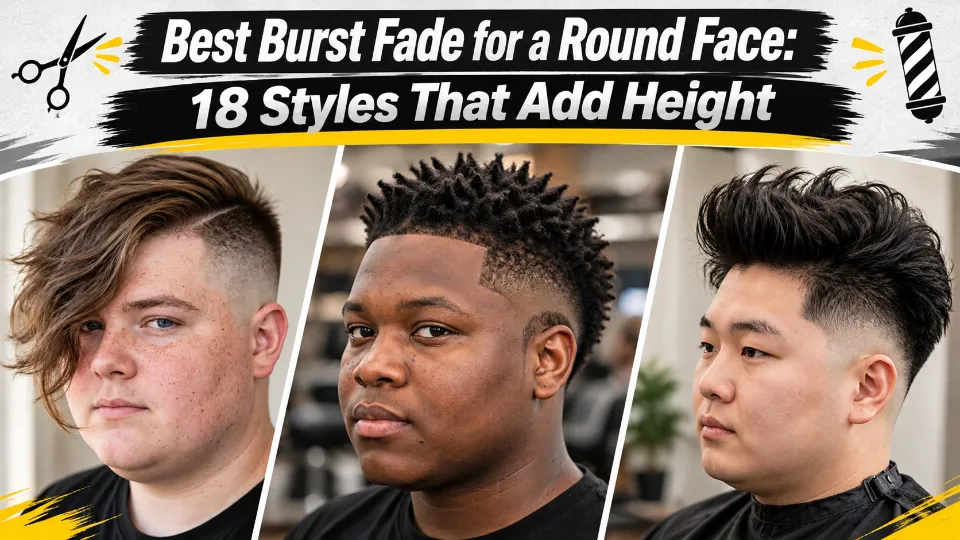
A round face is roughly as wide as it is long, with soft angles and full cheeks. The goal of any haircut on it is the same: add height, remove width, and introduce at least one angle the face doesn’t provide on its own.
You don’t need a different haircut family to do that. You need the right burst fade for round face shapes: the right version of the cut, chosen and adjusted for this face shape. This page is a selection guide only: every style below was picked with exactly that in mind.
The Quick Answer
The best burst fade for round face is a mid or high burst kept tight and narrow around the ear, paired with 2–4 inches of height on top (a quiff, spiky texture or brushed-up fringe). The high arc removes width at the cheeks while the height on top adds the visual length a round face lacks. Avoid low, wide arcs and rounded fringes, which mirror the face’s shape instead of correcting it. A low burst is not ruled out: kept narrow, with real height on top, it can still work — it is the low, wide arc that adds width.
Why a Burst Fade Can Suit a Round Face
A burst fade is unusually well built for round faces, for two reasons. First, the fade’s arc sits directly over the widest part of the face (the cheeks and jaw corners), so taking that zone down to skin removes visual width exactly where a round face has the most of it.
Second, the burst only fades around the ear and leaves the top and back untouched. That means all the hair’s volume can be directed upward, and height on top is what makes a face look longer. A standard fade spends some of that effect on the sides; a burst concentrates it where it counts.
The catch: the same round arc that helps can also echo the face’s roundness. Everything depends on keeping the arc tight and high, and the top tall, which is what the next section covers.
If you are not sure your face is actually round, check before you commit to a correction it may not need — our face shape detector for men works from one front-facing photo and names your shape in seconds, so the styles below start from a measurement rather than a guess.
The 3 Rules
- Build height on top. Aim for at least 2 inches of lift at the front, since quiffs, spikes, brushed-up fringes and pompadour shapes all count. If the front of the haircut lies flat, a round face will look rounder no matter how tight the fade is.
- Keep the arc tight and reasonably high. A narrow burst that hugs the ear takes width away. A wide, low arc that spreads across the side of the head adds a round shape right beside a round face. Mid is the safe default; high is the strongest correction.
- Add an angle somewhere. Angled fringes, asymmetric cuts, a defined side part or a sharp line-up: one straight, deliberate line breaks up the circle. Avoid rounded fringes and curved, bowl-like outlines entirely.
The table below maps all 18 styles at a glance, so you can shortlist by burst height before reading the full descriptions.
| Style | Burst | Best for |
| High Burst Fade with Tall Quiff | High | Straight, wavy, thick |
| High Skin Burst with Faux Hawk | High | Straight, wavy, curly |
| High Burst with Short Pompadour | High | Straight, wavy |
| High Burst with Textured Crown Height | High | Difficult hairlines |
| High Burst with Slicked Height | High | Straight |
| High Burst with Line-Up | High | Coily, curly |
| Mid Burst with Spiky Textured Top | Mid | All except very fine |
| Mid Burst with Messy Height | Mid | Wavy, thick |
| Mid Burst with Brushed-Up Fringe | Mid | Straight, wavy |
| Mid Burst with Point-Cut Volume Top | Mid | Flexible styling |
| Mid Burst with Short Textured Quiff | Mid | Fine, thinning |
| Mid Burst with Faux Hawk Lite | Mid | Office-safe lengthening |
| Angled Fringe with Mid Burst Fade | Mid | Straight, wavy |
| Asymmetric Fringe with High Burst Fade | High | Thick, straight |
| Textured French Crop with Raised Front | — | Straight, wavy, fine |
| Side-Swept Long Fringe with Mid Burst | Mid | Longer tops, 3–4 inches |
| Short Crop with Lifted Front and Tight Burst | Tight | Receding hairlines |
| Buzz Cut with High Burst Fade | High | Very short hair |
High Burst Styles
The strongest options for round faces. A high burst fade starts the arc up near the temple, so the fade removes the most width and leaves the most room for height above it.
1. High Burst Fade with Tall Quiff

Three to 4 inches at the front, dried up and back into a quiff, over a high burst taken to skin. This is the benchmark round-face burst: maximum height on top, maximum tightness at the cheeks.
Suits straight and wavy hair with some thickness. The quiff needs a blow-dryer and a matte paste. If you won’t dry it, pick a spikier style below instead.
The quiff itself has more versions than the tall one shown here — different heights, finishes and hair types all change how it reads on a round face, and our quiff fade guide walks through each one with the words to use in the chair.
2. High Skin Burst with Faux Hawk

The centre strip is left 2–3 inches and pushed upward while the high burst strips both sides to skin. Channelling all the hair into one vertical line is the most direct way to lengthen a face.
Works on straight, wavy and curly hair. Keep the strip narrow, because if it widens toward a mohawk it starts adding width back at the crown.
If the narrow strip appeals to you, the full faux hawk treatment covers longer and shorter versions, product choices and how the strip width changes the effect — our burst fade faux hawk guide has the complete breakdown.
3. High Burst with Short Pompadour

A pompadour’s rounded front might sound wrong for a round face, but worn short and high over a tight burst it reads as height, not roundness. The key is keeping the sides of the pomp slicked close, not puffed out.
Needs about 3 inches at the front and a blow-dry with a brush to build the lift. Best on straight and wavy hair; very curly hair should take the faux hawk route instead.
4. High Burst with Textured Crown Height

Instead of styling the front up, the height is built at the crown: 2–3 inches point-cut and lifted, with the front left flatter. This lengthens the profile from the side view, which is where round faces often look shortest.
A good option for men whose hairline makes a quiff difficult. Style with a volumising powder or matte paste worked into the crown only.
5. High Burst with Slicked Height

Hair of 3–4 inches slicked up and back with a wet-look product, over a high skin burst. Slicking removes all side volume while the upward direction keeps the lengthening effect.
Best on straight hair. Watch the finish: a very shiny product on a round face can emphasise roundness, so choose a medium shine rather than a gloss.
Slicked styles live or die by the finish, and the shine question matters more on a round face than anywhere else — our burst fade slick back guide compares wet, matte and medium finishes side by side so you can pick before you sit down.
6. High Burst with Line-Up

The burst and fade do the slimming while a sharp, squared line-up at the forehead and temples supplies the angle from Rule 3. Straight lines against a round face create definition the face shape doesn’t have naturally.
Especially effective on coily and curly hair where the front line is clearly visible. Budget for it: line-ups blur in 10–14 days, well before the fade needs redoing.
Coily and curly hair changes every rule in this guide slightly, from how the arc blends to how height holds without product — our burst fade curly hair guide covers the curl-specific versions of these same cuts.
Textured and Spiky Tops
Texture creates height without commitment to a formal style, which makes it the most forgiving group for daily styling. Most of these sit on a mid burst fade, high enough to slim the cheeks but softer than a high burst.
7. Mid Burst with Spiky Textured Top

Two to 3 inches on top, point-cut and spiked upward with matte paste. Spikes are pure vertical lines, which is exactly what a round face needs, and the mid burst keeps it wearable anywhere.
Works on almost every hair type except very fine. The one rule: spike the centre and crown, not the sides, because spikes at the sides point outward and add width.
8. Mid Burst with Messy Height

Deliberately rough texture, 2–3 inches, pushed up and slightly forward with the fingers. The uneven peaks break up the head’s outline so it doesn’t echo the face’s curve.
Ideal for wavy and thick hair that resists neat styling. Use a matte clay on dry hair and stop styling while it still looks unfinished, because overworked messy hair just looks flat.
Messy texture and fringes overlap more than most men expect, and the line between a pushed-up fringe and a textured crop is mostly a matter of length at the front — our burst fade textured fringe guide shows where that line sits and which side suits rounder faces.
9. Mid Burst with Brushed-Up Fringe

The front is worn up and slightly back rather than down on the forehead, which is the opposite of a normal fringe. Two to 3 inches at the front is enough to stand it up with a dryer.
This is the safest first burst fade for a round face: it follows all three rules without looking dramatic. Suits straight and wavy hair best.
10. Mid Burst with Point-Cut Volume Top

No fixed style: just 2–3 inches of heavily point-cut hair that can be pushed up, forward or to the side. The point-cutting removes bulk from the sides of the top while keeping length at the centre, which is where you want the volume.
A barber skill-dependent cut: ask specifically for the weight to be kept through the middle of the top, not the edges. Style with whatever product you already use.
11. Mid Burst with Short Textured Quiff

A quiff scaled down: 2–3 inches at the front, lifted with the fingers rather than a brush, over a mid burst. Less height than style 1, but far less morning effort.
Good for fine or thinning hair, where a tall quiff exposes the scalp. Dry the front upward on a low heat setting and use a light paste, because heavy products collapse fine hair by midday.
12. Mid Burst with Faux Hawk Lite

A softer faux hawk: the centre is left longer and gathered upward, but the burst stays mid and the blend is gradual, so it reads as a textured top with direction rather than a statement cut.
Suits round faces that want the lengthening effect of style 2 in an office-safe form. Keep the centre strip around 2 inches long and push it up with matte paste.
Fringe and Crop Options
Fringes are risky on round faces, because a straight, rounded fringe draws a second circle under the first. The six below work because every one of them is angled, asymmetric or swept, so the line across the forehead cuts diagonally instead of curving.
13. Angled Fringe with Mid Burst Fade

The fringe is cut on a diagonal, longer at one side, and worn swept across. The slant creates the angle from Rule 3 while the mid burst keeps the cheeks tight.
Needs 2–3 inches at the front. Suits straight and wavy hair; the angle disappears in tight curls, so curly hair should use the crop options instead.
14. Asymmetric Fringe with High Burst Fade

One side cropped short, the other left long and falling diagonally. This is the most fashion-forward entry here. The high burst underneath keeps the whole thing tight so the asymmetry looks deliberate.
Best for younger wearers and thick, straight hair. It grows out unevenly by design, so expect a trim every 2–3 weeks to keep the two sides distinct.
15. Textured French Crop with Raised Front

A short crop whose fringe is cut choppy and pushed slightly up at the front edge instead of lying flat. That raised, jagged front edge is the difference: it adds a broken horizontal line and a hint of height rather than a smooth curve.
The most low-maintenance style in this guide, with under 2 inches on top and styled with a pea-sized amount of matte product, or none. Works on straight, wavy and fine hair.
16. Side-Swept Long Fringe with Mid Burst

Three to 4 inches on top swept fully to one side, with a hard or natural part. Sweeping moves the hair’s bulk off-centre, which visually narrows the face the same way a diagonal fringe does.
Needs the burst on the lighter side kept tight, or the sweep looks lopsided. Blow-dry in the direction of the sweep while wet; it won’t redirect once dry.
A side sweep is only one way to part and direct the top — the comb-over family covers the full range of parts, directions and volumes, and our burst fade comb over guide shows which ones keep width off the sides of a rounder face.
17. Short Crop with Lifted Front and Tight Burst

A classic short crop (1 to 2 inches), but the front inch is textured and lifted upward rather than brushed forward. From the front it reads as height; from above it’s still a crop.
This is the minimal-effort option for men who dislike styling. It suits receding hairlines better than any fringe here, since nothing is asked to cover the forehead.
18. Buzz Cut with High Burst Fade

A #3 or #4 buzz on top offers almost no height, so the slimming has to come entirely from the fade, which is why the burst must be high and taken to skin. Our Burst Fade Buzz Cut guide covers the guard numbers in full. This entry deliberately breaks Rule 1 and the Quick Answer’s call for at least 2 inches of height on top, and it still works because the high burst taken to skin does all the slimming from the sides instead of relying on length on top.
Honest assessment: this is the weakest entry here for a round face, included because some men won’t grow the top out. If you choose it, keep the buzz at #4 rather than shorter, and add a line-up for the missing angle.
Guard numbers decide how much of the slimming the fade actually delivers, and the difference between a #3 and a #4 on top is visible from across the room — our clipper guard size chart lists every guard with its length so you can name the exact number in the chair.
What to Avoid
- Low, wide burst fades — a low arc that spreads wide across the side of the head draws a circle next to a circle. If you prefer a low burst for other reasons, keep it narrow and compensate with extra height on top.
- Rounded or bowl-like fringes — any fringe that curves down around the forehead mirrors the face shape. Fringes must be angled, asymmetric or raised.
- Volume at the sides — long or puffy hair left at the temples and above the ears adds width at the worst point. Everything above the arc should go up, not out.
- Very short, flat tops with a low fade — no height and no tightness means nothing corrects the shape.
- Centre partings with flat sides — they frame the face symmetrically and emphasise its width. If you part your hair, part it on the side and sweep it.
None of this means a low burst is never the right call — kept narrow with real height above it, it can work, and the low burst fade guide shows exactly how narrow and how tall that combination needs to be.
How to Ask Your Barber
- Bring reference photos — pick shots of men with a similar face shape to yours, not just a cut you like on someone else. The same burst reads completely differently on an oval face.
- Say “tight arc” explicitly — ask for a mid or high burst that hugs the ear rather than spreading wide, faded to skin or a #0 at its lowest point.
- Agree the top length in inches — 2–4 inches at the front for quiffs and brushed-up styles, and tell your barber the height is the point of the cut.
- Ask for weight off the sides of the top — length should be kept through the centre and crown, with bulk removed near the temples.
- Decide your angle — angled fringe, side part or line-up. Pick one and name it, so the finished cut has a deliberate line in it.
Maintenance
- Fade refresh: every three to four weeks for a low burst, two to three for a mid and one to two for a high — the slimming effect depends on the arc staying tight, and a grown-out burst drifts lower and wider, which is the opposite of what a round face needs
- Line-ups: every 10–14 days if you have one
- Top trims: every 3–4 weeks to keep the front at working height
- Daily: 2 minutes with a dryer beats any product — height is built with heat and direction, then held with a small amount of matte paste
The two minutes with a dryer mentioned above do more than hold height — done properly they are a blowout in miniature, and our burst fade blowout guide teaches the full towel-to-finish routine for men who want the most lift their hair can give.
Frequently Asked Questions
Is a burst fade good for a round face?
In the right version, a burst fade suits a round face well. A mid or high burst kept tight around the ear removes width at the cheeks, and the untouched top can be styled upward to add visual length. The low, wide version of the same cut is one of the worst choices for this face shape, because the height of the arc matters more than the fade itself.
Which is better for a round face, a low or high burst fade?
High, in almost every case. A high burst clears more width from the sides and leaves a taller block of hair to style upward. A mid burst is the compromise if a high fade feels too severe for work or school, provided the arc stays narrow and the top keeps its height.
How much height on top do I need to make a round face look longer?
Roughly 2 inches of lift at the front is enough to change the proportions noticeably; 3–4 inches in a quiff gives the strongest effect. Height has to be styled in with a dryer, though, because 4 inches of hair lying flat adds width, not length.
Should I avoid a fringe if my face is round?
Avoid straight and rounded fringes, which copy the face’s curve. Angled, asymmetric and side-swept fringes are genuinely useful on round faces because the diagonal line breaks up the circle, and six of the styles in this guide use one.
Does a beard help a round face with a burst fade?
A shaped beard usually helps: keeping the cheeks of the beard tight and leaving length at the chin adds the vertical line the face lacks. Ask your barber to fade the sideburn into the beard so there’s no step, and avoid a wide, bushy beard, which adds the width you just removed.
What if I want a burst fade but my hair is very short?
Go high and tight: a high skin burst does the slimming work when the top can’t provide height, as
in style 18 above. Our main burst fade guide shows how the heights compare if you’re deciding between versions.
What face shape suits a burst fade?
Almost any, because the arc height adjusts to the face: round faces take a mid or high burst with height on top, longer faces take a low burst with a shorter top, and oval faces suit a mid burst. The rule stays the same: keep the arc tight around the ear and put the height where the face needs length.

