
Quiff Fade: Lift on Top, Burst at the Sides, Clear Words for the Chair

Key Points Up Front
• In short, a quiff fade is a lifted quiff on top over short faded sides, and this guide pairs it with the burst fade.
• Leave roughly three to four inches at the front, then ask for the sides to curve around each ear.
• Name the top, the sides and the finish, and bring one front photo and one side photo.
Quiff Fade Meaning: Lift on Top, Fade Below
A quiff fade is a quiff, the top swept up and back from a longer front, worn above sides that fade down to short hair or bare skin. The fade used throughout this guide is the burst fade, which curves in an arc around each ear and keeps more length at the back.
The quiff supplies the height and the fade supplies the clean sides. Since the two parts work separately, either one can change while the other stays put.
Saved photos usually show one fade and one quiff together, so naming both parts helps your barber match the picture.
Quiff, Pompadour and Side Part Compared
| Cut | Direction of the top | Feel |
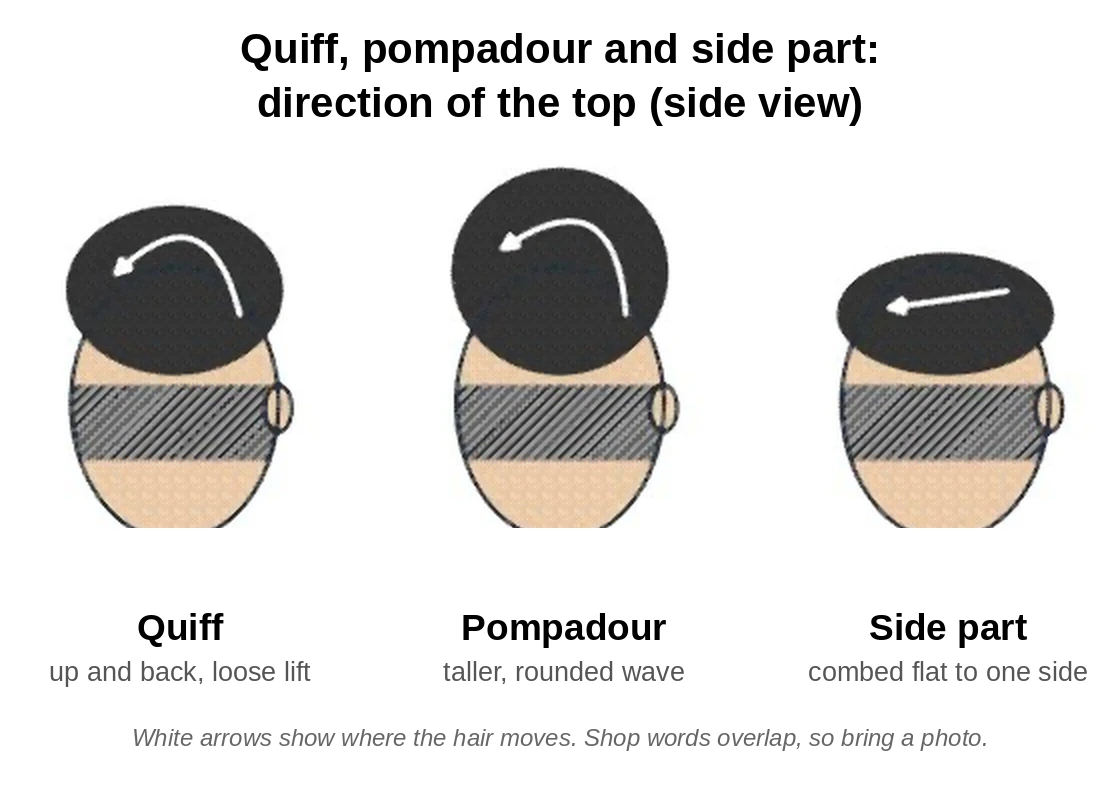
| Quiff | Up and back, with the front lifted | Relaxed and a little loose |
| Pompadour | Up and back, with more height and a rounded wave | Bold and more formal |
| Side part | Combed flat to one side | Neat and quiet |
| Comb over | Combed across from a deep part | Sharp and tidy |
Shop words overlap, so a barber might call a medium lift either a quiff or a short pompadour. A pompadour usually has more height and shine at the front. A photo settles it faster than any label.
Seven Fades You Can Pair With a Quiff
A quiff works above many different fades. This guide leads with the burst, and the table shows how the others compare.
| Fade | Look | Upkeep |
| Burst | Curves in an arc around the ear | Sides every three to four weeks for a low burst, two to three for a mid and one to two for a high |
| Low | Starts just above the ear and stays subtle | Every three to four weeks |
| Mid | Starts halfway up the side for balance | Every two to three weeks |
| High | Starts near the temple for strong contrast | Every one to two weeks |
| Skin | Ends in bare skin at the lowest point | Every two weeks |
| Taper | Shortens gently at the neckline and sideburns | Every three to four weeks |
| Drop | Line dips lower behind the ear | Every three to four weeks for a low burst, two to three for a mid and one to two for a high |
Upkeep is a typical guide for a quiff fade, and your own hair growth can shift them. Heights and finishes can also be mixed, so a mid burst can end in bare skin.

The quietest pairing on this list is the low burst, which keeps the arc small and leaves more weight on the sides — a calm base for the compact looks below. Our low burst fade guide covers its heights, guard numbers and upkeep in full.
How Long the Front Should Be
A quiff fade needs enough length at the front to lift and sweep back. Barbers often say about three to four inches is typical. The exact number varies, so use it as a starting point only.
• Shorter top: gives less lift, so it suits a starter quiff.
• Longer top: adds height but asks for more styling time.
Hair type changes the number, so let your barber check the length on your own head.
Fitting a Quiff to Your Hair and Face Shape
• Straight hair: rises well with a blow dry and holds with a firm product.
• Wavy or curly hair: has natural body, so the quiff needs less product and more shaping by hand.
• Fine hair: responds to a light touch and short layers.
• Hairline: ask your barber to shape the front around your own hairline.
If you wonder what is my face shape, a face shape detector online can give a quick starting point from a photo. Treat the result as one more thing to show your barber, who can study your head up close and shape the quiff around it.
Three Parts to Say Out Loud
Give your barber three pieces of information about your quiff fade, in this order.
| Part | What to say | Example |
| Top | Length and direction of the quiff | Quiff, lifted at the front |
| Sides | Fade type and where it starts | Mid burst around the ear |
| Finish | Neckline and edge | Tidy neckline, soft edge |
Take one photo from the front and one from the side. The front view hides the burst and the side view hides the lift, so two photos tell the whole story.
37 Quiff Looks Built on a Burst Fade
Every quiff fade look has a short request to read aloud and one chair tip, and the burst is part of each cut.
A quiff is just one way to wear this cut. If you are still weighing the base style, our burst fade guide collects all 41 styles in one place, so you can compare the quiff with the rest before you commit.
Compact and Tidy Quiffs
These six keep the top short, so the burst and the lift are easy to see.
1.Compact Quiff Rising From a Low Burst

A short top lifts at the front while a low burst curves just above each ear. The sides stay slim, and the quiff reads as small and tidy.
• Request: Short quiff, low burst, small lift in front, tidy neckline.
• Tip: Dry the front upward for ten seconds, then stop.
2.Short Brushed-Up Quiff on a Mid Burst

The top is brushed straight up and back from a slightly longer front. A mid burst sits halfway up the head, so the sides and the lift balance well.
• Request: Brushed-up quiff, mid burst, short sides, slightly longer front.
• Tip: Brush the front up with a small comb while damp.
3.Neat Office Quiff With a Quiet Burst

A modest lift keeps the top smooth enough for a work day. The quiet burst stays close to the ear, so nothing looks loud or overdone at the desk.
• Request: Work-ready quiff, quiet burst, modest lift, low shine, tidy edges.
• Tip: Choose a light cream, since heavy product stiffens the top.
4.Starter Quiff With Little Daily Work

This is the easiest way into a quiff. The top is only a little longer in front, so a quick blow dry and a dab of product do the job.
• Request: First quiff, soft burst, only a little extra length up front.
• Tip: Start with a pea-sized amount, since you can always add more.
5.Short Forward Quiff Lifted at the Front

Hair at the front is pushed forward first, then lifted a little at the very edge. The burst keeps the sides short, so the small lift stands out.
• Request: Forward quiff, short sides, burst at the ear, light lift.
• Tip: Comb the front forward, then use your fingers to raise it.
6.Weekday Quiff Beside a Gentle Curve

A relaxed short quiff for every day of the week. The gentle curve around the ear keeps the sides soft, so you can skip fussy styling most mornings.
• Request: Everyday quiff, gentle burst, easy top, soft blend, natural finish.
• Tip: Style it once in the morning and leave it alone.
Classic and Polished Quiffs
These six go smooth and polished, with a clear shape and a clean part or sweep.
7.Classic Quiff Combed Up Over a Mid Burst

A smooth, combed lift with a clear shape from front to back. The mid burst frames the ears, and the whole cut looks neat and sure of itself.
• Request: Classic quiff, mid burst, combed smooth, defined sides, medium shine.
• Tip: Run a fine-tooth comb through once the product is in.
8.Quiff Swept Sideways Over a Burst

The lift is brushed over to one side instead of straight back. That angle adds movement, and the burst keeps the sides tight so the sweep stays clear.
• Request: Swept quiff, burst, lift toward your natural side, tight sides.
• Tip: Blow dry against the direction of the sweep first.
9.Side-Part Quiff Above a Soft Burst

A defined part sits on one side, and the hair on the other side lifts up and over. The soft burst keeps the sides gentle and the part easy to see.
• Request: Side-part quiff, soft burst, part where it falls, medium lift.
• Tip: Find the part by combing straight back, then let it fall.
10.Quiff Parted by a Razor Line Next to the Burst

A thin line is cut into the hair with a razor to mark the part. It sits crisp beside the burst curve, and the lifted quiff rises from it.
• Request: Quiff, razor part, mid burst, crisp line, soft top.
• Tip: Keep product off the razor line so it stays sharp.
11.Glossy Quiff Brushed Back Over a Burst

A glossy top is combed up and back. For a wetter, flatter finish, the slick back burst fade guide is the place to start.
• Request: Wet-look quiff, mid burst, combed back, high shine, clean sides.
• Tip: Comb through damp hair for a smoother, shinier finish.
12.Medium Quiff With Smooth Lift and a Burst

A medium-length top gives the lift room to curve back smoothly. The burst trims the sides short, so the extra length on top is the focus of the cut.
• Request: Medium quiff, mid burst, smooth backward lift, light hold.
• Tip: Let it dry about halfway before you shape the lift.
Messy and Textured Quiffs
These six give up some neatness for texture, with loose ends and a lived-in feel.
13.Messy Quiff on a Soft Burst Taper

Loose, uneven texture gives the quiff a lived-in look. The burst eases into a soft taper at the ear, which keeps the sides from looking harsh next to the messy top.
• Request: Messy quiff, soft burst taper, loose texture, natural finish.
• Tip: Scrunch a little paste through the top, then leave it.
14.Textured Quiff Lifted Over a High Burst

Texture adds grip and height at the front. A high burst reaches up toward the temple, so the sides look clean and the top looks bigger by comparison.
• Request: Textured quiff, high burst, very close sides, strong lift.
• Tip: Dust texture powder onto the roots for extra grip.
15.Choppy Quiff With a Loose Fringe Lift

Choppy ends keep the front lifted but loose. The textured fringe burst fade guide has more ideas for tops with this kind of movement.
• Request: Choppy quiff, loose fringe, mid burst, light lift, textured ends.
• Tip: Ask for point cutting if the front feels too heavy.
16.Razor-Cut Quiff With Feathered Ends and a Burst

A razor thins the ends into soft, feathered points. The lifted top looks much lighter and airier, and the burst keeps the sides neat and short around it.
• Request: Razor-cut quiff, feathered ends, mid burst, light texture on top.
• Tip: Skip heavy wax, since it weighs feathered ends down.
17.Tousled Quiff With Heavy Texture and a Burst

Thick, rough texture gives the quiff a windswept, full look. The burst keeps the sides trimmed, so the heavy top has a clean base to sit on neatly.
• Request: Tousled quiff, heavy texture, mid burst, windswept top, short sides.
• Tip: Twist small sections between your fingers to set the shape.
18.Spiked Quiff Standing Tall Over a Burst

The front stands up firmly instead of falling back. The burst keeps the sides close, so the spiked top looks sharp rather than wild, and it holds its shape.
• Request: Spiked quiff, firm hold, mid burst, tall front, close sides.
• Tip: Press the spikes into place with a firm hold product.
Volume and Length Quiffs
These six vary how much length sits on top and how high the burst starts.
19.Big-Volume Quiff With a Rounded Burst

Extra height at the front gives the quiff real presence. A rounded burst curve balances the volume, so the head still looks even and tidy from the side.
• Request: Big quiff, rounded burst, extra height, short sides, firm hold.
• Tip: Build height with a round brush and warm air.
20.Longer Quiff Sitting High Above a Burst

More length gives the quiff a bigger wave. Find more cuts that keep length on top in the long hair burst fade guide.
• Request: Longer quiff, high burst, length kept on top, tidy sides.
• Tip: Trim split ends first so the longer top lies cleanly.
21.Mid-Length Quiff Settled on a Tight Low Burst

A top of medium length rests on a low burst that sits tight and small. The balance suits men who want some length but a cut that stays calm.
• Request: Mid-length quiff, tight low burst, soft lift, even sides.
• Tip: Use a sea salt spray for light grip and body.
22.Layered Quiff Softening Into a Burst

Layers cut through the top let the quiff move and blend into the sides. The burst finishes the blend, so there is no hard line to see at the sides.
• Request: Layered quiff, soft burst, blended sides, movement on top.
• Tip: Ask to see how the layers fall on dry hair.
23.High Burst Under a Backswept Quiff

The top sweeps up and back in one clean movement. The high burst climbs toward the temple, which leaves short hair under the lift for a clear contrast.
• Request: Backswept quiff, high burst, clean lift, smooth finish, tight temples.
• Tip: Hold the comb flat and sweep from front to back.
24.Quiff Growing Out From a Fresh Burst

The sides are newly cut while the top has grown long enough to lift. This look shows how a quiff changes as the length builds week by week.
• Request: Grow-out quiff, fresh burst, keep the top long, trim the sides.
• Tip: Trim only the sides while the top is still growing.
Length can run backwards as well as up. If the grown-out feel suits you but you want the back left long too, you are crossing into burst fade mullet territory, and that shape has its own set of styles and rules.
Hair Type and Growth Quiffs
These seven begin with your hair type, your hairline or the way your hair grows.
25.Curly Quiff Above a Rounded Burst Curve

Curls pile up at the front for natural height. The curly hair burst fade guide explains how the curve works around tighter hair.
• Request: Curly quiff, rounded burst, curls lifted high at the front.
• Tip: Diffuse the curls on low heat to keep them defined.
26.Wavy Quiff With Natural Lift Beside a Burst

Waves add soft body, so the quiff needs less help to stand up. The wavy hair burst fade guide shows more ways to use that movement.
• Request: Wavy quiff, soft burst, keep the natural wave, lift in front.
• Tip: Work a light mousse through damp waves, then lift the roots.
27.Thick-Hair Quiff Thinned Beside a Burst

Dense hair can feel heavy, so the barber thins it to let the front lift. The burst keeps the sides slim and takes away extra bulk at the ears.
• Request: Thick-hair quiff, thinned top, mid burst, slim sides, easy lift.
• Tip: Use a strong paste, because thick hair resists soft hold.
28.Fine-Hair Quiff Built With Light Product

Fine hair lifts best with a light touch. Short layers add a little body, and the burst keeps the sides trim so the top does not look thin.
• Request: Fine-hair quiff, short layers, mid burst, light lift, trim sides.
• Tip: Mist root lift spray onto the roots, then blow dry.
29.Matte Quiff for a Higher Hairline and a Burst

A matte finish keeps the top soft and natural when the hairline sits higher. The quiff lifts forward, and the burst frames the sides cleanly at both ears.
• Request: Matte quiff, forward lift, mid burst, soft front edge.
• Tip: Pick a dry-finish cream and keep the amount small.
30.Air-Dried Quiff With Loose Natural Texture

No blow dryer is needed here. The hair dries on its own with a loose lift, and the burst keeps the sides tidy while the top stays relaxed.
• Request: Air-dried quiff, loose texture, soft burst, natural lift, no fuss.
• Tip: Rake your fingers through the front as it dries.
31.Quiff Built Around a Stubborn Cowlick

A cowlick pushes hair in its own direction. The barber leaves extra length there and shapes the quiff to follow it, with the burst keeping the sides neat.
• Request: Quiff that follows the cowlick, extra length there, soft burst.
• Tip: Point out the cowlick before the barber starts cutting.
Detail Quiffs Around the Burst
These six zoom in on the details where the quiff meets the burst.
32.Quiff and Beard Joined by a Burst

The burst curve runs into the beard in one smooth line. Plan the join with the help of the burst fade with beard page.
• Request: Quiff, mid burst, beard blended at the sideburn, tidy cheek line.
• Tip: Leave your beard untrimmed so the barber can plan the join.
33.Edge-Up Quiff With a Crisp Hairline

A crisp edge-up sharpens the forehead and temple. Pair it with ideas from the burst fade design guide, which collects sharper line work.
• Request: Edge-up, quiff, mid burst, crisp temple line, clean forehead line.
• Tip: Check the hairline in a mirror before the cape comes off.
34.Quiff With a Sharp Step Down to the Burst

A visible step drops from the lifted top to the short burst. The clear break between the two lengths gives the cut a bold, structured look from the side.
• Request: Quiff, sharp step down, mid burst, defined break, tidy neckline.
• Tip: Look at the step from the side before you leave.
35.Drop-Burst Quiff Dipping Behind the Ear

The fade line dips lower behind the ear instead of running level. That small drop gives the sides extra shape while the quiff stays exactly as it was.
• Request: Drop burst, quiff on top, line dips behind the ear.
• Tip: Turn your head sideways in the mirror to see the dip.
36.High Burst Quiff With Clean Bare Sides

Short sides are taken close to the skin, and the high burst lets the quiff stand out above them. The look is bold, and it needs regular trims.
• Request: High burst, close sides, quiff on top, clean temple line.
• Tip: Plan a trim for the sides every three to four weeks for a low burst, two to three for a mid and one to two for a high.
37.Low Burst Quiff for a Quiet Finish

A low burst hugs the ear and stays out of the way. The quiff does the talking, and the sides stay calm and easy to keep tidy between visits.
• Request: Low burst, quiff on top, soft sides, simple neckline.
• Tip: Choose this if you only want a trim once a month.
Styling a Quiff From Damp Hair to Dry Finish
Five steps cover most quiff fade styles.
1. Rub a towel over your hair until it stops dripping.
2. Work a light styling cream or sea salt spray from the roots to the ends.
3. Blow dry the front up and back with a brush, using medium heat.
4. Shape the lift with your fingers, then add a small amount of paste or clay.
5. Lock the lift with a final pass of hairspray if you need extra hold.
Start with less product than seems necessary, since more can be added but none can be removed.
The best product type depends on how your hair behaves, so match it before buying.
| Your hair | Product type | Why it works |
| Fine or flat | Light cream or sea salt spray | Adds grip without adding weight |
| Thick or heavy | Soft paste or light clay | Holds the lift without a hard shell |
| Wavy or curly | Curl cream, then a little paste | Keeps the pattern loose and the front soft |
| Straight and slick | Matte clay with a blow dry | Gives grip so the front does not slide down |

Flat, Greasy or Lopsided? Quick Fixes
| Problem | Likely cause | Fix |
| Flat front | Too much product or too little dry time | Use less product and dry the roots upward |
| Greasy look | Heavy product on fine hair | Switch to a lighter cream and rinse first |
| Uneven shape | Front dried in two directions | Dry from one side and comb once |
| Crown spike | A cowlick pulls hair up at the back | Wet it and dry it flat, or ask for extra length there |
How Soon to Rebook and How to Grow It Out
| What | Typical window |
| Sides with a burst or mid fade | Every two to three weeks |
| Low burst or taper | Up to four weeks |
| Top | Every four to six weeks |
| Grow-out | Trim the sides, leave the top |
Timing varies for a quiff fade, so read these as typical windows and adjust them to how quickly your hair grows.
Mistakes to Skip and Cuts to Consider Instead
• Too little length: keep enough on top for the quiff to lift.
• Too much product: a small amount does the job.
• Skipping the side photo: the burst can only be judged from the side.
• Long gaps: book the next visit before the curve softens.
• Brushing it flat: dry the front upward first.
Think twice if you want no styling at all. Pick a short crop or a plain taper if mornings are short, since a quiff fade takes more effort.
Frequently Asked Questions
What is a quiff fade?
A quiff fade combines a swept-up quiff on top with sides that fade short. The burst fade suits it well because the curve wraps around each ear. Describe the top and sides in your own words, then bring a photo.
Is a quiff fade the same as a pompadour?
Not quite. Both lift the top up and back, yet a pompadour usually has more height and shine at the front, while a quiff looks looser and more relaxed. Barbers read the two words differently, so explain the lift and bring a picture.
How long should your hair be for a quiff fade?
Many barbers suggest about three to four inches at the front of a quiff fade, with shorter hair at the sides. Hair type moves the number. A shorter top gives a smaller lift, so have your barber measure on your own head.
Which fade works best with a quiff fade?
No single fade wins. A burst keeps the sides slim and curves around the ear, a mid fade balances the shape, and a high or skin finish adds contrast. Choose by how much contrast you want, and ask the barber to show the height on your head.
How often should you get a quiff fade?
Most men book a quiff fade every three to four weeks for a low burst, two to three for a mid and one to two for a high at the sides. The top usually wants a trim every four to six weeks. These windows are typical, so adjust them to your own hair growth.
How do you keep a quiff fade from going flat?
To keep a quiff fade tall, dry the roots upward before adding product, and use a small amount of matte clay or paste. Heavy product weighs the front down. Finish with cool air, and add light hairspray if your hair is fine or the day is humid.
Final Thought
Choose the lift, choose the fade, and say all three parts aloud, and a quiff fade will look the way you pictured it. Bring two photos, and let your barber check the length on your own head before the first snip.
Editorial Note
This guide gives general grooming advice, not personal advice for your hair. Your barber sees your hair up close, so ask for a view on length, fade height and finish before you decide

