
Burst Fade Braids Twists: Pick the Pattern, Then Set the Arc
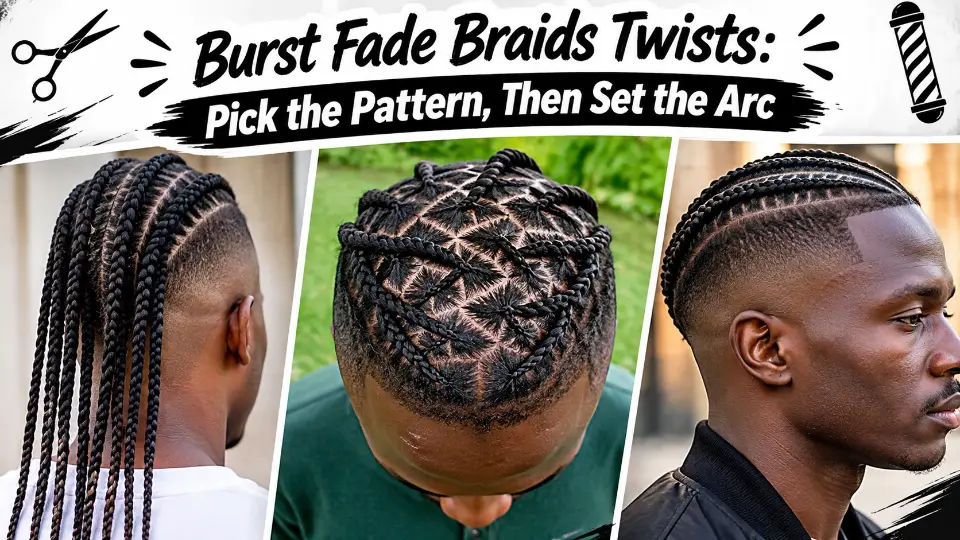
· A burst fade braids twists cut pairs a curved arc around each ear with braids, twists or cornrows worn on top.
· Your request needs four parts: arc height, base finish, pattern length and neck edge.
· Return by arc height. Low burst: three to four weeks. Mid: two to three. High: one to two.
Burst fade braids twists in plain terms
Burst fade braids twists is a burst fade, a fade that curves in a half circle around each ear and leaves the back fuller, with braids, twists or cornrows worn on top. The barber sets the arc and the blend at the sides, and the wearer keeps the top neat with a light product.
Think of two zones. Up top, the hair is worked into rows, coils or plaits. Down at the sides, clippers carve a rounded patch around each ear, and the back keeps its weight.
The contrast is the point: busy pattern above, clean skin or shadow below. Readers who found this page from the burst fade styles overview usually want to know one thing, which pattern sits best on that arc.
What changes against a plain burst fade
A plain burst fade pairs with nearly any top shape. Braids and twists add a pattern, so four decisions move. The table lines them up. Compare a lower curve in the burst fade versus drop fade article.
| Decision | Plain burst | With braids or twists |
| Top | Cut or textured | Worked into rows, coils or plaits |
| Top length | Chosen for the cut | Long enough to hold the pattern |
| Daily care | Brush and product | Light cream and a wrap at night |
| Visits | Barber only | Barber for the arc, braider for the top |
Check the right column against your plan as a quick test. Is the top long enough to braid or twist? Does the pattern have a clear stopping line at the sides? Will you wrap it at night? Three yeses and the plan is workable. Business in front with extra length behind is handled under burst fade mullet.
If rows and coils feel like too much, a cut top under the same arc is a calm alternative. Two things stay constant: the fade wraps each ear in an arc, and the back keeps more length than the sides.
Where braids and twists meet the arc
The pattern-first rule. Settle the braid or twist pattern before the arc. The arc has to meet the pattern, so a barber who sees the finished rows can place the fade to match.
The meeting-line rule. Name the line where the top pattern ends and the faded zone begins. A crisp meeting line keeps the sides sharp, while a vague one blurs both zones.
The height rule. Advice on arc height for patterned tops differs from site to site. For a first visit, low or mid usually works, because neither competes with the pattern.
The stopping point rule. State the exact spot behind the ear where the arc should end. An early finish keeps the back fuller, and a longer sweep drifts toward a plain fade.
The order rule. Ask whether the fade comes before or after the braiding or twisting. The sequence changes how neat the parts and the edge look on the day.
If a rule fights your hair texture or head shape, tell the barber early. These rules are starting points, not orders.
Chair work and home work
| In the chair | At home |
| Arc position and height | Light cream along the rows |
| Side density and finish | A scarf or wrap overnight |
| Back edge and meeting line | Leaving the arc alone |
Clippers set the arc, the sides and the meeting line. Cream, a wrap and a light hand look after the top between visits.
Sharp sides with a tired top point to home care. Messy sides with fresh rows point to the chair.
Hair type and face shape
Texture shapes the top pattern, while the arc stays the barber’s call. Four types give a starting point.
· Tightly coiled hair holds twists and rows well, and it shrinks, so ask for more length than looks right.
· Curly hair takes both patterns, with twists giving the neatest coil definition.
· Wavy or straight hair needs enough length and some grip, and cornrows usually stay put better than loose twists.
· Fine hair does best with small, close rows and a light touch of cream.
Whatever the type, the top needs enough length to take the pattern.
Curious what is my face shape? Snap a straight-on photo by a window and try a face shape detector online for a quick label. Use it as a rough hint only, because the arc height and top pattern matter far more to this cut than any outline.
What to ask the barber
| Part | What to say |
| Arc height | “Low burst arc, smooth blend.” |
| Finish | “Shadow finish, not bare skin.” |
| Top pattern | “Two-strand twists in neat rows.” |
| Top length | “Long enough to hold the twists.” |
| Back edge | “Rounded back edge, clean meeting line.” |
A full order could run: “Low burst arc, shadow finish, two-strand twists in neat rows, rounded back edge.” Say it once, then ask the barber to repeat it.
Bring three photos. Use the front for pattern lines, the side for the arc curve and the back for the neck edge.
Twenty-seven looks in three groups
Each look changes one visible choice, and a request and a tip close it. A look that already has a page gets a short mention and a link.
Twist looks
These nine put twists on top and vary the size, the set and the arc beneath.
Rope-Twist Rows
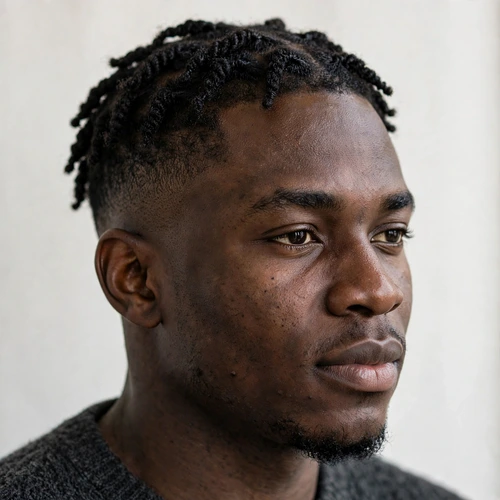
Neat two-strand twists sit over a low arc, a pairing the burst fade for Black men guide describes. The twists lead and the sides stay light.
· Request: “Low arc, two-strand twists, soft shadow finish, tidy back edge.”
· Tip: Run a finger down each row to confirm it lies straight.
Short Twists, Compact Low Arc

A low burst fade keeps most hair at the sides, so small twists on top read tidy. Choose it when you want the quietest pairing.
· Request: “Small twists, compact low arc, gentle fade, round nape edge.”
· Tip: Pick this set when you plan visits every few weeks.
Flat-Twist Top

Twisted rows lie flat against the head in clean, straight lines, which leaves the sides open for a crisp arc and a clearly defined meeting line at the temple.
· Request: “Flat twists in straight rows, low arc, sharp meeting line.”
· Tip: Photograph the row direction so the barber follows it.
Barrel Twists Over a Mid Arc

Thicker barrel twists suit a mid burst fade, where the arc starts halfway up the side and adds contrast under the bulkier top.
· Request: “Barrel twists, mid arc, smooth blend, squared nape edge.”
· Tip: Try mid height if low looks a little too plain.
Sponge Twist Cap

Short twists are made with a sponge into a rounded cap of tiny coils. The top stays low and even, and the arc beneath carries all the edge.
· Request: “Sponge twist cap, mid arc, clean skin finish, even sides.”
· Tip: Show the barber a top-down view of the cap.
Twist-Out Top

Twists are set, dried and unraveled into soft, defined waves, then worn loose. The arc stays crisp, so the top can look relaxed without ever losing its order.
· Request: “Twist-out top, low burst arc, skin-to-shadow blend, clean nape.”
· Tip: Wait until the twists are completely dry before unraveling.
Hanging Twists

Longer twists fall free at the crown and ends. The arc holds the sides close, and the swing of the twists gives the whole cut real, easy movement.
· Request: “Hanging twists to chin length, mid arc, neat back edge.”
· Tip: Tie the twists back during your fade appointment each time.
Shadow-Base Twists

A thin shadow of short hair sits under the arc instead of bare skin. The twists above look sharper because the base never looks stark, bare or harsh.
· Request: “Shadow base at both ears, twists above, gradual blend.”
· Tip: Agree what shadow means before clippers touch the hair.
Coily Twist Crown

Tight coils pull up as they dry, so this crown needs spare length. The burst fade afro page gives length guidance for tight coils.
· Request: “Coily twist crown, low burst arc, smooth blend, soft nape.”
· Tip: Measure length on damp, stretched hair, never on dry hair.
Braid and cornrow looks
These nine use braids or cornrows on top and vary the pattern and the direction.
Straight-Back Cornrows

Cornrows run from the front straight to the crown in even lines. The look is simple and clean, and the arc gives the sides a sharp, finished frame.
· Request: “Straight-back cornrows, low arc, shadow finish, clean meeting line.”
· Tip: Agree on the number of rows before any clipping.
Box Braid Crown

Square-parted box braids form a full crown, and the fade keeps the sides short. The contrast is strong and bold, so the arc needs a clean, level, even blend.
· Request: “Box braid crown, mid arc, seamless blend, squared back edge.”
· Tip: Point out the part width in your reference image.
Skin Arc With Single Braids

Individual braids hang from the crown above an arc faded to skin. Bare sides give the strongest contrast, so check the join with a mirror before leaving the chair.
· Request: “Single braids, skin arc round each ear, tidy neckline.”
· Tip: Judge the join by a bright window before leaving.
Tied-Back Braids

Braids are gathered at the back into one tie, which opens the sides and the arc fully to view. It works best when the arc is the star.
· Request: “Braids tied back, mid arc, crisp meeting line, rounded back.”
· Tip: Tie them loosely so the tie never pulls the edges.
Stitch Braid Lines

Narrow stitch braids run in clear parallel lines with sharp, even gaps between each line. The fade stays very plain, so the line work is the only decoration.
· Request: “Stitch braid lines, low arc, shadow finish, even sides.”
· Tip: Choose a pattern with fewer, wider lines for easy upkeep.
Zigzag Cornrow Parts

Angled parts turn the cornrows into a zigzag, a graphic top that sits well above a calm, clean, low arc and a plain, quiet shadow or skin finish.
· Request: “Zigzag cornrow parts, low burst arc, simple shadow finish.”
· Tip: Keep the sides plain so the pattern gets attention.
Feed-In Braid Rows

Extra hair is fed in gradually by hand, so each row starts thin at the front and thickens toward the crown. The sides stay clean, low and calm.
· Request: “Feed-in rows, mid arc, soft transition, rounded nape line.”
· Tip: Plan the braiding visit a day before the fade.
Braided Top Knot

Braids are pulled up into a high knot at the crown, which clears the sides and nape. The arc is visible from all sides, so the blend has to be clean.
· Request: “Braids in a top knot, low arc, skin finish, tidy nape.”
· Tip: Choose a soft tie, since tight ones strain the roots.
Curl-Pattern Braids

Looser curls braid well with a little cream, and the burst fade curly hair page outlines how to cut for spring above the arc.
· Request: “Braids on loose curls, low arc, even blend, round nape.”
· Tip: Braid the curls while they are damp and lightly creamed.
Length and finish looks
The last nine change the length of the pattern, the finish at the base and the extras.
Short Beard and Braids

Short facial hair can flow into the arc at the sideburn. Sideburn-to-arc joins are explained step by step on the burst fade with beard page.
· Request: “Short beard blended into a low arc, braids on top.”
· Tip: Keep facial hair short so the arc stays clear.
Cropped Braids

Short braids stay close to the head and finish above the ears. The top is easy to manage between visits, and the arc supplies all the visible contrast.
· Request: “Cropped braids, low burst arc, light shadow base, neat nape.”
· Tip: Shorter braids relax quickly, so schedule the redo early.
Loose Twists Over the Arc

Looser twists drape over the top of the arc while the fade still shows through beneath it. Length decides how much of the arc stays visible, so test it first.
· Request: “Loose twists, mid arc, soft blend, clear meeting line.”
· Tip: Pin the twists back during the fade to check the arc.
Long Braids Past the Arc

Braids that hang past the ear keep the arc partly in view. The burst fade long hair page shows how length changes the visible curve.
· Request: “Long braids, mid arc, seamless join, squared nape edge.”
· Tip: Pull the braids back to see the whole arc.
High Arc, Short Twists

A high arc starts right near the temple and leaves little at the sides, so short twists on top keep the proportions even and the whole cut sharp.
· Request: “High arc, short twists, crisp meeting line, seamless blend.”
· Tip: Book the next appointment earlier, because high arcs grow in fast.
Bare-Skin Cornrow Set

The arc drops to bare skin at its lowest point under neat cornrows. Contrast is high, so the blend has to stay seamless from the front, side and back.
· Request: “Cornrows on top, skin finish at the ear, seamless blend.”
· Tip: Hold a mirror behind you to inspect the arc.
Shadow-Finish Box Braids

Short stubble follows the arc as a shadow finish, so the edge looks gradual rather than cut. The box braids keep their full weight on top of the head.
· Request: “Shadow finish, box braids on top, mid arc, rounded back.”
· Tip: Ask how the shadow will look in two weeks.
Line-Parted Twist Set

Visible part lines separate each row of twists, a graphic top with fresh, straight parts. It looks best against a clean, low arc and a tidy back edge.
· Request: “Parted twist rows, low burst arc, shadow finish, crisp nape.”
· Tip: Ask the braider for straight part lines between rows.
Braided Center Ridge

One broad ridge of braids runs front to back along the middle, with faded sides and a clear arc. The line gives the cut a strong, clear center.
· Request: “Braided center ridge, mid burst arc, skin finish, tidy neckline.”
· Tip: Choose the ridge width before you choose arc height.
Upkeep and growing out
Arc height drives the diary, since a bigger short area fades out faster. Barber practice sets these windows, and individual growth speed can shift them. A central strip instead of braids is covered by mohawk fade.
| Arc height | Typical visit window | Why |
| Low burst | 3 to 4 weeks | The small short area fills in slowly |
| Mid burst | 2 to 3 weeks | Growth shows at a steady pace |
| High burst | 1 to 2 weeks | The large short area fills in fastest |
| Clean-up line only | 1 to 2 weeks | The neckline blurs first, ahead of the arc |
The window varies here, with some quoting one flat window for every arc. Each row above belongs to one height, and the braid or twist refresh follows your braider’s own schedule.
To grow the cut out, let the sides catch up while the top pattern stays in. A quick nape tidy keeps the outline presentable meanwhile.
Looking after the top in five steps
Plan on five minutes a day for the top, and go light on product so rows and coils stay neat.
1. Start with the top slightly damp, never dripping.
2. Press a pea of light cream along each row with your fingertips.
3. Press any loose strands back into their row.
4. Leave the arc alone and brush only the top.
5. Wrap the top in a scarf before you sleep.
Problems and fixes
Most trouble comes from the top, the arc or the meeting line drifting apart. Most remedies are a quick ask at the next visit. Wondering about a shaved line in the arc? That sits under burst fade design.
| Problem | Fix |
| The rows look frizzy | Use less cream and refresh the pattern sooner |
| The arc looks too loud | Ask for a lower arc next time |
| The meeting line looks blurry | Request a sharper line at the next visit |
| The back looks too full | Ask for a tidier back edge |
| The grow-out looks uneven | Book the clean-up line sooner |
Mistakes and who should pick another cut
· Never naming the meeting line: the barber guesses it.
· Picking a loud arc: it clashes with a busy pattern.
· Braiding too tightly: strain shows at the roots.
· Booking fade and braids in the wrong order: the parts suffer.
· Expecting a photo match: every head grows hair differently.
Think twice if the top is shorter than a finger length, because braids and twists need something to grip. A cut top under the same arc is the easier route.
Locs follow the same rule as braids and twists: the style on top stays untouched and the burst arc is drawn around it. Where that line goes for short, medium and long locs is set out in the locs guide.
Questions answered before your visit
Which braids suit a burst fade?
Cornrows and box braids suit best, since both hold clean lines above an arc. Fine stitch braids add detail, and single braids add length. Pick the pattern first, then ask the barber to set the arc around the finished rows.
What fade goes with braids?
Burst fades suit braids because the arc frames each ear and the back keeps its weight. A taper also works for a quieter edge. Choose by contrast: a skin finish is bold, while a shadow finish looks gentler and grows in gradually.
How often does a burst fade braids twists need a touch-up?
Low burst: three to four weeks. Mid burst: two to three. High burst: one to two. Give the clean-up line its own slot, one to two weeks apart. Treat these as typical windows, since growth varies from person to person.
Does burst fade braids twists work on straight hair?
It can, with enough length and some grip. Straight strands slip from loose twists, so cornrows or tight small braids hold better. Ask the braider about length first, then have the barber match the arc to the finished top, and check it in daylight.
Does burst fade braids twists work on curly hair?
Yes. Curls take both patterns, and twists give the neatest definition. Braid or twist on damp hair with a little cream, and leave extra length for shrinkage. A low arc is the gentlest way to try the combination for a first visit.
What should I tell my barber for burst fade braids twists?
Start with arc height, then base finish, pattern length and neck edge. Photos from three angles help: front, side and back, ideally in daylight. Ask the barber to read the plan back before clippers start so errors show up early.
Can I get burst fade braids twists with a beard?
Yes. A short, tidy beard works well. Ask the barber to run the sideburn straight into the arc without a gap, so the join reads as one line. Check it in a mirror in good light before you pay, and again once home.
How long does burst fade braids twists take to grow out?
Let the sides grow while the top pattern stays in, and tidy the nape now and then to keep the outline neat. Starting low is kinder for a first try, since low arcs grow out more gradually than high ones.
Which arc height suits burst fade braids twists?
Start with low or mid, because either lets the pattern lead. Low is quietest, mid adds contrast, and high is boldest and calls for a short, tidy top. Show a photo of the height you mean, because a picture removes any guesswork.
Can I style burst fade braids twists at home?
Yes, for the top. Smooth a little light cream along each row, press loose strands back and wrap the top at night. Leave the arc to your barber, since one slip of the clippers beside the ear is hard to undo.
What products suit burst fade braids twists?
Think in types. A light cream or leave-in keeps rows neat, a light oil adds a little shine, and a setting foam gives twists some grip. Use small amounts at first, since heavy product leaves residue and flattens the pattern.
What is the difference between burst fade braids twists and a plain fade?
A plain fade sits at one level all the way around. This cut bends the fade into a half circle at each ear, keeps the back fuller and adds a braided or twisted top, so the rounded arc is the clearest giveaway.
How do I keep burst fade braids twists neat between visits?
Wrap the top every night, use light cream on the rows and leave the arc alone. Rebook the clean-up line within one to two weeks, and schedule full visits by arc height, not by a single date. Small habits help.
What photos should I bring for burst fade braids twists?
Bring a front, a side and a back view of the cut, all taken in clear light. Choose pictures of hair like yours, in daylight, and hold them up so the barber can see the meeting line clearly and judge the arc.
Which top length suits burst fade braids twists?
Long enough to hold the pattern, which often means at least a finger length for twists and a little more for braids. Too short and nothing grips. Show the barber a photo, and confirm the length with your braider before booking.
Before you book
Pick the pattern first, then a low or mid arc, and say all four parts out loud. Take three photos along, agree the meeting line and rebook before you walk out.
Editorial Note
This guide gives general grooming information and is not medical advice. Run each point past your barber before you book. A dermatologist with board certification handles lasting soreness, scarring or hair loss, not a barber.

