
Burst Fade Locs: Where the Barber Draws the Line Around Your Locs
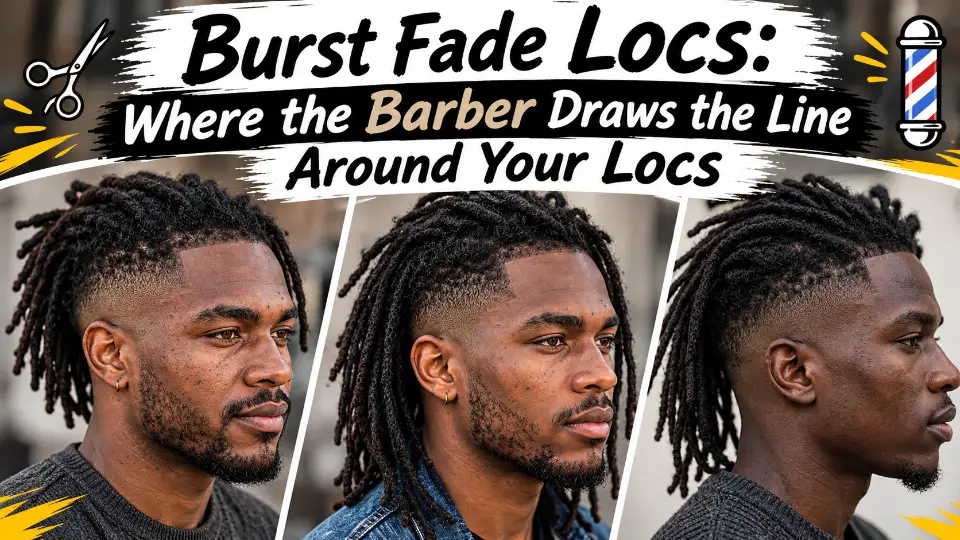
· A burst fade locs cut keeps your locs at full length and curves a clean fade around the ear, so the one rule that matters is agreeing the boundary before the clippers start.
· Choose the arc by the clear area you want: low clears little, mid clears a medium amount, high clears the most.
· Next step: pick an arc height and a finish, then photograph your locs styled, from three angles.
What a burst fade locs cut is and who does what
A burst fade with locs is a burst fade, a fade that curves around the ear, cut around locs that stay full length on top. The barber agrees the boundary between the locs and the faded sides before any clipper work. Your part is to keep the locs and the scalp clean and tidy.
The short hair in a burst fade never runs level around the head. Instead the line bends around the ear, beginning at the temple and falling to the nape, while hair behind the bend stays longer. With locs, the top is untouched and only the sides and the neckline change.
That split makes the job simple to describe. The locs set the length and the shape on top, and the haircut sets the arc and the clean edge. Start with our overview of burst fade styles to learn the arc itself, then plan the loc side of the cut.
Some shops say dreads for the same cut, and videos use both words. This page says locs and treats the two as one request. What counts is that you and your barber agree where the locs end and the fade begins.
What locs change about a burst fade
A standard burst fade works on loose hair that can be cut anywhere. Locs are fixed lengths of hair, so a clipper pass in the wrong place removes a whole loc and cannot put it back. One more reference: the burst fade versus drop fade comparison, if you want to see a lower curve.
| What changes | Standard burst fade | Burst fade with locs |
| The boundary | The barber blends into loose hair | The barber marks where the locs stop first |
| The arc | Sets the shape of the sides | Also sets how much clear area frames the locs |
| The roots | Loose hair hides the join | Loc roots show beside the clear area |
| Regrowth | The arc softens evenly | Short hair near the roots shows before the arc blurs |
Use the table as a checklist for the chair. Every row hands your barber a single decision on a burst fade locs cut: where to stop, how high to go and how to leave the roots.
Rules for the boundary, the arc and the loc length
The boundary rule. Agree the line between the locs and the faded sides before any clipper work, so no loc is cut by mistake. Point to it in the mirror, and ask the barber to say it back.
A good habit is to lift the locs out of the way yourself first. Then the barber sees exactly which hair belongs to a loc and which hair is open to cutting.
The arc and the loc roots. The arc wraps the ear while the locs begin higher up. A higher arc leaves a larger clean area, so it also leaves more of the loc roots on show.
Loc length. Starter locs, shoulder-length locs and long locs change how the sides frame the head. Short locs sit close to the clean area, while long locs hang over it and hide part of the arc.
The join. At the point where the arc touches the locs, request a gentle blend. A hard line can look like a gap beside the roots.
Guides disagree on the words. Some call the cut a burst fade, some call it a taper, and one looks at a drop shape. Show a photo and name the boundary, and the label stops mattering.
In short, you need four answers before booking: the boundary, the arc height, the loc length and the join.
Who cuts what and who looks after the rest
| The barber cuts | You look after |
| Marks the boundary and sets the arc | Keep your locs tied back in the chair |
| Blends the clear area beside the locs | Keep the locs and the scalp clean |
| Cuts the neckline | Lift the locs, never tug them |
| Re-cuts the arc | Book before the roots look untidy |
Haircuts and loc care are different kinds of work. The barber supplies the arc and the clean edge, and what you do to your locs at home is a different job with its own routine.
This guide covers the cut only. For anything about the locs themselves, ask the person who makes them.
Hair type, loc stage and face shape
Loc length and stage change how the cut is planned. The arc around the ear stays the same.
· Starter locs need a cautious boundary, since loose hair and new locs look alike.
· Short locs leave little room, so a low arc keeps the cut simple.
· Shoulder-length locs cover part of the arc when worn down.
· Long locs work best tied up if you want the arc to show.
· Curly roots show beside the clear area, so the barber softens the join.
For a wider look at coils, waves and braids with a burst fade, our Black men’s burst fade guide covers them. This page stays with locs.
Wondering about your face shape? Run a single photo through a face shape detector online and see what it says to “what is my face shape.” Use the answer only as a loose guide to how much loc length to keep near the front. The boundary, the arc height and the finish matter more for this cut.
What to ask the barber
| Part | What to say |
| Boundary | “Mark where the locs stop first.” |
| Arc height | “Low, mid or high burst arc.” |
| Finish | “Shadow finish or bare skin.” |
| Loc length | “My locs stay at this length.” |
| Neckline | “Rounded, squared or tapered.” |
Read the five parts out in one go: “Mark the boundary above the ear, mid burst arc with a shadow finish, locs stay as they are, rounded neckline.”
Bring three photos with your locs styled the way you wear them: front, side and back. The side shows the arc and the back shows where the locs fall.
Say the boundary first. It is the part most likely to go wrong on locs, and the rest of the request depends on it.
Burst fade locs in fifteen looks, grouped by what each one alters
Every look below changes one decision on a locs cut. Looks with their own page on the site stay short here and link out for detail.
Boundary and arc
These five looks vary the arc height and the way the arc meets the locs.
Full Locs Over a Low Arc

A low burst fade keeps the clean area small, with the boundary set high above the ear and the locs left at full length.
· Request: “Low burst arc, boundary kept high, locs left untouched.”
· Tip: Tie the locs up before the first clipper pass starts.
Crown Boundary With a Mid Arc

A mid burst fade climbs halfway up the side, so the boundary moves to the crown and more of the locs sit above clean hair.
· Request: “Mid burst arc, boundary at the crown, locs stay full.”
· Tip: Check the boundary line in the mirror before blending starts.
Locs Held Clear of a High Arc

A high burst fade clears a large area, so the locs are gathered and kept clear of the sides while the arc rises.
· Request: “High burst arc, locs gathered clear, boundary marked first.”
· Tip: Have the line pointed out to you before cutting.
Soft Taper Beneath the Locs

A burst taper fade replaces the clear edge with a gradual blend, so no hard line shows beside the roots of the locs.
· Request: “Burst taper under the locs, soft blend, no hard line.”
· Tip: Choose this if bare skin beside the roots feels too stark.
Shadow Edge Beside the Roots

Rather than bare skin, the fade ends in a soft shadow of short hair. The loc roots sit beside a gentle edge, and the arc still reads clearly.
· Request: “Burst arc ending in shadow, nothing bare by the roots.”
· Tip: Look at the shadow from the side, not just the front.
Loc length and shape
Here the five looks differ in how long the locs are or how they are worn.
Short Starter Locs Over a Clean Arc

Starter locs are short and still settling, so the barber keeps the clean area small and the boundary cautious. The arc stays soft, and the locs get room to grow.
· Request: “Small clean area, cautious boundary, starter locs left alone.”
· Tip: Show the barber which sections are your starter locs now.
Shoulder-Length Locs Worn Down

When shoulder-length locs fall over the sides, they cover part of the arc. The barber sets the arc a little higher so the clean edge still shows beside them.
· Request: “Arc a touch higher so it shows under locs worn down.”
· Tip: Wear your locs down when you sit in the chair.
Locs Tied Up in a Top Knot

Tying the locs up in a top knot lifts them off the sides, so the whole arc is visible. The barber keeps the boundary tidy because every line shows.
· Request: “Locs in a top knot, burst arc and boundary fully visible.”
· Tip: Bring a photo with the knot in the same spot.
Mohawk Strip of Locs

The locs are gathered on a centre strip over clean sides. The mohawk fade guide shows how the strip is cut and how wide to go.
· Request: “Centre strip of locs, burst arc on both sides.”
· Tip: Mark the strip width before the clippers touch the sides.
Loose Freeform Locs With a Clean Arc

Freeform locs vary in thickness and direction, so the boundary follows the hair where it grows. A clean arc below keeps the uneven locs looking tidy and deliberate.
· Request: “Clean arc under freeform locs, boundary follows how they grow.”
· Tip: Choose a soft join so the clean edge feels natural.
Pairings and finish
These five looks pair the arc and the locs with a beard, roots, a part, a longer back or a design.
Beard Running Into the Arc Beside Locs

A beard that runs into the arc ties the face to the clean sides. Our burst fade with beard guide covers how the join is cut.
· Request: “Burst arc that meets my beard, locs left full on top.”
· Tip: Say where the beard should meet the sideburn first.
Locs With Curly Roots Showing

Curly regrowth shows at the roots beside the clear area. Our burst fade curly hair page explains how the join is softened.
· Request: “Soft join where curly roots meet the clear area.”
· Tip: Show the barber where your curly roots begin first.
Locs With a Part Shaved In

A single part line is cut into the clear area beside the locs, next to the arc. The barber keeps the line short and simple so it stays sharp.
· Request: “One part line beside the locs, burst arc kept clean.”
· Tip: Check the part line’s placement against your photo first.
Locs With a Mullet Back

Long locs fall past the nape while the sides stay clean. The burst fade mullet guide explains the longer back, including how often it needs trimming.
· Request: “Locs kept long behind, burst arc wrapping both ears.”
· Tip: Say clearly that you are keeping the full length.
Carved Line Pattern Beside the Locs

A carved line sits inside the clear area next to the locs. Our burst fade design guide covers placement and upkeep for simple lines.
· Request: “One carved line in the clear area, locs left alone.”
· Tip: Pick a simple line, since fine lines blur first.
Upkeep and growing out
On a burst fade locs cut, short hair next to the roots grows in first, so aim for the early end of each window. Treat the windows below as typical ranges, since your barber sets the real date. Hair that reaches further down the back is handled in burst fade long hair.
| Arc height | Typical visit window | Why |
| Low burst | 3 to 4 weeks | The small clear area grows in gently |
| Mid burst | 2 to 3 weeks | Growth shows at a steady rate |
| High burst | 1 to 2 weeks | The large clear area grows back fastest |
| Clean-up line only | 1 to 2 weeks | The line near the roots blurs before the arc does |
No source gives an interval made for locs; quoted fade windows range from two to four weeks. Start from the table, then rebook once the roots look untidy.
For a grow-out, leave the locs alone and let the clear area fill back in. A low arc fills in the most slowly, which keeps the in-between weeks neat. Book a neckline clean-up between full cuts.
Getting the cut ready to wear
Wear a burst fade locs cut with little product, because the haircut already does the shaping.
1. Tie the locs back before you sit down.
2. Ask the barber to mark the boundary and show it to you.
3. Look at the arc side-on in a hand mirror.
4. At home, keep the clean area tidy with a gentle brush.
5. Rebook before the arc loses its edge.
Problems and fixes
Most problems on a locs cut come from an unclear boundary or a visit that came too late. Wearing the top as one central strip? Mohawk fade explains how the sides get cut around it.
| Problem | Fix |
| A loc was cut by mistake | Agree the boundary first next time and tie the locs back |
| Roots look untidy | Book a clean-up line sooner |
| Arc looks harsh | Request a gentler blend where they meet |
| Locs were pulled during the cut | Ask the barber to lift the locs, not pull them |
| Clear area grows in fast | Go lower or use a shadow edge |
Mistakes and who should pick another cut
· Skipping the boundary talk: say where the locs stop before the first pass.
· Leaving the locs loose: tie them back so the barber sees every line.
· Going higher than needed: a higher arc clears more and needs visits sooner.
· Forgetting the finish: name shadow or bare skin.
· Rebooking late: the roots look untidy and blur the arc.
Think twice about a burst fade locs cut if your locs are brand new and unsettled. Ask your barber for a cautious boundary first.
Burst fade locs questions answered
Do locs work with a burst fade?
Yes. A burst fade locs cut leaves the locs at full length on top and curves the fade around the ear. The barber agrees the boundary first, so no loc is cut by mistake, then sets the arc and the finish.
What does the barber do at the boundary between locs and fade?
The barber marks the line where the locs stop and the faded hair begins, then shows it to you. Only after you both agree does any clipper work start, which keeps every loc safe and the edge clean from the start.
Is there a best loc length for a burst fade?
There is no set length. Starter, shoulder-length and long locs all work, because the fade only changes the sides. Short locs sit close to the clean area, while long locs hang over it and may hide the arc. Ask for a quick check.
Are starter locs ready for a burst fade?
It can, with care. Starter locs are short and look like loose hair, so ask for a small clean area and a cautious boundary. Point out which sections are locs before the barber starts, and expect a softer, more cautious arc.
When should I rebook a burst fade with locs?
It depends on the arc. Low burst: three to four weeks. Mid burst: two to three. High burst: one to two. A clean-up line on its own has a separate window of one to two weeks, so book it between full cuts.
Which burst height suits locs?
A low arc keeps the clear area small and the cut simple. A mid arc sits in the middle and a high arc clears the largest area. Start low if you are unsure, then step up once you see how it grows.
Is a burst fade with dreads the same as with locs?
In practice, yes. Shops and videos use dreads and locs for the same cut: full-length hair on top with a fade curved around the ear. Use whichever word you like, and show a photo so the barber reads it the same way.
Can I wear locs up with a burst fade?
Yes, and tying them up shows the whole arc. A top knot lifts the locs off the sides, so the barber keeps every line tidy. Bring a photo with the locs worn the same way you plan to style them.
How do I keep the loc roots tidy between visits?
Brush the clean area gently, keep the locs and scalp clean, and avoid trimming your own line at home. Home trims tend to creep upward. Book a clean-up line within one to two weeks when the roots start to look untidy.
Can a burst fade with locs include a mohawk?
Yes. The locs gather on a centre strip while the arc curves around each ear. Decide how wide the strip should be before sitting down. Our mohawk fade guide covers the strip cut and its width choices in more detail.
What details about my locs does the barber need?
Name the boundary, the arc height, the finish and the neckline. Say how long your locs are and whether they are new. Bring front, side and back photos with your locs styled, and ask the barber to repeat the plan.
Can a beard join the arc beside my locs?
Yes. The beard meets the arc at the sideburn, and the locs stay full on top. Tell the barber where the beard should join the sideburn, and agree the boundary first so the beard line and the arc match from the first pass.
How does a burst differ from a taper when the top is locs?
A burst fade curves around the ear and clears a visible area, while a taper blends gradually with no hard edge. With locs, a taper keeps more hair beside the roots. Choose the burst for contrast and the taper for softness.
Can I let a burst fade grow out while keeping my locs?
Keep the locs as they are and let the clear area fill in. A low arc fills in slowest, so the weeks between cuts stay neat. Book a neckline clean-up between full cuts and avoid trimming the arc yourself at home.
Should I attempt a burst fade on locs myself?
It is risky. The curve is harder to cut than a straight line, and a clipper pass in the wrong place removes a whole loc. A barber who marks the boundary first is the safer choice at the chair for this cut.
Before you book
A burst fade locs cut stays easy to wear when the boundary is clear and the arc is soft. Settle the boundary before anything else, then pick the height and finish, and bring photos from the front, side and back.
Editorial Note
This guide gives general grooming information and is not medical advice. Run each detail past your barber first. See a board-certified dermatologist if your scalp stays sore after a cut

