
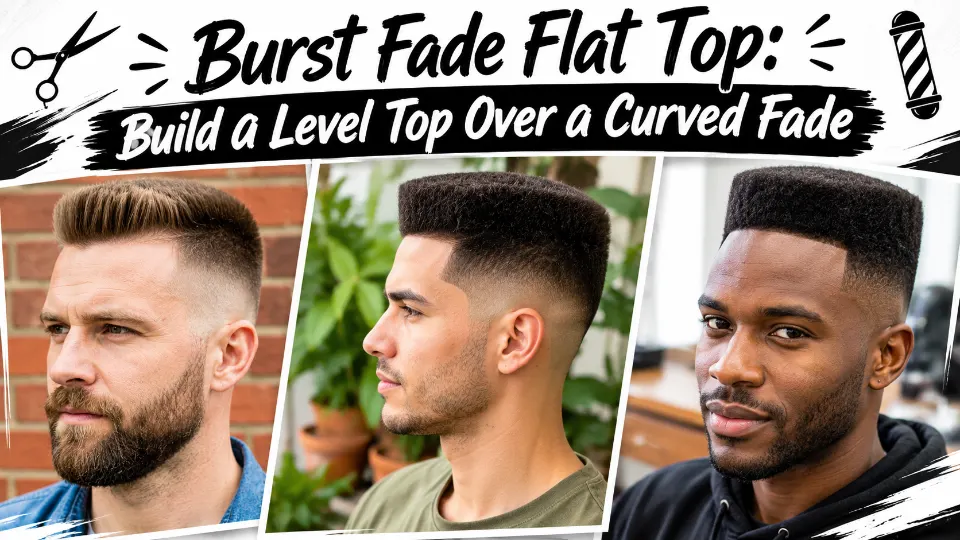
Burst Fade Flat Top: Build a Level Top Over a Curved Fade
Before You Book: The Essentials
• A burst fade flat top is a curved burst fade at the ears under a top cut level like a shelf.
• Three choices shape it: how tall the top stands, how sharp the corners are and how high the burst starts.
• Your hair decides whether a burst fade flat top works, because the top has to stand up on its own.
• Find your box among the 23 looks below, each with words to say.
Burst Fade Flat Top or Plain Flat Top
A burst fade flat top sits a level top on a burst fade, the fade that sweeps in an arc around each ear. The curve stays at the sides, and the cut itself gives the top its shape, so the hair must be short and stiff enough to stand without help.
A plain flat top usually drops to a straight taper or fade. The burst swaps that straight line for a curve around the ear, which leaves a rounder base under the box.
The curve also changes how the box reads from behind. A straight fade cuts a hard line across the head, while the burst curves around the ear and keeps the back softer. That softer back is why many men choose the burst version.
A faux hawk raises a soft strip with styling, while a flat top squares off the whole top with the cut. Barbers label these cuts differently, so bring a photo.
Top Height, Corners and Burst Height
| Choice | What it decides | What to tell your barber |
| Top height | How tall the box stands | A length in inches, measured dry |
| Corners | How sharp the outline reads | Square or rounded |
| Burst height | Skin showing and contrast strength | Low, mid or high |
Settle these before you choose a product. When the three suit each other, a burst fade flat top looks deliberate instead of boxy. The same three choices run through every look below, so read this table once and the request lines will make sense.
How Tall the Top Should Stand
| Top height | What it gives | Best fit |
| About 1 in | A close, crew-style box | Men who want almost no styling |
| 1.5 to 2 in | An everyday box with room to level | Most men with stiff hair |
| 3 in or more | A tall box with a strong silhouette | Thick, coarse or tightly curled hair |
These heights are typical and measured dry. Fine hair tends to droop when it grows long, so keep it shorter. Coarse or tightly curled hair holds a taller box. A side photo shows your barber exactly which height you want.
Height also changes the upkeep. A taller top needs more product and a steadier hand to stay level, while a short top mostly needs a trim. If you are unsure, start at two inches and go taller next time, because hair can be cut shorter but never longer. A burst fade flat top rewards that patience.
Cutting the Flat Plane With Comb and Clippers
Your barber starts with the burst at each ear, then builds the top above it. A flat top comb lifts the hair straight up, and the clippers run across the comb to cut one level surface.
The barber sets the guide length first and works outward from it, one section at a time. Flatness gets checked from the front, the side and the back, because a small dip shows from the side.
At the join, clipper over comb blends the top into the burst so no heavy line sits at the edge. Skilled hands matter here, so a burst fade flat top is not a cut to try at home. It also asks for more checking than most fades, because the curve and the plane must meet cleanly.
The corners blur first as hair grows unevenly. Ask whether the barber squares them with clippers or scissors, and keep the same method at each visit.
How Burst Height Changes the Box
| Burst height | What it does to the box | Refresh pace |
| Low | A quiet box with fuller sides | The longest window |
| Mid | A balanced box and sides | A middle window |
| High | A tall, bold box with more skin showing | A shorter window |
| Skin finish | The sharpest edge between box and sides | The shortest window |
A higher burst makes the top look taller, since more skin shows beneath it. A low burst keeps the sides closer in length to the top, so the box looks calmer. A very tall top over a very high burst can read as a tower, so keep one of the two in check.
Blended Join or Stepped Join
In a blended join, the hair shortens smoothly from the top into the burst and no line appears, so the box grows out of the sides. A stepped join, often called high and tight when the sides are very short, leaves a clear step under the top, so the box sits apart like a cap.
Rounded corners and a low burst go well with a blended join, while square corners and a high burst pair with a step. Ask your barber to point to where the top begins before the final pass.
A stepped join shows regrowth sooner, since the step blurs as the sides grow. A blended join forgives a late visit. Choose by how often you plan to sit in the chair.
23 Ways to Wear a Level Top Over a Burst
Every look ends with a request line you can read aloud and a tip for the chair.
How High the Top Stands
The first five looks vary in height, from a close crew-style box to a tall one.
Short Flat Top, About an Inch High
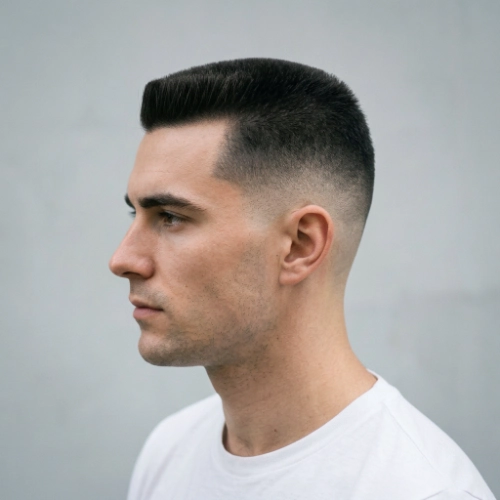
A short flat top keeps the hair near an inch high, which gives a close, tidy box. It is simple to level, and it shows the burst curve clearly at each ear.
• Request: Top at one inch, razor-flat, burst at ear level.
• Tip: Keep a small comb handy to check the level.
Everyday Flat Top, Two Inches Level

Two inches gives enough height to stand clearly while staying easy to level. Most stiff hair holds this height without much product, and the burst frames it neatly.
• Request: Two inches dry, level top, low burst, squared sides.
• Tip: Choose this height if you are trying a flat top first.
Tall Flat Top Standing Three Inches or More

A tall flat top lets the box stand three inches or higher for a strong silhouette. It needs thick, coarse or tightly curled hair, because soft hair cannot hold that height.
• Request: Stand it three inches or taller, sharp corners, high burst.
• Tip: Dry the roots upward first so the height holds.
Front Raised for a Sloped Top

The barber leaves the front a little taller and lets the top slope gently toward the crown. The slope adds height at the hairline while the surface still reads as level.
• Request: Front slightly taller, gentle slope back, mid burst, square sides.
• Tip: Show a side photo so the slope stays subtle.
Crew-Style Flat Top Kept Close

A crew-style flat top stays short and tight with a barely raised surface. For other close-cropped options, open the short burst fade page.
• Request: Crew-style top, cut level, low burst, no styling needed.
• Tip: Skip heavy product, since the short top needs none.
Corners and Surface
Four looks follow the shape of the box itself, from sharp corners to a softer finish.
Square Corners Left Sharp

Square corners give the box its strongest outline. The barber squares the sides and the back so the edges meet at clean right angles from every side view.
• Request: Sharp square corners, level top, two inches, squared back.
• Tip: Expect a refresh sooner, since sharp edges blur first.
Rounded Corners for a Softer Box

Rounded corners soften the box and make it feel less severe. The top stays level, but the edges curve slightly, which suits men who want shape without a hard look.
• Request: Rounded corners, level top, mid burst, softened edges all round.
• Tip: Let the barber round each corner to suit your head.
Dead-Level Top Cut Over the Comb

The barber cuts across a flat top comb so every strand ends at the same height. Checking the surface from the side catches any dip before the cut is finished.
• Request: Level top cut over a comb, checked from the side.
• Tip: Watch the mirror while the barber checks the plane.
Textured Flat Top With Soft Movement

Soft texture keeps the surface level but breaks up the solid look. Light separation on top makes the box feel relaxed and suits hair that is slightly less stiff.
• Request: Level top with light texture, rounded corners, mid burst.
• Tip: Work matte clay through with your fingertips, then stop.
Starting Points for the Burst Curve
Five looks change with how high the burst begins and how the sides finish under a burst fade flat top.
Low Burst Leaving the Box Quiet

A low burst keeps the sides fuller by starting well above the ear. Anyone choosing a gentler curve will find the low burst fade page useful.
• Request: Burst starting low by the ear, softly rounded corners.
• Tip: Choose a low burst if the box must stay discreet.
Mid Burst Squaring the Profile

A mid burst sits at ear level and squares up the profile. Mid height is explained fully on the mid burst fade page.
• Request: Mid-height burst, an even box, squared corners all round, please.
• Tip: Pick mid height when you want balance, not drama.
High Burst Beneath a Tight Tower

A high burst reaches the temples, so the box towers over bare sides. The high burst fade page details how much skin to expect.
• Request: Burst up to the temples, three inches of height, sharp corners.
• Tip: Keep the top full so the tower does not look thin.
Skin Burst Sharpening the Box

Bare skin at the burst draws a crisp line between the sides and the box. The contrast is the sharpest of any finish, and regrowth blurs it within a couple of weeks.
• Request: Bare skin under the burst, square box, sharp corners.
• Tip: Rebook within two weeks to keep the skin edge crisp.
Burst Taper Softening the Sides

A burst taper graduates the length from the ear to the top, so the box sits on softer sides. The burst taper fade page covers it.
• Request: Gradual burst taper, no skin showing, rounded box edges.
• Tip: Choose this blend if you dislike a harsh contrast.
Edges and Details
Here the focus moves to the borders around the box and the small details at its edges.
Line-Up Framing the Flat Edge

The barber outlines the forehead and temples with a sharp line-up, giving the front edge a clean border. A level top looks deliberate with that edge in place.
• Request: Sharp razor line at forehead and temples, top left level.
• Tip: Soften the line-up a little if your hairline is uneven.
Temple Edge Kept Clean Beside the Burst

A neat temple edge removes stray hair beside the box without cutting into the burst. The curve at the ear stays intact, so the temple and the arc read as separate lines.
• Request: Tidy the temples only, keep the burst arc untouched.
• Tip: Point out where the burst starts before the barber trims.
Hard Part Marking the Flat Top

A single shaved line across the top adds a small accent without disturbing the level surface. Browse the burst fade design guide for other details.
• Request: A hard part on the left, razor line only, nothing extra.
• Tip: Choose the side where your hair already parts naturally.
Beard Fading Into a Burst Beneath the Flat

Beard hair stops where the burst curve begins, so face and head share one outline. Choosing a beard length? Open the burst fade with beard page.
• Request: Beard tapered at the sideburn, curve untouched, two-inch top.
• Tip: Keep the beard edge as clean as the top.
Neckline Squared Behind the Burst

The barber squares the nape so the back of the head matches the level top. A straight neckline finishes the box from behind and ties it to the burst.
• Request: Straight, squared neckline that meets the burst curve cleanly.
• Tip: Check the back with a hand mirror before leaving.
Hair Types Compared
The last four looks change with your hair type, since the top has to stand on its own.
Thick Straight Hair Held Level

Thick straight hair holds a level top once weight is removed. Straight strands get their own treatment in the burst fade straight hair guide.
• Request: Thinned weight, level top, two to three inches, mid burst.
• Tip: Use a firm product, since straight hair slides flat.
Coily Hair Packed Into a Level Top

Dense coily hair stands into a level top with a clean burst beneath. Find more textured options in the Black men burst fade guide.
• Request: Coily hair, level top, high burst, clean arc at the ear.
• Tip: Use a wide-tooth pick to lift the top evenly.
Curls Trained Into a Level Plane

Curls can form a level plane when the barber cuts them dry and keeps extra length. The top sits flat once they spring back.
• Request: Curls cut dry, level plane, extra length, mid burst.
• Tip: Judge the level only after the curls have settled.
Fine Hair Kept Short and Dense

Fine hair holds a flat top best when it stays short, because long fine hair droops. Keeping the top near an inch and a half helps it stand and look dense.
• Request: Fine hair, one and a half inches, level top, low burst.
• Tip: Use light powder for grip instead of heavy product.
Style It Upright
Styling supports the cut, but hair under a burst fade flat top needs hold to stay up. Name product types, never amounts, and build up slowly, since heavy product drags the top down.
| Version | What changes | Product |
| Upright | Dry the top straight up, then smooth it level | A strong-hold, matte type |
| Relaxed | Comb the top lightly and skip the smoothing | Little or none |
1. Start with clean, towel-dried hair.
2. Blow-dry the top straight up with a brush or your fingers.
3. Work a strong-hold product through the roots to lock the height.
4. Smooth the top level with your palm.
5. Check the surface from the side in a mirror and fix any dip.
Thick or coarse hair often stands with little help. Fine hair needs a lighter product and a shorter top. If your top lies flat after a few hours, ask for a shorter cut before you buy a stronger product.
Your Hair, Your Hairline and the Box
| Hair type | What changes in the cut | Watch for |
| Thick or coarse | Level top held with little product | Bulk that makes the box too wide |
| Coily | Dense top kept level, burst clear of the ear | A top that hides the burst |
| Thick straight | Weight thinned, firm product | A top that slides flat |
| Curly | Cut dry, extra length kept | Shrinkage that hides the height |
| Fine | Short top, light powder | Drooping past about two inches |
| Wavy | Shorter top, strong hold | Waves that break the plane |
A receding hairline needs your barber’s call. A level front with a crisp line-up can frame it, but a thin front rarely stands. Face shape counts for little here, and your hair type counts for much more. To find out what is my face shape, run your photo through the free face shape detector.
Flat Top Beside Crew, Caesar and Buzz
Several short cuts sit close to a burst fade flat top, so this table shows where each one fits.
| Cut | Pick it if |
| Crew cut | You want short hair with a slight slope and no sharp box |
| Buzz cut | You want one even length and no styling |
| Caesar | You want a short, forward-brushed top with a straight fringe |
| Faux hawk | You want soft height that fades into the sides |
| Mohawk | You want a strip with hard sides |
Sharp Corners Between Barber Visits
| What | Typical window | What loses shape first |
| Burst curve and sides | Low burst three to four weeks, mid two to three, high one to two | The arc behind the ear |
| Softer or blended sides | Three to four weeks | The blend into the top |
| Skin finish | The short end of the range | The skin line |
| Top plane | About every three to four weeks | The corners and the level |
Treat these as typical windows for a burst fade flat top. The corners and the skin line blur first, so book when the box looks soft.
Exact Words for the Chair
• Show a side photo of the top and a front photo of the corners.
• Give the top height in inches and the corner shape.
• Ask the barber to explain how the top will join the burst.
• Ask what the barber will do about the corners before the first pass.
Try this line: “Burst fade, mid burst, two inches dry, level top, square corners, joined smoothly to the burst.” Swap in your own picks. Avoid vague labels like classic or modern, because every barber reads them differently.
| Hair type | Line to read aloud |
| Thick or coarse | Burst fade at mid height, top two to three inches, square box. |
| Coily | Burst fade, high burst, dense level top, clean arc at the ear. |
| Fine | Burst fade, low and soft, short dense top, light finish. |
| Curly | Burst fade, curls cut dry and left long, plane leveled once they settle. |
Five Slips That Spoil the Box and Who Should Choose Differently
• Choosing a top too tall for soft hair: keep it near an inch and a half so it holds.
• Skipping the side check: have the barber hold a mirror beside the top before finishing.
• Using a heavy, shiny product: pick a firm matte type so the surface looks even.
• Pairing a tall top with a very high burst: lower one of the two so the cut does not look like a tower.
• Waiting too long between visits: book early, because the corners blur first.
If your hair is fine, wavy or soft, ask your barber about a lower, rounder cut instead. If frequent visits are hard to fit in, pick a low burst and rounded corners.
Frequently Asked Questions
What changes when you add a burst fade to a flat top?
Add a burst and the straight fade line at the sides becomes a curve around each ear, so the box sits on a rounder base. The level top itself does not change, and the hair on top still needs to stand on its own.
How much hair do you need on top for a flat top?
About one inch is the minimum for a clear box, and two to three inches gives the standard height. Your hair type matters more than the number, since soft hair droops when it is long. Measure dry and let your barber decide.
Can you cut a burst fade flat top at home?
It is a hard cut to do alone. The top must stay level from every angle, and you cannot see the back or sides well. A barber uses a comb to guide the clippers and checks the plane in a mirror, so book it.
Which hair types hold a flat top?
Thick, coarse and tightly curled hair holds the box best, because it stands up on its own. Thick straight hair can work with a firm product. Fine or wavy hair struggles to stand, so keep the top short and dense, and ask your barber how much it will hold.
What does a higher burst do to a flat top?
Raising the burst exposes more skin, which stretches the top visually and sharpens the contrast. A lower burst leaves fuller sides and a calmer box. Pick the height by how bold you want the outline to be, and by how often you can visit.
How many weeks can a flat top burst go untouched?
Book the burst and sides every three to four weeks for a low burst, two to three for a mid and one to two for a high, and the top every three to four. Corners and skin lines blur first, so expect the sharp parts to fade soonest. Softer, blended versions can stretch a little longer between visits, and a low burst forgives the most.
Final Thought
Settle the top height first, then the corners and the burst, and let the join finish a burst fade flat top that suits your hair. For other cuts, see the full set of burst fade guides.
Editorial Note
What you read here is general grooming advice and not a medical opinion. The final call on height, corners and the join belongs to your barber, who can feel your hair and see your head. See a board-certified dermatologist if itching, flaking or breakage lasts.
Sources and Review
Last reviewed on 4 November 2026 by Jamshed Raza, a professional barber at Professor Gents Saloon, 43rd St, Al Dhahir, Abu Dhabi, UAE, who checked the cut descriptions, top heights and barber wording on this page for accuracy.
Written by Joseph J. Dennis.
Sources: London School of Barbering and the American Academy of Dermatology (hair and scalp care).

