

Burst Fade Caesar Cut: Short Fringe, Curved Sides and What to Tell Your Barber
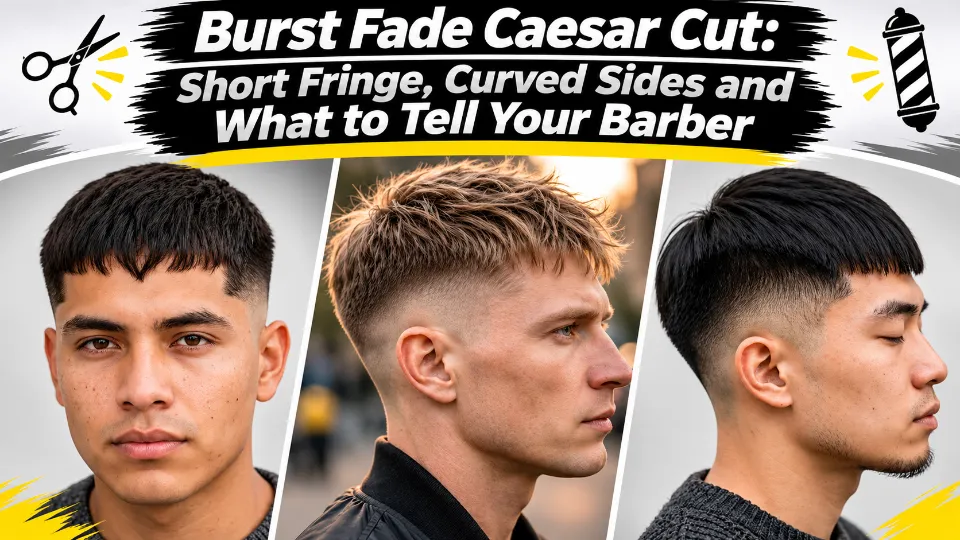
Short Answers for Booking Day
• A burst fade caesar cut pairs the short, straight Caesar fringe with a fade that curves around each ear, and skin is optional.
• Settle the fringe length first, then the burst height, and say both when you sit down.
• Rebook the sides sooner than the fringe, since the arc blurs first.
Burst Fade Caesar Cut: Where the Straight Fringe Meets the Curve at the Ear
A burst fade caesar cut joins the Caesar cut with a burst fade at the sides. A short top carries a straight fringe combed forward, and the sides and back bend in an arc around each ear. Skin is optional.
The Caesar cut is the front of the haircut. Up top, the hair is cut short and level, with a fringe that runs straight across the forehead. Nothing about that part changes when a burst is added.
The burst covers the sides. Rather than fading straight across the temple, the fade bends round the ear and often leaves a little more hair at the nape. Some shops call this a burst cut.
Together they give a compact, tidy shape. The straight fringe draws a flat line across the top, and the curve gives the sides a rounded finish.
Shops use the names loosely. Some barbers call every short crop a Caesar, and others reserve the word for a clear, straight fringe. Here, Caesar cut means a short top with that straight fringe.
Diagram 1: Caesar cut, burst and the pair drawn as front-view head outlines with fringe and fade band.
Caesar Cut, Burst and Both: What Each Part Covers
The names overlap, so the table sets out what each part covers in this guide.
| Cut | What it does | What you see |
| Caesar cut | Keeps the top short with a straight fringe | A flat fringe line across the forehead |
| Burst | Fades in an arc around the ear | Neat ears and a fuller nape |
| Both | Pairs the straight fringe with the arc | A flat front above rounded sides |
A Fringe Alone, With Plain Fade Sides
A plain Caesar cut keeps the same short top and straight fringe, but the fade on the sides can be anything. It often runs straight across, so nothing curves round the ear.
A Curve Alone, Under Any Top
A burst on its own can sit under any top, long or short. The arc is there, but the hair above it has no set length and no fringe rule.
Fringe and Curve Together
With both, the fringe sets the front and the burst sets the sides. Fringe length and arc height are separate choices, so one can move without the other.
Close Cousins and How They Differ
Four nearby cuts get mixed up with the Caesar. Each has its own page, so only the main difference is given here.
| Cousin | Main difference from the Caesar cut |
| French crop | A longer, textured top with the fringe pushed forward |
| Edgar | A blunt, squared front edge with a very sharp line |
| Crew cut | A top that shortens toward the back and has no set fringe |
| Buzz cut | One short length all over, with no fringe at all |
Which Name to Ask For
• Say Caesar cut when the straight fringe is the main point and the sides are open.
• Say burst when the ear curve is the main point and the top can be anything.
• Say burst fade caesar cut to ask for the fringe and the curve in one go.
Labels shift between shops, so bring a photo to settle any doubt.
Fringe Length, Top Length, Side Finish and Burst Height
Start at the front, because the fringe decides the look.
About one to two inches is typical for the top, and the fringe usually sits at about half an inch to one inch. Sources give anything from half an inch to two inches in total, and one gives a few inches on top, so treat these figures as a guide and let the barber match your hair.
Side finish matters as much. Skin gives the sharpest contrast but needs the most trims. Very short is cleaner and calmer, and a shadow finish leaves a faint trace of hair that reads softest. Skin and bald mean the same thing here, so only one needs saying.
| Height | Where it starts | What it does beside a short top |
| Low | Just above the ear | Keeps more weight at the sides and looks calm |
| Mid | Halfway up the side | Gives a clean step below the fringe |
| High | Near the temple | Gives the strongest contrast and needs more trims |
A low burst fade caesar cut stays quiet, a mid burst fade caesar cut balances the fringe and the arc, and a high burst fade caesar cut gives the boldest contrast. If you are unsure, go mid and adjust at the next visit.
Low, mid and high are labels, not measurements, so a picture is the safest way to agree on one.
Hair Type First, Then a Quick Look at Face Shape
• Straight hair: shows each edge, so ask for a very clean fringe line.
• Wavy hair: tends to lift, so keep the top short enough for the fringe to stay flat.
• Coily hair: springs up and hides length, so pull a section straight before picking the fringe.
• Thick hair: may need bulk thinned inside so the fringe sits flat.
• Fine hair: gains body when cut blunt and kept short.
Anyone asking what is my face shape can start with a face shape detector online, which reads one clear photo and offers a first answer. Take that result to the chair, where the barber can assess the head properly and set the fringe length and burst height.
Telling the Barber What You Want, Line by Line
Four details cover the whole request. Keep each one short and plain, and the result is less likely to surprise you.
| Part | What to say | Example |
| Fringe | Length and edge | Straight across, about half an inch |
| Top | Length and texture | About one to two inches, smooth |
| Burst | Height and finish | Mid burst, shadow finish |
| Photos | Front, side and back, all dry | Fringe, arc and nape visible |
A front photo shows the fringe, a side photo shows the arc and a back photo shows the nape. Before the final pass, ask for both ears to be checked against each other.
A short script works: a straight fringe near half an inch, a top around one to two inches, a mid burst on both ears and a shadow finish, then the photos. That covers what the words Caesar and burst leave open.
Forty Burst Fade Caesar Cut Looks, Grouped by Fringe, Burst and Hair
Below, each look describes the fringe, the top and the burst in simple terms. Pick the nearest match, read its Request line aloud and check the Tip for a final detail.
How Long the Fringe Runs and How It Ends
Only the fringe changes across these five, in length and in edge.
Ruler-Straight Fringe Resting Above a Close Burst
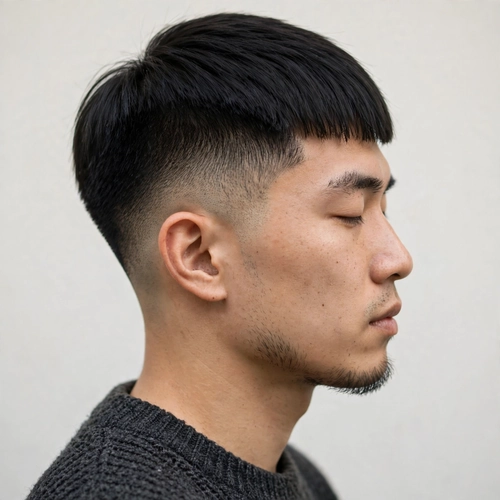
The fringe is cut dead straight and rests just above the brow. A close burst frames each ear beneath it, and the flat line against the curve defines the look.
• Request: Close burst, flat Caesar fringe set straight above the brow.
• Tip: Hold a mirror up to check the fringe line.
Short Fringe Sitting High on the Forehead

The fringe is kept short and sits high on the forehead, leaving the brow fully open. A mid-height burst curves round each ear and gives the sides a calm outline.
• Request: High-set fringe on a short Caesar top, mid burst alongside.
• Tip: Say how high the fringe should sit before cutting begins.
Longer Fringe Brushed Down to the Brow Line

The fringe is left a little longer and brushed down toward the brow line. Hair around it stays short, and a burst curves very smoothly past each ear.
• Request: Let the Caesar fringe grow slightly, burst fade round both ears.
• Tip: Keep the extra length in the fringe only, not the crown.
Softened Fringe Edge Broken Up With Point Cutting

The fringe edge is point cut, so the line looks softer than a blunt finish. A burst rounds off the sides while the front stays relaxed and easy.
• Request: Softly point cut fringe, Caesar proportions, burst fade finish.
• Tip: Say point cutting by name so the edge is not blunt.
Fringe Combed Slightly Off Centre With a Burst at the Ears

The fringe is combed slightly off centre, which stops the front from looking too flat. A burst stays tight around the ears and the top remains quite short.
• Request: Caesar style, fringe parted a touch off centre, tight burst.
• Tip: Show which side the hair naturally falls toward when dry.
Burst Start Height and Side Endings
The arc moves up or down here, and the finish of the sides changes with it.
Low Burst Hugging the Ear Under a Short Even Top

The burst starts low, close to the ear, so the sides carry some weight beneath a short even top. It is the calmest burst fade caesar cut of the group.
• Request: Keep the burst low and even under a Caesar crop.
• Tip: Choose this height when the least contrast is the goal.
Halfway Burst Giving a Clean Step Below the Fringe

A halfway burst creates a clean step beneath the fringe. The arc starts about midway up the side, so the sides look quite neat without ever being stark.
• Request: Mid burst fade caesar cut, clean step under the fringe.
• Tip: Bring a photo so halfway means the same to both.
Tall Burst Arc Stopping at the Temple Beside a Short Top

The burst rises toward the temple and gives the strongest contrast beside a short top. The fringe stays straight, so the shape looks bold but still very neat.
• Request: Burst up to the temple, Caesar fringe straight and short.
• Tip: Book sooner, since high bursts show regrowth very quickly.
Skin Finish Burst Beneath a Tidy Fringe

The sides are taken to skin, with the fade curving round the ear beneath a tidy fringe. This finish shows the burst clearly and suits a very clean appearance.
• Request: Bare skin sides blending into a burst, then a Caesar fringe.
• Tip: Reserve the next visit now, because skin grows in fast.
Shadow Finish Burst With a Gentle Step to the Top

A shadow finish leaves a faint trace of hair, so the burst looks softer and the step up to the top feels gentle. A short, straight fringe sits above it.
• Request: Soft shadow burst below a neat Caesar fringe, gentle transition.
• Tip: Say shadow rather than skin if some softness is wanted.
Top Texture
The cut stays the same here, and the top gets a different finish.
Smooth Top Combed Flat Into the Fringe

The top is combed flat into the fringe, so the whole front looks smooth and even. A burst at the sides gives that clean surface a curved frame.
• Request: Caesar top smooth and flat, burst curving round each ear.
• Tip: Comb forward after a quick spritz of water on the top.
Matte Textured Top With Loose Choppy Ends

The top carries loose, choppy ends that give the cut a lived-in feel. The fringe keeps its straight line while the burst gives the sides a clear shape.
• Request: Roughed-up ends on the Caesar top, burst kept tight.
• Tip: Ask for texture on the top only, fringe left clean.
Messy Top Pulled Forward by Hand

Hair is pulled forward by hand instead of combed, so the fringe falls in a relaxed, uneven way. The burst round the ear gives the cut a deliberate finish.
• Request: Tousled Caesar top pulled forward, burst round the ears.
• Tip: Use dry fingers, because a comb flattens the loose effect.
Light Layers on a Short Top Above Burst Sides

Light layers are cut into the short top so the hair sits with more movement. The fringe still runs straight across, and the burst curves past the ear.
• Request: Lightly layered Caesar crop with a burst fade either side.
• Tip: Ask for the layers to be soft, not stepped.
Front Lifted Slightly Above the Fringe Line

The very front is lifted slightly above the fringe line, which adds a little height without turning the cut into a quiff. The burst frames the ears below.
• Request: Caesar crop with a raised front, mid burst, tidy sides.
• Tip: Lift the first inch with a dryer, then smooth it forward.
Looks for Each Hair Type
Hair type decides the tweaks in these five.
Pin-Straight Hair Brushed Evenly Over the Brow

Straight hair is cut flat against the forehead, and every single edge shows clearly. The burst gives the sides a rounded shape beneath the very neat, even top.
• Request: Precise Caesar fringe on straight hair, burst finished cleanly.
• Tip: Ask the barber to trim the fringe dry last.
Wavy Top Held Short So the Fringe Stays Neat

Wavy hair is held short so the fringe stays flat instead of lifting. A burst finishes the sides while the waves also add gentle movement across the top.
• Request: Wavy hair held short as a Caesar crop, burst fade.
• Tip: Keep the top short so the waves do not spring up.
Curly Top Cropped Close With a Defined Fringe

Curly hair is cropped close with a clear fringe line, so curls stay tidy. The burst fade for curly hair guide covers more curl choices.
• Request: Tight crop on the curls, Caesar shape kept, burst at ears.
• Tip: Cut the fringe curl by curl rather than as one block.
Dense Coils Kept Short Next to the Burst Edge

Dense coils are kept short beside the burst edge, so the top looks full without growing outward. The fringe is shaped carefully and the sides stay very crisp.
• Request: Caesar crop on coils, defined edge, burst fade at sides.
• Tip: Stretch the hair first, then judge the true length.
Thick Hair Reduced Inside to Sit Flat

Thick hair is reduced from the inside so it sits flat beneath the fringe instead of pushing out. The burst trims the sides back to a light, clean outline.
• Request: Take weight from thick hair, Caesar fringe flat, burst sides.
• Tip: Ask for bulk to be removed where hair sits heaviest.
Density and Hairline Looks
These five suit hair that is fine, thin or uneven at the front.
Fine Hair Cut Blunt to Look Fuller

Fine hair is cut blunt, which gives the top a thicker look, and the fringe is kept straight. A soft burst stops the sides from overpowering the front.
• Request: Fine hair cut blunt, Caesar style, softer burst finish.
• Tip: Skip heavy product, which flattens fine hair very quickly.
Thin Hair Left a Little Shorter on Top

Thin hair is left a little shorter on top, so the fringe still looks even and well formed. The burst hugs the sides and gives the whole shape a clear edge.
• Request: Shorter top for thin hair, Caesar shape, even fringe, burst.
• Tip: Request light thinning only, since fine hair has little to spare.
Short Fringe Worn With Thinner Front Corners

The fringe is cut short and straight, with the front corners following the natural hairline. The burst finishes the sides while drawing very little attention to those corners.
• Request: Caesar fringe that respects the hairline, burst fade round ears.
• Tip: Show a photo of the hairline before the first cut.
Cowlick at the Front Worked Into the Fringe Direction

A front cowlick is worked into the direction of the fringe instead of being cut against it. The burst finishes the sides while the top follows its natural lean.
• Request: Follow the cowlick with the Caesar fringe, burst fade both sides.
• Tip: Show the barber exactly where the cowlick sits on the head.
Widow’s Peak Left Visible Under a Short Fringe

A widow’s peak is left visible and the fringe is cut short and straight beneath it. A crisp burst at each ear balances the sides and finishes the look.
• Request: Show the peak, cut a short Caesar fringe below, burst fade.
• Tip: Ask the barber to cut around the peak, not over it.
Neckline and Back
Only the shape of the back changes in these five.
Rounded Neckline Below a Burst Fade Caesar

The neckline is rounded and follows the curve of the burst, so the back looks soft and finished. At the front, hair stays short, with the fringe lying flat across the forehead.
• Request: Burst fade caesar cut finished with a rounded neckline.
• Tip: Ask to see the finished back shape in a mirror.
Squared Neckline With Sharp Corners

The neckline is cut square, with sharp corners that give the back a very crisp edge. The burst curves round the ear and the fringe stays straight across.
• Request: Crisp square neckline, Caesar top, burst starting mid-side, tidy ears.
• Tip: Expect square corners to blur fast, so rebook early.
Tapered Neckline Fading Into the Skin

The neckline tapers away into the skin, so there is no hard line at the back. The burst round the ear carries the same softness to the sides.
• Request: Caesar top, burst sides, neckline tapering softly to skin.
• Tip: Ask where the taper finishes compared with the burst.
Back Left Slightly Fuller Than the Sides

The back is left slightly fuller than the sides, which gives the burst a clear job shaping the ear area. Top and fringe stay short, with a straight line across the front.
• Request: Keep some fullness at the back, Caesar top, burst at ears.
• Tip: Tell the barber exactly where the fuller part should stop.
Clean Line Around the Forehead and Temples

A clean line is cut around the forehead and temples, which sharpens the frame of the fringe. The burst finishes the sides with a smooth, even arc around the ear.
• Request: Sharp forehead line-up, burst at the temples, Caesar fringe.
• Tip: Ask for the line-up last, once the shape is settled.
Add-Ons and Sides
Each of these five adds something to the base cut, from a beard to a new top direction.
Trimmed Beard Meeting a Close Burst Side

A trimmed beard joins the burst neatly at the sideburn, and the burst fade with beard page plans that join at every beard length.
• Request: Caesar crop, burst fade, beard blended in at the sideburn.
• Tip: Touch the spot on your cheek where the beard begins.
Shaved Part Cut Into the Side Above the Burst

A shaved part is cut above the burst, and the burst fade design guide offers more line ideas that suit a Caesar top.
• Request: A single shaved part above the burst on a Caesar crop.
• Tip: Check how many weeks pass before the shaved part needs redrawing.
Short Caesar With a Long Back Section

The back stays longer behind short burst sides, and the burst fade mullet page covers how long that section can go safely.
• Request: Longer back, burst sides, Caesar top kept short and tidy.
• Tip: Agree on the final back length before cutting starts.
Sideburns Cut Short and Square Beside the Burst

The sideburns are cut short and square beside the burst, which gives the sides a very controlled finish. The fringe stays straight across and the top stays short and even.
• Request: Sideburns cut short and square, burst fade, Caesar fringe.
• Tip: Choose where the sideburn ends and mark it clearly.
Top Pushed Back Instead of Forward

The top is pushed back instead of forward, which gives the Caesar cut an open forehead while the burst frames the sides. The length stays short and tidy.
• Request: Brush the Caesar top backward, burst fade on both sides.
• Tip: Blow the hair backward, then finish it with your hands.
Close Cousins of the Caesar
These five lean toward nearby cuts while the burst stays.
Longer Textured Fringe Leaning Toward a French Crop

A longer, textured fringe leans toward a French crop but keeps the burst, and the textured fringe burst fade page covers that cut fully.
• Request: Textured fringe a little longer, burst fade, Caesar-length sides.
• Tip: Say how far the fringe may grow past the brow.
Crew Cut Top Shortened Over a Burst Curve

The top is cut to crew cut length over a burst curve, so the fringe is barely there. It suits men who want the Caesar shape in its shortest form.
• Request: Very short Caesar top, tiny fringe, burst over close sides.
• Tip: Say clearly that a short fringe must still remain.
Buzzed Top Left Just Long Enough for a Fringe

The top is buzzed but left long enough for a fringe, and the burst fade buzz cut page covers the all-over buzz version.
• Request: Buzzed crop with a small fringe, burst fade, Caesar shape.
• Tip: Ask for the fringe to be set one setting longer.
Blunt Front Edge Over a Burst Like an Edgar

The front edge is cut blunt and squared, much like an Edgar cut, while the burst keeps the sides curved. The fringe line is very sharp and even.
• Request: Blunt squared front, Caesar-length top, burst fade at the sides.
• Tip: Show a photo of the front edge you want.
Temple-Height Burst Under a Short Pushed Forward Top

A burst sits at temple height beneath a short top that is pushed forward. The result is compact and neat, and the front line stays straight across the forehead.
• Request: Burst at temple height, Caesar top pushed forward and short.
• Tip: Check the burst height before the fringe is finished.
Rebooking Windows and Growing the Fringe Out
Advice on visits ranges from two to three weeks up to five. A workable plan for this cut is the sides every three to four weeks for a low burst, two to three for a mid and one to two for a high, and the fringe and top every three to five, and the barber can fine-tune it.
| What | Typical window |
| Sides with the burst | Low burst three to four weeks, mid two to three, high one to two |
| Fringe and top | Every three to five weeks |
| Skin finish | Rebook a little sooner |
| Growing out | Keep the sides trimmed and let the top lengthen |
The edge of the burst blurs before the fringe changes, so the sides come due first. Once the fringe reaches the brows, a trim is due.
Setting the Fringe at Home in Five Steps
Five short steps cover most of the looks above.
1. Begin with clean, slightly damp hair.
2. Blow the top forward, using your fingers to guide it.
3. Take a dab of light product and warm it in your hands.
4. Press it through the top, then set the fringe straight across.
5. Look at the fringe from the front and tidy any stray strands.
Keep the product light, because too much weighs a short fringe down.
If the fringe will not sit flat, mention it at the next visit, since a small change in length often solves it.
When the Fringe Is Wrong and Other Fixes
| Problem | Likely cause | Fix |
| Fringe too long | Growth since the last cut | Ask for the fringe to be shortened, not the whole top |
| Fringe too short | The cut went too far | Let it grow for about a week, then ask for a lower edge |
| Burst reads harsh | The arc is too high or the finish too bare | Ask for a softer arc or a shadow finish |
| Edge blurs early | A skin finish or fast growth | Book the sides sooner |
Most problems are small and easy to spot in a mirror. Anything that still bugs you after a few days is worth a quick return visit.
Typical Missteps and When to Choose a Different Cut
• Describing only the fringe: the burst needs its own height and finish, so say both.
• Skipping the top length: a vague short leaves the fringe to chance.
• Leaving out the back: show a back photo, because the nape hides in side shots.
• Waiting too long: the arc at the ear blurs first, so rebook early.
• Heavy product: weight pulls a short fringe flat.
Think twice if you want a long, flowing top or a deep part. Because the top stays short here, a longer cut is the better match for that wish. It also asks for frequent visits, so it is a poor fit for anyone who likes long gaps between trims.
Frequently Asked Questions
What is a burst fade caesar cut?
It takes the Caesar cut, a short top with a straight fringe, and adds a burst fade that arcs round each ear. Names vary between shops, so a photo and a stated fringe length avoid any confusion, and so does naming the burst height.
How is a burst fade caesar cut different from a plain Caesar cut?
A plain Caesar cut can have any fade or taper on the sides, and the fade usually runs straight across. A burst fade caesar cut bends the fade round each ear. The fringe and the top stay the same, so the ear area is what changes.
How long should the fringe be on a burst fade caesar cut?
About half an inch to one inch is typical, with the top at about one to two inches. Pages give anything from half an inch to two inches, and one gives a few inches on top. Ask the barber to match your own hair.
Do you need a skin finish for a burst fade caesar cut?
Not at all. Skin gives the sharpest contrast, yet very short and shadow finishes work well too. The name of the cut does not fix the finish, so state the one you prefer. Skin also grows in fast, which means earlier visits than a shadow finish.
How often should you get a burst fade caesar cut?
Sides usually come due every three to four weeks for a low burst, two to three for a mid and one to two for a high, and the fringe and top about every three to five. Skin finishes need earlier visits, while shadow finishes can often last a little longer, so ask what suits your own hair growth.
What should you tell your barber to get a burst fade caesar cut?
Give the fringe length and edge, the top length, the burst height, the finish and the neckline. Bring dry photos from three angles, and ask for a final symmetry check. Say each part in turn rather than describing the whole cut at once.
Final Thought
Pick the fringe length, the burst height and the finish, say all three aloud and bring your photos. Do that and your burst fade caesar cut should match the picture you chose.
Editorial Note
This page gives general grooming advice drawn from common barber practice. It is not personal advice for your hair or head. Ask your own barber to confirm the fringe length, the burst height and the finish before the first cut

