
Burst Fade Curtains: Part the Top, Keep the Ears Clean
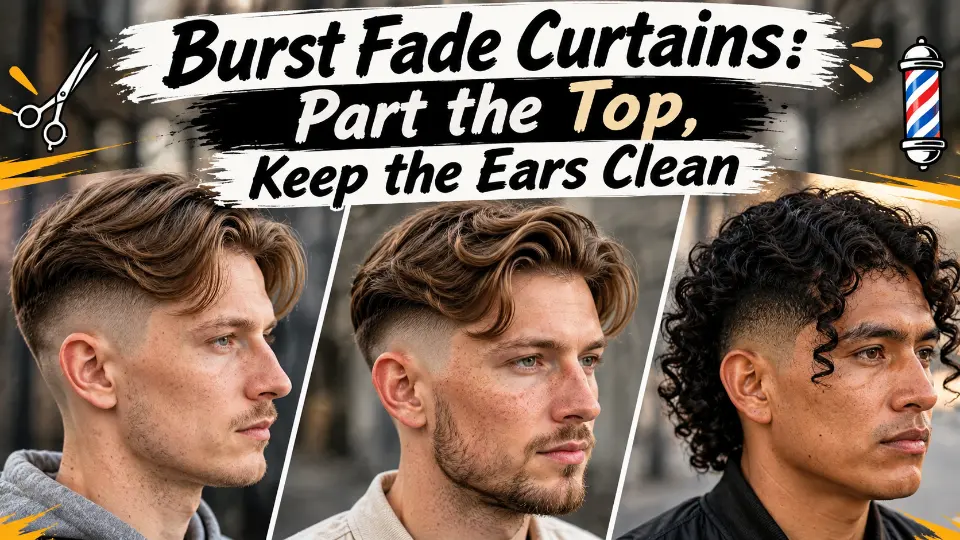
· Burst fade curtains pair a burst fade with a long, centre-parted top that falls to both sides: the barber cuts the arc and the length, and you keep the part neat.
· Choose the curtain length first, since it decides how much of the arc stays on show.
· Ask for layers in the curtains, because a heavy, flat top will not part cleanly.
What burst fade curtains are
Burst Fade Curtains is a burst fade, a fade that curves around the ear and leaves the back fuller, with long, layered, middle-parted curtain tops that fall to the sides. The barber sets the arc and the blend. The reader keeps the top neat with a light product.
The burst leaves length at the back and on top, and that spare hair is what a curtain cut needs. The front is kept long enough to part, while the arc holds the hair around each ear short.
Curtains are about the part and the fall: the hair splits at the centre, or slightly off it, and drops to each side. Searches such as burst fade curtains male or curtain bangs fade point at this same top sitting over a burst.
For the plain arc without any top, see the standard shapes on the burst fade styles homepage.
A burst fade with middle part is one option inside this page, and the live middle-parted page covers the part itself. This page is about the curtain length and how the top flows over the arc.
What changes against a standard burst
Without curtains, the burst carries a short, uniform top. Once curtains arrive, four details change, and the table compares them against the plain cut.
| Part of the head | Standard burst fade | Burst fade curtains |
| Top | Short, even length | Long and layered, split at a part |
| Front | Short | Long enough to part and fall |
| Back | Left fuller | Left fuller |
| Upkeep focus | The arc | The arc |
The arc stays where it was. The top is what changes, because curtains need length to part and layers to fall cleanly.
Curtains ask for some patience. The top needs months of growth, so the cut suits hair that is already long enough to part.
Four rules for curtains over the arc
A curtain top asks the barber to plan three things at once: the part, the length and the arc. Four rules keep them working together.
The part rule. The part sets where the curtains split. The barber marks it on dry hair, and a centre part needs even sides, while an off-centre part leaves one side slightly longer.
The length rule. Curtain length decides how much of the arc shows. Short curtains leave the ears open, and long curtains cover the top of the arc unless they are tucked back.
The layer rule. Layers are cut in so the curtains fall away from the part instead of lying flat. Without them the top sits heavy and the part closes up by midday.
The stop rule. Where the arc ends at the nape and where the curtain length begins are separate choices. Tell the barber how far down the back should run before the layers start.
These rules are barber practice, not laws. Hair grows differently from head to head, so your barber may bend any of them to suit your crown and your density.
What the barber cuts and what you style
| The barber cuts | You style |
| The arc and the blend | The part, with a comb |
| The layers and the length | The fall, with a round brush and a dryer |
| The neckline and the back | The finish, with a light product |
The cut gives you the arc, the layers and the length. A comb, a brush and a light product only finish the top, so the parting you see in the mirror is the barber’s work.
Between visits, keep scissors away from the curtains. Uneven home trims show straight away on a parted top.
Hair type, face shape and the curtains
Hair texture decides how curtains hang, so the cut adapts to it.
· Straight hair falls flat and clean, so the layers must be even to keep the part sharp.
· Wavy hair parts easily and keeps some lift, so the curtains need little help.
· Curly hair bounces outward, which is why it is cut dry with spare length left.
· Fine hair gets weighed down easily; light layers and a touch of volume spray lift it.
Hair that grows in a strong cowlick at the front may resist a centre part. Say so before the cut, and the barber can shift the part a little.
Wondering what is my face shape? Snap a straight-on daylight photo, then upload it to a face shape detector online. Treat the result as a hint only: the curtain length, your hair texture and how the hair grows at the front count for more, and your barber can judge them in person.
What to ask the barber
| Part | What to say |
| Arc height | “Low burst around the ears, back left fuller.” |
| The part | “Centre part, or just slightly off centre.” |
| Curtain length | “Curtains that reach the cheekbones.” |
| The layers | “Layers so the curtains fall away from the part.” |
| The neckline | “Tapered nape.” |
Put it in one sentence: “Low burst, centre part, curtains to the cheekbones, layered, tapered nape.” Then ask to see the part when your hair is dry.
Capture your own head in natural light from the front, the side and the back. Add one picture of curtains you admire on similar hair.
15 burst fade curtains looks in three groups
Each entry gives the cut, a sentence to say aloud and a finishing tip. Skim all three groups first, then pick two favourites for your barber.
Part and length
These five looks change where the curtains split and how long they hang, while the burst stays the same.
Centre-part curtains, low arc
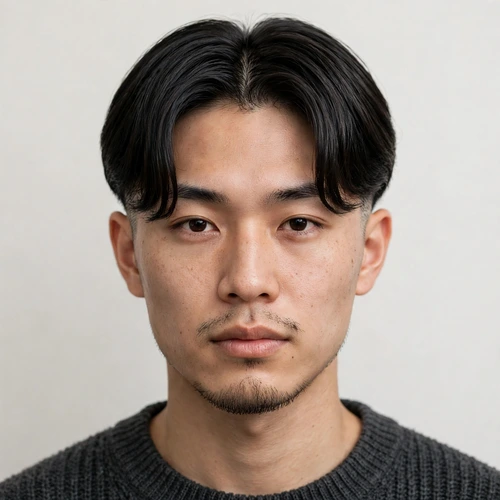
Splitting the top down the middle, a middle-parted burst fade lets the curtains fall evenly on both sides, while a low arc keeps the sides quiet beside each ear.
· Request: “Low burst at the ears, centre-parted curtains reaching the cheekbones.”
· Tip: Rake a comb through wet hair to mark the part.
Halfway-up curtains

Halfway-up curtains end between the brow and the cheek, and a mid burst fade lifts the arc to meet them, so the whole shape feels measured and tidy.
· Request: “Curtains to mid-forehead height, mid burst around the ears, soft nape.”
· Tip: Dry the curtains outward with a small round brush, roots first.
Soft off-centre curtains

An off-centre part leaves one curtain slightly larger than the other, so the top looks relaxed and natural, and the burst keeps the sides trim without a hard line.
· Request: “Part slightly off centre, soft curtains, burst around the ears.”
· Tip: Move the part a touch each week for variety.
Short curtains

Short curtains end near the brow, so the top needs less drying time, and the burst arc keeps the sides slim and the whole cut easy to carry.
· Request: “Brow-length curtains, burst cut around the ears, neat back.”
· Tip: A little cream stops short curtains from sticking up.
Tucked long curtains

Long curtains can tuck behind the ears, which shows the arc clearly, and the extra length gives the top a flowing, dramatic shape from the part all the way downward.
· Request: “Long curtains that tuck behind the ears, burst showing, back fuller.”
· Tip: Use a flat brush to guide the sides back.
Curtain mullet and flow
These five looks add back length or movement, from a curtain mullet to a blow-dried sweep.
Curtain mullet

A burst fade mullet keeps the back long while the front parts into curtains, so burst fade mullet curtains read as one flowing shape with a tight arc at the ears.
· Request: “Parted curtains, long nape, burst closing in around each ear.”
· Tip: Texture the back lightly so it blends with the curtains.
Taper-blend curtains

A burst taper fade eases the sides into the curtains with no step, so a curtain burst taper fade looks smooth, a little more formal and easy to keep tidy.
· Request: “Taper the sides into the curtains, soft burst, neat neckline.”
· Tip: Keep the sides brushed flat to hold the taper.
Combed-back drape

Combing the curtains back turns them into a drape, and a burst fade slick back finish keeps the arc sharp against the smooth, glossy top, even in strong light.
· Request: “Curtains combed back into a drape, mid burst, clean sides.”
· Tip: Comb the top backward in one pass before it fully dries.
Layered curtain flow

Layers cut into the curtains let them move as one flowing shape, so the top feels light and airy, and the burst arc keeps the sides neat beneath it.
· Request: “Soft layers inside the curtains so they move, tight burst.”
· Tip: Finger-dry the layers upward, then flick the ends outward.
Blow-dried sweep

A burst fade blowout lifts the curtains at the roots and sweeps them to the sides, so the top gains volume while the burst keeps the sides tight.
· Request: “Volume at the roots, curtains swept outward, burst at the ears.”
· Tip: Blow-dry upward at the roots, then ease each curtain outward.
Texture and extras
These five looks adapt the curtains to hair texture and to a beard or a textured front.
Waves parted centre

Waves part naturally into curtains, so the burst fade for wavy hair version needs very little styling each morning, and the arc keeps the sides defined and clean.
· Request: “Wavy hair, parted centre, burst trimmed close at the ears.”
· Tip: Rub a little wave cream into soaked strands, then stop touching.
Springy curl drape

Curls spring into soft curtains that frame the forehead, and a burst fade for curly hair arc keeps the sides trim, so the drape stays full without widening.
· Request: “Curls parted in the centre, dry cut, burst around the ears.”
· Tip: Smooth leave-in cream through damp curls, then diffuse softly.
Straight-hair drape

Straight hair falls cleanly into curtains, so a burst fade for straight hair cut shows every layer, and burst fade curtains straight hair benefits from light texturing near the ends.
· Request: “Even layers for straight hair, parted centre, burst around each ear.”
· Tip: Mist straight curtains with light salt spray for extra grip.
Textured fringe parting

A textured fringe parted in the centre keeps the front choppy and loose, so the curtains look casual and relaxed, and the burst arc keeps the sides tidy.
· Request: “Choppy fringe parted in the centre, burst around the ears.”
· Tip: Separate the fringe tips using a pinch of paste.
Curtains plus stubble

Short stubble contrasts with the parted top, and a burst fade with beard runs the sideburn straight into it so the cheeks look continuous, tidy and well planned.
· Request: “Curtains on top, burst at the ears, stubble meeting the sideburns.”
· Tip: Keep the stubble edge at the same angle as the sideburn.
Settle the length first when choosing among the fifteen. Short curtains need the least drying, and the tucked long ones need the most patience. See the burst fade long hair guide for ways a longer top rests above short sides.
The arc comes second. Arc height comes next: low keeps the curtains gentle, mid lets them fall freely, and high sets the top apart from bare sides.
Upkeep and growing out
Curtains and arc age unevenly, with the arc giving way first. Choose the visit schedule from the arc height, plus a fast neckline tidy if required.
| Height | What you will notice | Visit window |
| Low burst | The arc shows wear first, and the blur comes latest. | 3 to 4 weeks |
| Mid burst | The arc shows wear first. | 2 to 3 weeks |
| High burst | Bare skin shows regrowth fast | 1 to 2 weeks |
| Clean-up line only | The neckline | 1 to 2 weeks |
Published guides often give one flat interval for every fade, which hides how much skin each height exposes; the windows above follow arc height instead, and your barber can tune them.
While growing out, skip the arc appointments and book nothing beyond a neckline tidy. Over time the curtains reach a longer length while the arc softens into the sides without a visible step.
Five-step styling routine
The barber builds the part and the layers, and you spend a few minutes on the finish.
1. You wet the top lightly and comb the part into place.
2. You dry the roots upward with a round brush.
3. You sweep each side outward and away from the part.
4. You press a little matte paste through the ends.
5. You check the part in the mirror and leave it alone.
Common faults and quick fixes
Most faults trace back to curtains that were never layered or parted on dry hair. Point to the problem area and request a single adjustment next time.
| Problem | Fix |
| The part keeps closing up | Ask for lighter layers and part the hair on dry strands |
| Home trims leave the arc uneven | Save trims for the barber |
| Small home snips show for days | Hand the layers and the arc to the barber |
| Curls shrink when they dry | Ask for a dry cut and leave extra length |
| The part was marked on wet hair | Ask the barber to check the part on dry hair |
Mistakes that spoil the cut, and when to pick another
· Cutting the curtains on wet hair, then finding them shorter when dry.
· Heavy product, which weighs the curtains down and hides the part.
· Never naming an arc height, which leaves the choice to the barber.
· Cutting the fringe yourself, since a tiny slip is obvious on a parted top.
· Arriving with no photos, so the barber guesses the length.
Think twice if you want a quick, no-fuss morning. Curtains need a little drying, and a short burst fade takes less time.
Common questions, answered
What fade goes well with curtains?
A burst fade goes well with curtains, because the arc keeps the ears clean while the top stays long enough to part. A low or mid arc suits most clients, and a taper gives a softer, more formal result. Both work well.
What haircut suits curtains?
Curtains suit a long, layered top over shorter sides. A burst fade or taper keeps the sides tidy, a mullet-leaning back adds length, and a crop with a long front also works. The top must be long enough to part.
How often does a burst fade curtains need a touch-up?
Timing follows the arc height. Low versions go three to four weeks between visits, mid versions two to three, high versions one to two, and a short neckline tidy fills any gap in between. The arc shows wear first, well before the curtains.
Does burst fade curtains work on straight hair?
Yes. Straight hair falls cleanly into curtains and shows every layer, so the cutting needs to be even. Ask for light layers and a little volume spray, because a flat top closes the part and loses its shape. Fine hair needs it most.
Does burst fade curtains work on curly hair?
Yes. Curls spring into soft curtains that frame the forehead, and the burst keeps the sides trim. Ask for a dry cut so the barber sees the true length of the curls, and leave some extra length. Curls shrink when they dry.
What should I tell my barber for burst fade curtains?
Name five things: arc height, part, curtain length, layers and neckline. Bring photos from the front, side and back, and ask the barber to check the part on dry hair before finishing the cut. Then check it again at home.
Can I get burst fade curtains with a beard?
Yes. A single clean line runs from the sideburn into the beard, and the parted top balances it. Tell the barber how the beard should meet the fade, and trim it at the same angle between visits. Keep both sides even.
How long does burst fade curtains take to grow out?
Regrowth shows at the arc first, and the curtains lengthen afterwards. Low bursts blur latest and high bursts earliest. To grow it out, skip the arc trims and book a neckline tidy only, until the length has caught up. Patience helps here.
Which arc height suits burst fade curtains?
A low or mid arc is easiest to keep, because the curtains fall softly beside the sides. Going high to skin sharpens the contrast, yet it demands the tightest visit schedule of all. Choose the height you will keep. Your barber can advise.
Can I style burst fade curtains at home?
You can style the top, and the arc is best left to the barber. Wet the hair, comb the part, dry the roots upward and add a little matte paste. Home trimmers usually leave the arc uneven. Save trims for the barber.
What products suit burst fade curtains?
Light products suit curtains best. A salt tonic or volume spray adds lift, and a little matte paste, clay or light cream adds hold without shine. Use a small amount on the ends and keep it off the roots. Test one product first.
What is the difference between burst fade curtains and a plain fade?
An ordinary fade just steps the sides down in length, whatever the outline. A burst curves around the ear and leaves the back fuller, and the curtain top adds a long, parted front that falls to each side. Both need regular visits.
How do I keep burst fade curtains neat between visits?
Schedule a brief neckline clean-up every one to two weeks, and comb the part each day with a dab of product. Small home snips show for days, so hand the layers and the arc to the barber. Little and often works best.
What photos should I bring for burst fade curtains?
Bring three daylight photos of your own head from the front, side and back, plus one picture of curtains you like on similar hair. Side views show the arc, and front views show the part and length. Photos save time in the chair.
Which top length suits burst fade curtains?
The top must be long enough to part and fall, usually from the brow to the cheekbone. Shorter curtains are easy to manage, and longer ones can tuck behind the ears. Pick the length first, then the arc. Test it on dry hair.
The short version
For this cut, choose the curtain length, ask for layers and a clean part, and set the arc height to suit your visits. Bring photos, and let the barber check the part in the mirror.
Editorial Note
Treat this page as general grooming information, not medical advice. Your barber has the final say on what suits your hair. Persistent soreness after nape shaving is worth showing a board-certified dermatologist.

