
Burst Fade Arab Men: Cutting Dense, Wavy and Curly Hair With a Beard Line
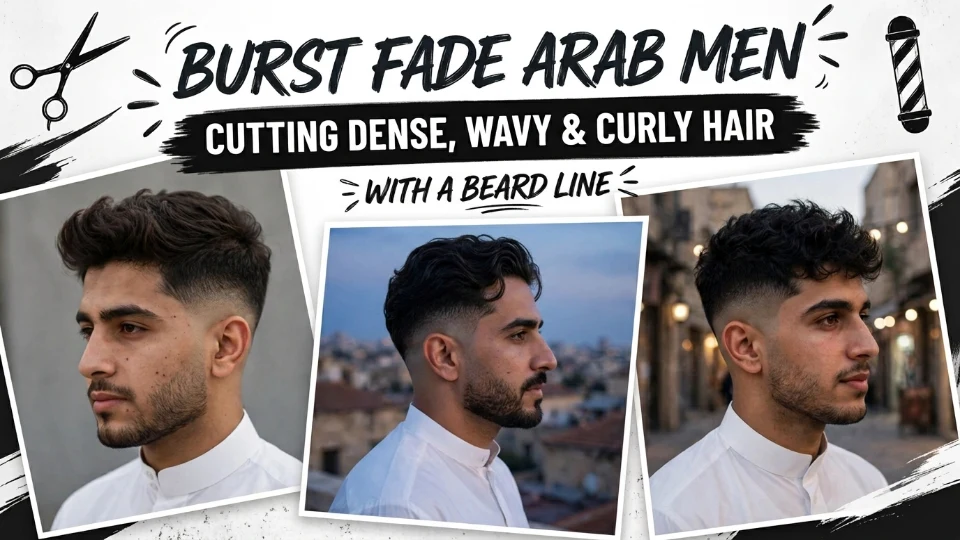
Burst fade arab men is a search phrase for a burst fade on dense, wavy or curly hair with a neat top and a sharp beard line.
Choose the arc height first, then the top, then where the beard line meets the sideburn.
Book by arc height. Low burst: three to four weeks. Mid: two to three. High: one to two.
Burst fade arab men, defined
Burst Fade for Arab and Middle Eastern Men is a burst fade, a fade that curves around the ear and leaves the back fuller, with a neat top and a sharp beard line, cut for dense, wavy or curly hair. The barber sets the arc and the blend. The reader keeps the top neat with a light product.
Imagine a semicircle clipped round each ear. Behind it the hair keeps its length, and above it the top stays full enough to shape. The sharp line most readers want sits lower, where the sideburn turns into the beard.
Arab men is the wording people type into search, nothing more. What matters is hair type, top length, arc height and beard line, so those are the topics here. Nothing here depends on who is wearing it.
Readers who want the wider menu of cuts can start at the burst fade styles overview. This page narrows in on thick, bending or coiling hair, and on the beard edge that frames the fade.
No single standard defines a neat top. Describe it by what you can do with it, such as comb it, brush it up or let it fall in loose waves.
What changes for dense, wavy and curly hair
Normally a burst fade starts from the curve. With heavy or springy hair, the barber also plans weight, shrinkage and the beard edge, because all three change how the same arc reads once the hair dries.
| Decision | Standard burst | Dense, wavy or curly hair with a beard line |
| Blend | Any smooth step | Slower and checked dry, since curls pull up as they dry |
| Top weight | Left as cut | Thinned inside so the top sits instead of puffing |
| Sideburn | Faded away | Carried into the beard so the two edges meet cleanly |
| Beard line | Not planned | Set against the arc, because both draw a visible edge |
Beard density matters as much as head hair here, because a patchy beard cannot hold a razor-sharp line while a thick one can. Read the last column before you book. Does your hair puff, bend or lie heavy? Do you keep a beard? Do you want the edge crisp or soft? Your answers decide the plan.
A fade set lower runs toward the nape, which the burst fade versus drop fade page explains, and it shifts where the back begins. The arc still wraps each ear either way. The rest of the plan changes around it.
Six rules for dense, wavy and curly hair
The weight rule. Dense hair stacks up, so a top left untouched tends to look wide and boxy. Ask the barber to remove weight from the inside with texturizing, then check the shape from the front before the fade begins. Thinning the underside leaves the surface length alone, so the top keeps its fullness.
The shrinkage rule. Curls and tight waves pull up as they dry, so wet hair looks longer than it will be. Have the barber measure the top dry, and leave a little extra on the first visit rather than too little.
The height rule. Because a high burst fade strips so much side hair, dense hair above it looks very heavy by comparison. A low or mid arc blends into the weight above it. Reserve high for the days you want strong contrast.
The beard line rule. Decide the line first, then match the fade to it. Set the cheek line and the neck line, and let the sideburn run into the beard without a gap, so the face edge and the arc look planned together. Ask which edge the barber will cut with a trimmer and which with a razor, because the choice changes how crisp the line looks.
The direction rule. Study the growth at the front and crown before any clipper touches the head. Hair near a crown swirl or firm part grows away in its own direction. The barber should cut with that direction, since cutting against it makes gaps.
The neckline rule. Let the arc stop behind each ear, then pick a natural or a squared nape. A squared nape looks sharp for a week and needs earlier visits, while a natural one grows out evenly. A pointed nape is a third choice, explained in the V-shaped neckline guide.
Treat these as barber practice. Heads and hair differ, so your barber may adjust each rule.
Barber work and your morning routine
| The barber cuts | You do |
| Arc, blend and beard line | Dry roughly, then finger-shape the curls |
| Weight removed from the top | Apply a light product, then leave it alone |
| Sideburn and neckline | Keep the beard line tidy between visits |
Split the work in two. Good cutting settles the arc, how much hair stays at the sides and the top shape. Your dryer, a brush and a light product finish the top at home.
A fuzzy top over sharp sides points to the routine. A visible step between the two points to the cut. Work out which before you rebook.
Hair type and face shape
Hair type decides how the top behaves, while the arc stays where it is. Four types matter most for this cut, and the burst fade straight hair guide goes deeper on the flat one.
· Dense hair stacks up, so light thinning inside helps the top sit flat.
· Wavy hair bends and lifts as it dries, so the top reads shorter once it is dry.
· Curly hair springs and shrinks, so trim it dry and leave a touch more on top.
· Straight hair lies flat, so the blend needs to be gradual and the ends textured.
Readers with loose bends can see more in the burst fade wavy hair guide. Show photos of your own hair, since a different texture in a picture can lead the barber to the wrong length. A beard changes the plan too, since its density sets how soft or sharp the sideburn join can look.
Asking what face shape do i have? With a free face shape detector, one straight-on selfie is all it takes to get a shape name. Take whatever label appears as a mild suggestion. Here the arc, the top and the beard edge shape the result far more than the outline of your skull.
What to ask the barber
| Part | What to say |
| Arc height | “Mid burst arc around each ear.” |
| Finish | “Soft shadow, no skin at the ear.” |
| Top | “Thinned inside, brushed forward, kept a little long.” |
| Beard line | “Sideburn into the beard, crisp cheek line.” |
| Neckline | “Natural nape, arc ends behind the ear.” |
Put the parts in one line: “Mid burst arc, soft shadow, thinned top kept long, sideburn into the beard, natural nape.” Then let the barber play it back before the first pass.
Shoot three photos by a window on dry hair: side, front and behind. If you wear a beard, keep the jaw relaxed for the front shot.
Seven looks for dense, wavy and curly hair, grouped by what changes
Each entry names the one detail that defines the look, then gives a phrase to say and a styling pointer. A look that owns a full guide here gets only a brief entry and a link.
Arc height
These three change only how high the curve climbs, and the weight of the hair above it stays the same.
Low Arc Neat Crop
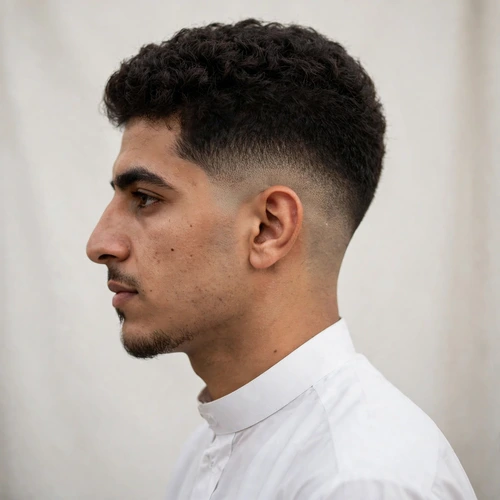
A low burst fade opens only just above the ear, so a thick short crop keeps its weight and the curve stays discreet.
· Request: “Low burst arc, short crop thinned inside, soft shadow.”
· Tip: Rub the product between your palms, then press it in.
Mid Arc Textured Top

A mid burst fade opens halfway up the side, and a textured top gives the curve something full to meet above it.
· Request: “Mid burst arc, textured top, steady fade, neat sideburn line.”
· Tip: Lift the top at the roots while it is half dry.
High Arc Clean Edge

A high burst fade strips the side close and high, so dense hair above it reads as a solid block with a crisp, stark edge.
· Request: “High burst arc, clean edge, kept weight on top, tight nape.”
· Tip: Expect to return sooner, because stubble shows fastest here.
Beard and curls
These two pair the arc with the beard or the curl pattern, since both change how the cut is blended.
Full Beard Join

A burst fade with beard lets the sideburn run into a full beard, and the fade stops a little above the cheek line.
· Request: “Fade into a full beard, crisp cheek line, even sideburn.”
· Tip: Trim the neck line first, then work upward to the cheek.
Dense Curly Top

In a burst fade for curly hair, the curls form a soft crown, and the arc keeps the sides narrow so the shape does not spread.
· Request: “Curls on top thinned inside, low arc, soft shadow.”
· Tip: Shape the curls with cream and a diffuser attachment.
Top and texture
These two change only the top, while the arc, the blend and the beard line stay as planned.
Wavy Swept Top

Loose waves sweep to one side while the arc stays tidy, so the movement on top stands out above two clean, narrow sides and a calm ear line.
· Request: “Waves combed over to one side, mid arc, easy fade.”
· Tip: Squeeze a little cream through the waves after washing.
Lifted Quiff Front

A quiff fade raises the front above the brow, and the arc leaves the sides short enough that the lift stays the focus.
· Request: “Raise the front into a quiff, mid arc, trimmed sides.”
· Tip: Dry the front roots upward, using warm air first.
Several other tops pair well with the same arc and each has its own page. The slick back burst fade brushes everything away from the brow, and the sides stay narrow beside it.
A side part works the same way in a burst fade comb over, where the top sweeps across and the far ear stays clear for a clean line.
A loose front suits the textured fringe version, where short pieces fall forward and break up the brow line.
Anyone who wants the whole cut compact can read the short burst fade guide, which keeps top, arc and beard line close and small.
Upkeep and growing out
The higher the arc, the sooner stubble shows, and a sharp beard line shows it even sooner. The figures are typical barber windows and not a promise for every head. Hair that grows quickly calls for the early end, and slow hair for the late end.
| Arc height | Typical visit window | Why |
| Low burst | 3 to 4 weeks | A small faded area stays tidy longer |
| Mid burst | 2 to 3 weeks | A medium faded area blurs gradually |
| High burst | 1 to 2 weeks | A wide faded area shows regrowth first |
| Clean-up line only | 1 to 2 weeks | Beard and nape edges blur before the arc does |
Plenty of write-ups give every cut the same rebooking date. Here the gap follows arc height, because narrow and wide faded areas return at different speeds.
The beard and the top run on their own schedules, and the beard line often needs a visit sooner than the haircut does. To grow the top out, keep its length and clean up only the sides and beard edges in between.
Styling in five steps
Dense and curly tops need a short routine with the right order, and the beard needs one extra minute. Rough-dry first, then add product, because product on soaked hair weighs it down.
1. Blot the hair in a towel and stop before it is fully dry.
2. Run a dryer on medium heat over the top while your fingers steer the air.
3. Warm a pea of light product by rubbing both hands together.
4. Work it through the top, starting at the roots and finishing at the ends.
5. Shape the top with your fingers, then brush the beard line if you wear one.
Problems and fixes
Most of these trace back to weight, shrinkage or an uneven edge. None is urgent. Mention whichever one annoys you at your next visit. A burst taper fade gives a softer transition if you want one.
| Problem | Fix |
| The top puffs out wide | Ask for thinning inside and a shorter, tighter side |
| A step shows at the blend | Request a slower blend and check it dry |
| The beard edge looks uneven | Reset the cheek line and match the sideburn |
| Curls look shorter at home | Leave extra length for the first cut |
| The fade grows fuzzy early | Book the clean-up line sooner |
Mistakes and who should pick another cut
· Cutting dense hair wet: it shrinks and the top ends up too short.
· Skipping weight removal: the top looks wide and heavy above the fade.
· Setting the beard line after the fade: the two edges then disagree.
· Piling on gel: it flattens curls and leaves strands stuck together.
· Waiting too long between visits: crisp edges fade out first.
Think twice if you want almost no upkeep, since a sharp beard line and a visible arc ask for regular trims. Anyone with very tight coils should talk through the shrinkage with the barber before deciding.
Questions answered before your visit
Which beard styles go with a burst fade?
A full beard, a short boxed beard, light stubble and a goatee all work. Choose by how much trimming you want to do each week. Whichever you pick, let the sideburn run into the beard and keep the cheek line sharp.
How often does a burst fade arab men need a touch-up?
Let arc height set the gap. Low burst: three to four weeks. Mid: two to three. High: one to two. Beard and nape edges can come in every one to two weeks. Growth differs from head to head, so read them as typical.
Does burst fade arab men work on straight hair?
Yes. Flat strands expose each step of the blend, so request a gradual join and texture on top. Blow it toward the side it falls and bring a photo of straight hair like yours, taken in daylight before any product goes on.
Does burst fade arab men work on curly hair?
Yes, and curls help soften steps in the blend. Ask the barber to cut the curls dry, thin the weight inside and keep the top a little long, because curls shrink once they spring back up as they dry out.
What should I tell my barber for burst fade arab men?
Give five details: arc height, ear finish, top, beard line and neckline. Bring side, front and back photos. Make the barber restate the plan before the first pass, so nothing important gets lost between your mirror and the barber’s chair.
Can I get burst fade arab men with a beard?
Yes. Have the barber set the beard line and the fade together. Have the sideburn flow into the beard, then inspect the join in window light. Beard and fade should read as one continuous, even edge from ear to chin.
How long does burst fade arab men take to grow out?
Growth speed differs, so think in phases. Short stubble reappears at the sides first, the curve fuzzes next, and the top lengthens last. Between phases, clean up the sides and the beard edges, and the overall shape stays tidy as everything grows back.
Which arc height suits burst fade arab men?
Low or mid suits most first-timers, because either leaves enough side hair to merge into dense or curly weight. A high arc draws a stronger edge with more contrast. A side-on picture shows the barber which height you are asking for.
Can I style burst fade arab men at home?
Yes, but only the top and the beard edge. Rough-dry the top, work in a little product and shape it by hand. Hand the arc and the nape to the barber, because working clippers around the ear takes real practice and a steady hand.
What products suit burst fade arab men?
Think in types. Cream shapes curls, paste holds a form, and salt spray gives waves their bend. Heavy gels flatten the top and glue strands together once the air turns damp or windy, so skip them for everyday wear altogether.
What is the difference between burst fade arab men and a plain fade?
An ordinary fade grades short hair evenly around the full head. Along each ear the burst fade curves, and behind it the length stays. This version also plans weight and the beard line for denser hair, which a plain fade skips.
How do I keep burst fade arab men neat between visits?
Rough-dry the top the same way each morning and use a tiny dab of light product. Treat the beard and nape clean-up as a quick stop on its own schedule, while full cuts follow arc height, from low to high burst.
What photos should I bring for burst fade arab men?
Three views do the job. Side shows the arc, front shows the top and the beard line, and behind shows the nape. Shoot in daylight on dry hair, and add one reference photo on hair like your own, if you have one.
Which top length suits burst fade arab men?
Enough length to brush, sweep or curl, without a long styling session. Dense and curly hair needs a little extra length because of shrinkage. Your barber can feel the hair and give you a straight answer on the right length for you.
Can I switch from burst fade arab men to another cut later?
Yes. A longer top keeps your next move flexible. Switching to a crop, a taper or a slick back mainly asks the barber to recut sides and top as a pair. Mention the plan up front so the arc suits it.
Before you book
Begin with a mid arc, settle where the beard line meets the sideburn, and pack three photos of your own hair. Say all five parts aloud and have the barber confirm each in turn.
Editorial Note
Treat this page as general grooming information, not medical advice. Check the specifics with your barber first. A board-certified dermatologist, rather than a barber, handles ongoing soreness, scarring or hair loss, because a haircut will not resolve any of them.

