

Fix a Bad Burst Fade: Diagnose the Problem, Then Choose the Fix
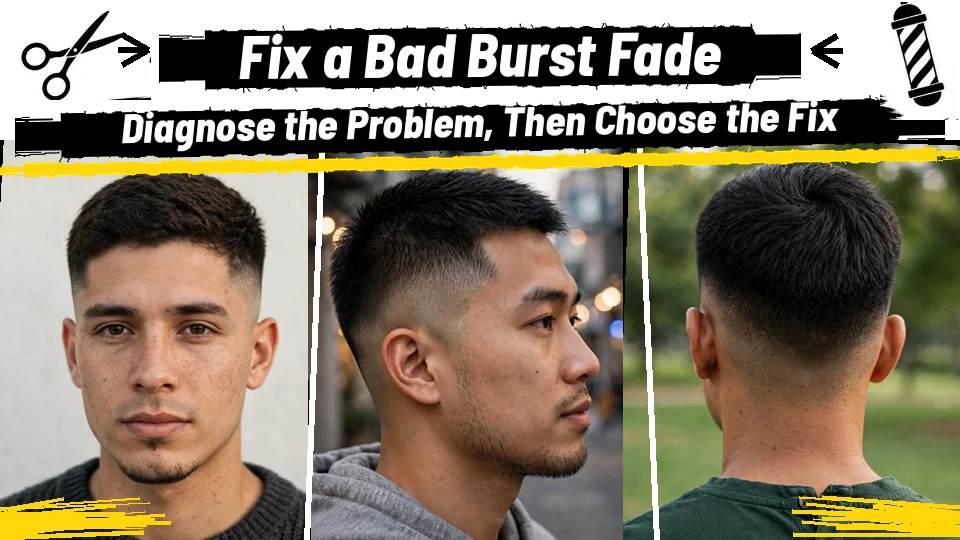
· To fix a bad burst fade, first name the fault: a rough blend, a misplaced arc or lost length. Each one needs a different answer.
· Put the clippers away. Another pass removes hair that cannot come back.
· Most problems need either a barber’s blend or some patience, and a few need both.
Fix a bad burst fade: start with the diagnosis
Fixing a bad burst fade means working out whether the problem is the blend, the arc placement or lost length, then choosing a fix: wait, restyle, ask a barber to blend, or redraw the arc. The reader should not cut deeper without a plan.
A burst fade is a curve, so a mistake in it shows from the side and the back as well as the front. That makes a burst fade gone wrong easy to spot and easy to misread.
A rough blend, an arc set too high and a patch cut too short can look alike on day one, especially in shop lighting, and fresh product makes the lines harder to read. They have different cures, which is why naming the fault comes before any fix.
If you want to see what a well-made version looks like first, the burst fade styles homepage is the place to compare.
This page works in order: diagnose, decide what is safe at home, brief a barber, then plan the weeks that follow. Anyone asking how to fix a bad fade haircut of any kind can use the same order, though the arc adds a few details of its own.
Diagnose the problem first
Look at the cut in daylight, with a hand mirror for the back. Match what you see to one of five faults before deciding anything.
| Problem | What you see | What it means |
| Visible line | A hard band where lengths meet | The blend needs softening |
| Uneven arc | One ear sits higher than the other | Placement is off, so a barber must balance it |
| Arc too high | More bare skin than you asked for | Hair is gone, so time is the fix |
| Back cut short | The nape lost its fullness | Length is lost and must regrow |
| Patch or dark spot | One small area looks shorter | Blend around it, or wait |



Only the first two need a skilled hand soon. The last three mostly need time, with a barber tidying around them.
Shoot each fault from three views under steady light. A clear picture helps a barber far more than the phrase “it looks off”.
Fix at home, or not
People search how to fix a bad burst fade without cutting, and the honest answer is that styling can help but only a clipper changes the outline. Styling changes how hair lies. It does not change how long it is.
A hard rule keeps the situation from getting worse: do not take clippers to the arc yourself. The curve sits behind the ear where you cannot see it, and one extra pass removes options for good. A fix a burst fade at home attempt is the usual start of a second repair.
The safe home steps are small and reversible.
1. Wash it, then give it a night to dry and settle before passing judgement.
2. Brush the top forward or to the side to draw attention away.
3. Use a matte product sparingly, since shine exposes every line.
4. Leave the sides and arc alone until a barber has seen them.
5. Keep the neckline neat, but only below the old edge.
Hats are fine for a few days. Nothing at home restores length, so use these steps to buy time while you book. For tops that sit well over short sides, see the textured fringe page.
Fix it with a barber
A barber can often blend a line, balance two sides or soften a patch when hair is left to work with. A barber cannot restore hair. The real question for each fault is how much length you are willing to give up for a cleaner shape.
Settle that before the clippers start. Ask what the correction will take off and what the barber would do if you waited instead.
If the back was cut short, the burst fade mullet guide shows why the burst leaves the nape fuller, so you can ask for it back as it grows.
| Part | What to say |
| The fault | “There is a hard line above my left ear.” |
| What to keep | “I want to keep the length on top and at the back.” |
| The limit | “I can lose a little off the sides, no more.” |
| The target | “I want a soft arc around each ear.” |
| The plan | “If it needs time, what should the next visit be?” |
Put it together: “Soften the line above my left ear, keep the top and back, and tell me what it will cost in length.” Then wait for the answer before any hair comes off.
Capture the front, one side and the nape in daylight. Add one picture of the arc you wanted. A burst taper fade is a good choice to show if the original felt too sharp.
Most corrections follow one of three paths: blend now, restyle and wait, or reset the arc lower once the hair returns.
Heights and fixes
What a fix can do depends on the height. A low burst fade leaves the most room to correct, because the arc sits close to the ear and little hair is gone.
| Height | What a fix does | Visit window |
| Low burst | Blend the line; most faults settle | 3 to 4 weeks |
| Mid burst | Rebalance the arc and soften the temple | 2 to 3 weeks |
| High burst | Tidy only; lost length needs time | 1 to 2 weeks |
| Clean-up line only | Edge and neckline between repairs | 1 to 2 weeks |
A mid burst fade gives a barber some room, so uneven arcs are usually fixable. A cut that is wrong by a small amount often settles inside the first window of the height chosen.
A high burst fade is the least forgiving. Much of the side hair is already gone, so repair mostly means waiting. To fix a bad burst fade at any height, the windows above set the rhythm, and your barber confirms them.
Sources differ on recovery time after a bad cut. Some give a single figure for every fade, while others give weeks per guard. This page ties recovery to the height and leaves the total to your barber.
Hair type, face shape and the redo
Texture changes how a fault shows, and that is a cutting-mechanics point.
· Straight hair shows every step, so a line is obvious and a soft blend matters most.
· Wavy hair bends across a join, which hides small faults well.
· Curly hair springs back and masks a line, but it can hide a short spot as well.
· Fine hair lets skin show through, so a tight arc looks starker.
Curls hide a harsh line well, so the burst fade for curly hair guide helps you judge what is really wrong before you book.
The burst fade for straight hair guide shows what a good blend should look like when every step is visible.
Waves bend across a join, so faults hide well; the burst fade for wavy hair page shows how the arc behaves on that texture.
Not sure what is my face shape? Face the camera near daylight, take one picture and try it in a face shape detector online. A label like that is only a hint: the arc height, the blend and the top length steer the redo far more.
Next time: five checks before the clippers start
Most repairs begin with a request that was too vague. Five checks keep the next cut from going wrong.
6. Bring a side-on picture of the arc you are after.
7. Name the height: low, mid or high.
8. Say how short the shortest part should go.
9. Say what must stay full, such as the top and the nape.
10. Ask for a mirror look at the arc from behind while the clippers are still in hand.
Think twice if a bad cut has left you with very little side hair. A repair may not be possible, and a short burst fade could be the cleaner reset.
Common questions, answered
How do I fix a bad burst fade?
Name the fault first: a harsh line, an uneven arc, a patch or lost length. A barber can blend a line or balance an arc, while lost length needs time. Skip home clippers and agree the full plan before any cutting.
How do I fix a bad burst fade without cutting?
Restyle it. Wash, let it settle, brush the top forward and use a little matte product. Restyling reshapes the look only; the length stays as it is. Nothing without cutting restores length, so use it to buy time before a barber visit.
How long does a bad burst fade take to grow out?
It depends on how much was removed and the height. Recovery is quickest on a low burst, slowest on a high one, with a mid in the middle. Your barber can estimate when enough length has returned for a clean reset of the arc.
What if the arc is too high?
The hair is already gone, so a barber cannot lower it. Ask for a tidy blend at the current height, or wait for regrowth and then reset the arc lower. Waiting keeps the most length, though the in-between stage looks unfinished.
What if the arc is uneven?
Compare both sides in daylight and photograph them. A barber balances them by bringing the higher side level, which may cost a little length overall. Ask how much will come off before you agree, because symmetry should not be chased with more cutting.
What if there is a visible line?
The usual repair feathers the two lengths either side of the line together, instead of drawing a fresh edge higher up. The fade may end up sitting slightly higher than before afterwards, so ask exactly what the blend will cost.
What if the back is too short?
The burst is meant to leave the nape fuller, so a short back needs time. Ask your barber to tidy the edges and leave it alone, and avoid evening it up. The back should catch up as the arc grows in.
Can I fix it at home?
Style it, but do not cut it. Brush the top, use a little product and keep the neckline tidy below the old edge. The arc sits behind the ear, so a home clipper pass usually makes the problem a lot bigger.
What should I tell my barber?
State the fault, the parts to keep, and the amount of length you can spare. Show three daylight photos and one picture of the arc you wanted. Ask what the fix will take off before any hair is cut at all.
Can a barber fix a bad burst fade?
Often, yes, when enough hair remains. Lines can be blended, arcs balanced and patches softened by a skilled hand. Nobody can put hair back, so some faults need regrowth first. Ask what can be done today and what needs time.
Should I restyle the top?
Yes, it is the safest move you have. Brush the top forward or to the side and use matte product so lines stay soft. A longer top also balances short sides while they grow, and it keeps your options open.
Does a fix differ for curly hair?
Somewhat. Curls spring up and hide a line, but they can also hide a short patch, so judge the cut when the hair is dry. Ask the barber to check the arc in its natural shape before deciding anything at all.
Does a fix differ for straight hair?
Yes. Straight hair sits close to the head, so each change of length is visible. A soft, slow blend matters most, and a touch of texture on top draws attention away. Judge the cut in daylight from several different angles before you decide.
How do I avoid a bad burst fade next time?
Bring a side-view photo, name the height, and say how short the shortest part should go. Say what must stay full, such as the nape and the top. Ask for a mirror check before the cut ends, while changes are still possible.
When should I book a fix?
Book once the cut has settled for a few days and you have photographed it. Three to four weeks suits a low burst, a mid wants two to three, and a high only one to two. Book a harsh line sooner.
The short version
To fix a bad burst fade, name the problem before you touch anything. Blend problems need a barber, lost length needs time, and the sides should stay clipper-free until a plan exists. Bring photos and agree the limit first.
Editorial Note
Treat this page as general grooming information, not medical advice. Growth varies from head to head, so your barber decides what can be repaired. If skin is slow to settle after a nick, ask a board-certified dermatologist.

