
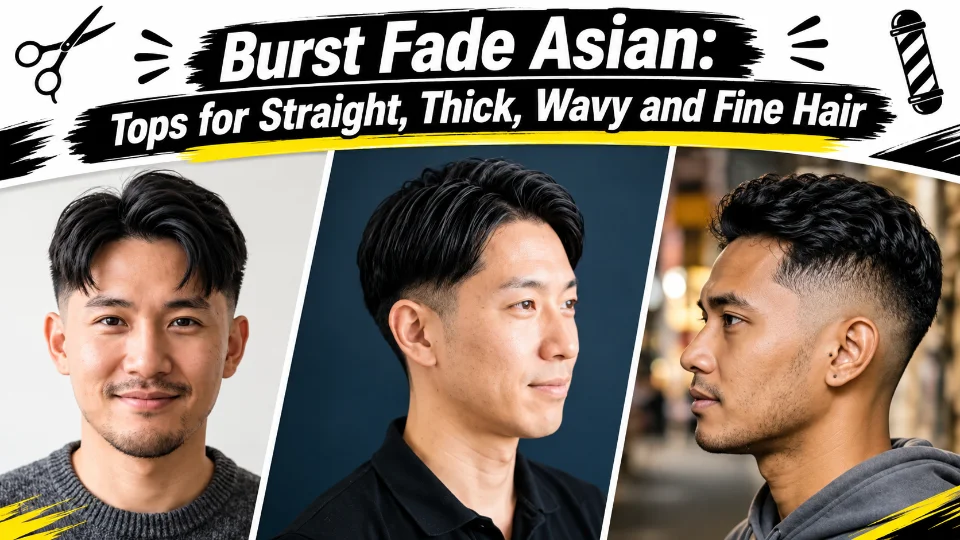
Burst Fade Asian: Tops for Straight, Thick, Wavy and Fine Hair
Start Here: Three Quick Answers
• A burst fade Asian hair is the same curved cut around the ear, tuned to the hair that grows from your own head.
• Many Asian men have straight, dense hair, and plenty have wavy, fine or curly hair, so texture decides the blend, the height and the top.
• Six tops for a burst fade Asian cut follow below, and each one includes a line you can read aloud in the chair.
Burst Fade Asian: Where the Curve Meets Dense Hair
The burst fade cuts a rounded arc behind and around each ear, and the hair above it stays long. On a burst fade Asian cut, which is often straight and dense, the arc matters because thick strands rarely lie flat on their own. Wavy, fine and curly hair get the same arc with a different top.
Dense hair tends to stand out above an ordinary fade, which makes the head look wider at the sides. The burst removes that weight around the ear only, so the top still sits cleanly over it.
Instead of one flat wall of hair at the temple, the weight steps in slowly along the curve. That gradual step is what keeps a heavy head of hair looking tidy for longer.
So any burst fade Asian guide has to begin with your hair, not with a style name. Check your texture first, then choose the top.
Top, Height and Texture: Your Three Decisions
| Choice | What it decides | What to tell your barber |
| Top | The shape and length above the burst | Name the style or bring a photo |
| Burst height | How much weight leaves the sides | Low, mid or high |
| Hair texture | How the top is cut and blended | Straight, wavy, fine or curly |
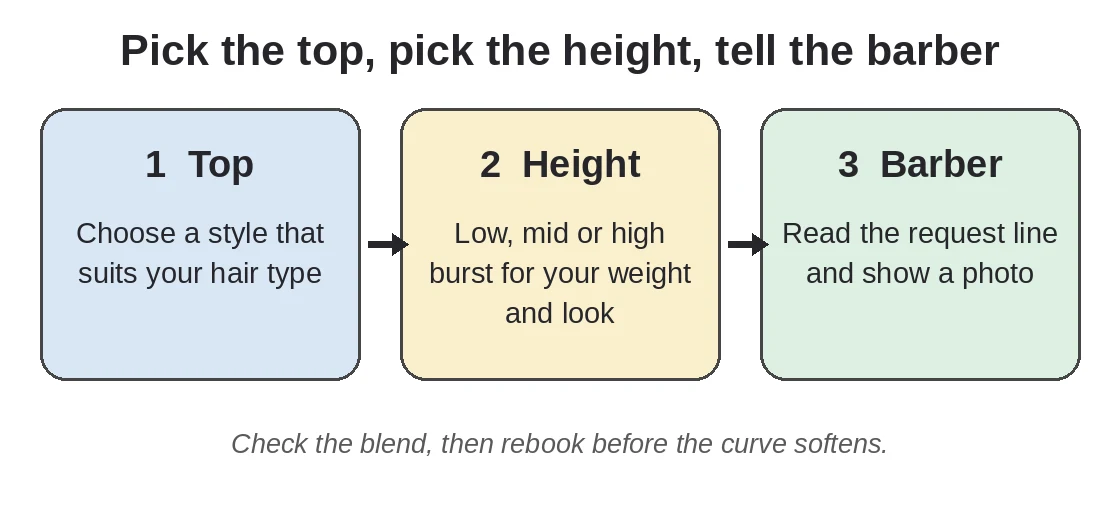
Settle these three first for any burst fade Asian cut and the rest gets easier. All six looks below grow out of these three choices, so each request line repeats them.
Know Your Hair Before You Sit Down
| Hair type | What the cut needs | Watch for |
| Straight and thick | Layers or point cutting to release weight, plus a well-blended burst | Puffy sides and a heavy, flat top |
| Straight and fine | A shorter top and light layers for lift | A top that falls flat |
| Wavy | Length left on top, loose, with a neat blend | Frizz at the sides |
| Curly | Short sides and longer curls on top | Dryness and bulk |
| Stiff or coarse | Light layers and regular trims | Spiky ends |
Watch how your hair behaves as it grows out. Sides that stand out after two weeks point to dense hair, so the blend matters most. A top that falls flat by noon needs lift, not extra length.
Treat the table as typical patterns for burst fade Asian hair and let your barber compare it with your own head. Straight, thick hair is common but far from universal, so judge your hair before you judge a label. For more on that texture, see the burst fade straight hair guide.

How a Burst Handles Thick, Heavy Hair
| Problem | What you see | What the barber does |
| Puffy sides | Dense hair stands out above the curve | Blends the burst slowly and keeps the sides close |
| Heavy top | A bulky, flat shape | Uses point cutting or layers to release weight |
| Hard join | A visible line between top and sides | Blends the top down into the burst |
Dense hair grows back as a visible shape, so the cut looks sharpest in week one and softens by week two. A good blend matters more than a short cut on a burst fade Asian head. If the sides still puff out, ask the barber to start the blend higher before cutting anything shorter.
Choose How High the Burst Starts
| Burst height | What it does | Best fit |
| Low | Keeps weight at the sides and looks calm | Thick sides and fewer trims |
| Mid | Balances the top and sides with a clear curve | Most dense hair |
| High | Strong contrast between a dense top and bare sides | A bold look and short rebook windows |
If unsure, begin with a mid burst. Go lower for a calmer shape, or higher once you know how fast your hair returns. A bare skin finish sharpens the curve but asks for trims more often.

Request Lines You Can Read Aloud
| Top | Line to read aloud |
| Comma hair | Comma top, layered fringe, low burst, soft blend. |
| Two-block | Two-block top, mid burst, short sides, point cut the top. |
| Quiff | Quiff, lifted front, mid burst, tidy neckline. |
| Layered top | Layered top, low burst, release the weight. |
Bring a photo and name the burst height. Mention how you style the top at home, since the cut should fit your routine. One-word labels mean different things in different shops, so describe the shape instead.
Six Tops That Suit the Burst
These six tops each have a request line and a short tip for the chair.
Soft Korean-Style Tops
These three tops leave length at the front and a clean arc at the sides.
Comma Hair Drooping Forward Above the Ears

A curved fringe falls forward over the forehead while the burst keeps the sides tidy behind the ears. Layers keep the fringe light and easy to move on thick, straight hair.
• Request: Comma top, layered fringe, low burst, soft blend, natural neckline.
• Tip: Bring a photo that shows the curve you want.
Two-Block Cut Softened by a Burst

A longer top sits over shorter sides, and the burst curves round the ear for a softer step than a plain undercut. Point cutting stops the top looking heavy.
• Request: Two-block top, mid burst, short sides, point cut the top.
• Tip: Ask exactly where the top meets the shorter sides.
Curtain Fringe Parted Above the Burst

A center part lets the fringe fall in two soft curtains over a clean burst. Straight hair holds the part well, and layers help the fringe move easily.
• Request: Center part, curtain fringe, mid burst, tidy neckline, soft blend.
• Tip: Part it the same way every morning to train the fringe.
Control and Lift for Dense Hair
The next three looks deal with weight, height and calm sides.
Straight Top Layered to Release Weight

Light layers take weight out of a thick, straight top so it lies neatly above the burst. The curve behind the ear keeps the sides from puffing out.
• Request: Layered top, low burst, release the weight, soft blend.
• Tip: Tell the barber if your sides tend to puff out.
Quiff Lifted Off a Dense Front

A dense front lifts into a quiff while the burst keeps the sides close and neat. Dry the front upward, then fix it with a touch of light product.
• Request: Quiff, lifted front, mid burst, tidy neckline, textured top.
• Tip: Lift with a blow dryer before adding any product.
Low Burst That Calms Thick Sides

A low burst keeps weight at the sides and looks calm on thick hair. Pair this height with other tops through the low burst fade page.
• Request: Low burst, thick sides, soft blend, natural neckline, calm finish.
• Tip: Choose this height if you want fewer visits to the barber.
Styling at Home, Step by Step
1. Start with clean, damp hair.
2. Dry the top with a blow dryer and lift at the roots.
3. Rub a touch of matte product between your palms, then work it through the top.
4. Shape the fringe or front with your fingers.
5. Use less product than you expect, because dense hair gets stiff fast.
Dense hair holds a shape best when it is nearly dry, so style it just before the last moisture goes. A short blast of cool air locks the lift in place.
Face Shape Notes and a Top Length Guide
Face shape is only a loose guide. A free face shape detector can show where you sit, and your barber can then choose a top length that suits your head.
| Top length | Fits | Note |
| Short | Quiff and layered top | Needs the most frequent trims |
| Medium | Two-block and curtain fringe | Easier to style |
| Long | Comma hair and long fringe | Needs layers to stay light |
How the Burst Compares With Other Cuts
| Cut | Pick it if |
| Burst taper | You want a softer curve with no bare skin |
| Two-block | You want a clear step between top and sides |
| Mullet | You want length at the back |
| Faux hawk | You want height down the center |
The burst keeps the curve of a taper and adds a firmer step above the ear. Pick the cut that matches how bold you want the sides to look.
How Often to Book a Trim
| What | Typical window | What shows first |
| Burst and sides | Low burst three to four weeks, mid two to three, high one to two | The arc behind the ear |
| Top and fringe | About every four to six weeks | The shape of the fringe |
| Layers and point cutting | Refresh with each trim | Weight coming back |
Use these windows as a first guess for burst fade Asian trims. Your barber can tune them to your own growth rate.
Five Common Mistakes With Dense Hair
• Cutting the sides too short: keep them closer, then blend higher up.
• Skipping layers: ask for point cutting so the top stays light.
• Using heavy products: pick a light, matte one and add slowly.
• Waiting too long to rebook: book before the burst loses its curve.
• Picking a style for the label: match the cut to your hair, not to a name.
If your hair is very fine or you have little time for upkeep, choose a low burst and a short top.
Frequently Asked Questions
Does a burst fade work on thick, straight Asian hair?
Yes, it often works well for burst fade Asian hair. The burst blends weight down at the sides, and layers or point cutting release bulk on top. Ask for a slow blend. Hair varies from one person to the next, so a barber should check yours first.
What should you ask the barber for?
Name the top, the burst height and the blend. A line such as mid burst, layered top, soft blend is clear. Bring a photo, and say if your sides tend to puff out. Avoid vague labels, since shops read them differently.
Which top works best with a burst fade on dense hair?
Tops with layers tend to work best for burst fade Asian hair, such as a layered top, a two-block cut or a curtain fringe. Layers release weight, and the burst keeps the sides tidy. Your barber can match a top to your texture and your daily routine.
How do you stop the sides puffing out?
Ask the barber to blend the burst higher up and keep the sides slightly closer, instead of cutting them very short. Dense hair stands out when the blend is hard. A soft blend, plus layers on top, calms it down. Check the sides every few weeks.
How often should you get a burst fade?
Most burst fade Asian styles need a trim on the sides about every three to four weeks for a low burst, two to three for a mid and one to two for a high, and the top about every four to six. These are typical windows. A low burst usually needs fewer visits than a high one.
Does a burst fade work on wavy or fine hair?
Yes. Wavy hair does well with length left on top and a neat blend. Fine hair does better with a shorter top and light layers for lift. Curly hair suits short sides and longer curls. Ask your barber for a plan.
Final Thought
Start with your hair, then the height, then the top, and a burst fade Asian cut will sit well. Every cut compared here has its own page inside the full set of burst fade guides.
Editorial Note
What you read here is general grooming advice and not a medical opinion. The final choice of cut belongs to your barber, who can see how your hair actually grows. Hair types differ widely, so treat every guide here as typical and not as a rule.

